Thursday, November 04, 2021

What to Do With a Child Like Esav


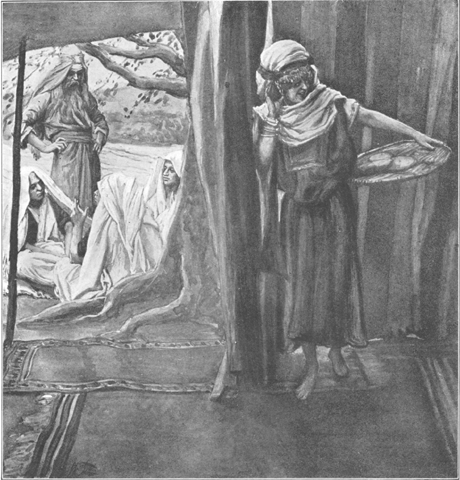
Esav is a problem child from the very beginning. The Bible carefully catalogues the failings of his early years. He is a hunter, a violent job that contrasts sharply with a family preference for shepherding -- and in an act of extreme impulsiveness, he sells the sacred privilege of the first born for a bowl of lentils. His choice of wives is inappropriate, marrying coarse women from the local Canaanites, and in his fury, he vows to murder his brother.

It is clear that Esav was fated to be a failure. The Midrash says that even in utero, Esav would jump every time his mother passed a pagan temple, as if he was ready to go in and worship. Esav is born with a ruddy complexion, and his body is covered in a coat of hair. Rashi says the redness indicates a propensity for murder. The commentary of Rabbi Moise Tedeschi, the Hoil Moshe, speculates that the word Esav means prehistoric man, which indicates that those around baby Esav thought his hairy, red appearance made him look like a small caveman. Other negative comments in the Midrash interpret Esav’s name as a reference to animal food (esev) and futility (shav). Esav appears flawed from birth.

This description of Esav is extremely problematic. How can a person be born bad? Free will is a fundamental Jewish belief; Maimonides calls it “the very pillar of the Torah and the commandments.” In his Letter on Astrology, Maimonides argues that if man had no free will, the commandments would be pointless; people would end up doing whatever they were predestined to do anyway, with or without commands. Free will seems to be a given in Judaism, and like Maimonides, many Jewish thinkers are free will absolutists, believing that everything is a matter of choice.

From this vantage point, every child has exceptional opportunity. As Maimonides puts it, “Every man is capable of being as righteous as Moshe our teacher or as wicked as Yeravam.” Remarkable turnarounds are always possible. Rabbi Naftali Tzvi Berlin, the Netziv, would tell a story about himself that emphasizes how easily potential can be overlooked. He said that when he was a child in school, he was lazy and didn’t pay attention. When he was eleven, he overheard his father saying to his mother that he'd spoken to young Naftali Tzvi’s rebbe, and together they concluded he would never become a Torah scholar; because of this, his father arranged for him to apprentice with the local shoemaker after his Bar Mitzvah. Young Naftali Tzvi ran to his father and begged for another chance, and overnight, he became an excellent student.

As a young child, the Netziv turned his life around. When we read our parsha, we must consider the very same question about Esav: Could he have transformed himself? Is changing behavior just about cracking down and strengthening one’s will? Free will is not quite that simple. Many Jewish thinkers take a different view than Maimonides; some, like Rav Zadok Hakohen of Lublin, fully accept determinism, the view that there is no free will. Rav Zadok is concerned that free will contradicts God’s omnipotence; and while he is an outlier in Jewish thought, his deterministic point of view would not be out of place in contemporary philosophy. Advances in neuroscience and genetics have led many to argue that the brain, and the choices it makes, are subject to the laws of nature instead of the person’s own will. And undoubtedly there is so much of life that isn't under our control; the Mishnah reminds us that “against your will were you born… and against your will you will die.” We know that much of what occurs in our lives is predetermined.

Many Jewish texts grapple with the fine line between free will and determinism. The Talmud tells about an inventive response to determinism from the mother of a prominent rabbi. It says that “an astrologer told Rav Naman bar Yitzhak’s mother: Your son will be a thief. (In response), she never allowed him to uncover his head. She said to her son: “Cover your head so that the fear of Heaven will be upon you, and pray for Divine mercy.” He did not know why she said this to him. One day he was sitting and studying beneath a palm tree that did not belong to him, and the cloak fell off of his head. He lifted his eyes and saw the palm tree. He was so overcome by impulse that he climbed up and detached a bunch of dates with his teeth.” This passage, which serves as one of the halakhic sources for wearing a kippah, is a powerful response to the questions of determinism. Perhaps Rav Nachman’s future was foretold; but his mother found a way to outwit his fate. Your will may be too weak to overcome your horoscope; but then again there are always creative responses to evade a direct collision with fate.

Even with creativity and determination, there remain times when we are simply unable to change, when free will falls short. Rav Eliyahu Dessler explains that free will is not universal. Some of our good habits are so deeply ingrained that we cannot imagine acting otherwise; and there are bad habits that we don’t even perceive as bad, that we are unable to change. But on the battlefield between what in our lives is predetermined for good and for bad sits one point where the battle takes place; this spot is the “point of free will.” It is at that spot where the battle for change occurs.

Rav Dessler's idea of “the point of free will” is profound and nuanced. It affirms the centrality of free will, and the importance of personal initiative and responsibility; yet it also offers greater understanding of those who are morally unlucky, whose bad behavior may be a product of their genetics and upbringing.

This idea is particularly significant in the realm of education. A particular student's temperament is critical to how they are educated; the challenge is to find that point where the student can choose to learn and grow. To treat the classroom as an assembly line is a mistake and will only frustrate the students whose capabilities differ from others. 

Esav may have been a victim of this misunderstanding. Perhaps his parents misjudged his temperament, and assumed that he could readily overcome inborn defects and deficits. Rabbi Samson Raphael Hirsch writes in an essay that “had Isaac and Rebecca studied Esav's nature and character early enough, and asked themselves, how can even an Esav, how can all the strength and energy, agility and courage that lies slumbering in this child be won over to be used in the service of God … then Jacob and Esav, with their totally different natures could still have remained twin brothers in spirit and life; quite early in life Esav's "sword" and Jacob's "spirit" could have worked hand in hand…”

Rabbi Hirsch is arguing for us to understand Esav, to educate him for who he is. We certainly need to be concerned that maybe he consigns Esav to vocational school too quickly; and of course, when a teacher assumes a student cannot learn, it becomes a self-fulfilling prophecy. But those possible mistakes should not prevent us from grappling with the challenge with which Esav confronts us. There are many people with inborn shortcomings; how do we help them find the right point where they can grow and flourish? How do we find a meaningful place for them in our schools and communities? These people carry the burden of struggles far larger than anyone can imagine. May God grant us the wisdom and creativity to help them find their way.


Thursday, October 28, 2021

How to Choose a Spouse


In 15th century Italy, a Jewish father and son got into an argument regarding who the son should marry. The father pressured his son to take an oath that he would never choose a wife without his father's permission; now, questions arose about the validity of the oath. This query was posed to the Maharik, Rabbi Joseph Colon Trabotto, the preeminent scholar of Italian Jewry. In his response, the Maharik tackled a related issue: Does the obligation to honor one’s father and mother extend to the choice of a spouse? He responded that the son can ignore his parents’ wishes, and marry whomever he chooses.  The Maharik offers a fascinating argument for this ruling. The Talmud rules that a child should not obey a parental request to violate the Torah. Since marriage is a mitzvah, and marriage requires mutual attraction, the son should marry someone of his own choosing. Because attraction is critical to marriage, the father's rejection of his son’s chosen spouse runs contrary to the mitzvah of marriage.

The Maharik’s conclusion was not obvious to other rabbis. Rav Tzemach Gaon, the leader of Babylonian Jewry in the late 9th century, wrote that it was immodest for a young woman to offer her opinion about whom to marry, and she should leave the choice to her father. The Sefer Chasidim of 12th century Germany pronounced that a son who doesn’t listen to his father’s voice regarding marriage is a sinner. However, the rabbinic consensus eventually followed the Maharik, who is cited by Rabbi Moshe Isserles in his glosses to the Shulchan Aruch.

Nearly a century after the Maharik, Rabbi Elijah Capsali of Crete amplified this ruling, and made it clear that romantic love is a Jewish value. He argued that forcing a young man to marry someone he doesn't love only creates anger and bitterness in the home, which is contrary to the Torah. The son's love must be respected, and he quotes in this connection a verse from the Song of Songs, "Vast floods cannot quench love, nor rivers drown it”; love is critical to marriage.  Jeffrey Woolf, in his analysis of Capsali's responsa, explains that its emphasis on romantic love contains "Renaissance echoes.” But while this is true, Capsali made a persuasive case that romantic love is very much a part of the Jewish tradition, beginning with the Bible. 

Our Torah reading offers a very different model for choosing a spouse: the arranged marriage.  Avraham is in need of a wife for his son Yitzchak, and dispatched his servant Eliezer to Aram Naharayim, his birthplace, to find an appropriate match. Eliezer returned with Rivka; and without a prior meeting, Yitzchak and Rivka marry. Remarkably, this marriage of two strangers flourished, and Yitzchak and Rivka grew to love each other.

Rabbi Samson Raphael Hirsch saw this arranged marriage as a superior model of true love. In his commentary to the Parsha, he contrasted this marriage with romantic love, and wrote that “... Jewish marriages are contracted not on the basis of passion, but on the strength of reason and judgment. Parents and relatives consider whether the two young people are suited to each other; therefore, their love increases as they come to know each other better. Most other marriages are made on the basis of what they call love. But... we immediately see the vast gulf between the love of the partners before marriage and what happens afterward ... how different (marriage is) from what the two partners had imagined beforehand. This sort of love is blind; each step into the future brings new disillusionment. Not so of Jewish marriage; here the wedding is not the culmination, but only the beginning of true love." To Hirsch, what mattered most in a marriage was compatibility and commitment; love is not necessary at the outset. Romance can even be a hindrance; the unrealistic dreams of star struck lovers may actually undermine their future marital happiness. And Hirsch's positive view of arranged marriage has some basis in experience; recent studies on couples in arranged marriages have shown that they have similar or greater levels of marital satisfaction as couples in romantic marriages.

The method by which one chooses a spouse is less significant than we might imagine; there are models of both romantic and arranged marriages in the Torah. But there is another issue that the Parsha highlights, which is far more significant: What are we choosing when we choose a spouse?

Many people believe that we are fated to marry a particular person. There is a folk belief in a bashert, a person that God intended to be your spouse. This idea is based on a passage in the Talmud, which says that 40 days before a baby is born, a divine voice announces who the child will marry. A similar concept, called soulmates, has evolved in general society. It is based on a passage in Plato that says that man and woman were divided at the beginning of their creation, and that the two halves continue to search for each other until they are finally reunited. From this perspective, you are not actually choosing; you are experiencing a miracle when your bashert/soulmate is revealed to you.

Eliezer's actions in our Parsha can be interpreted as the search for Yitzchak's bashert.  Upon arriving in Aram Naharayim, Eliezer turned to God, and established a sign; he would ask for water at the well, and the young woman who offered the right response would be the one meant to be Yitzchak’s wife. Eliezer is asking God to choose Yitzchak's bashert.

Maimonides criticized both Eliezer and the concept of bashert. He wrote that Eliezer's actions constitute divination and would later be prohibited by the Torah. In the opinion of Maimonides, there's no difference between turning around when a black cat crosses your path and what Eliezer did; both are forbidden forms of superstition.

More significant is Maimonides' rejection of the concept of bashert; he explained that man always has free will to choose what is right or wrong, and marriage is no different than any other activity. A person can choose if they want to marry, and who they want to marry; none of it is preordained.

Maimonides is intuitively correct. It is never simple to get married; it is, as the Talmud remarks, as difficult as splitting the Red Sea. There are many wonderful people who search for their bashert for years on end, without success; and there are many others who are trapped in painful marriages. They know that bashert simply isn’t true; and telling them that marriage is divinely predestined only adds insult to injury.

The ideas of bashert and soulmates have another great weakness:  the myth of happily ever after. Finding the “right one” feels like a dream come true and a divine miracle; and once the presumed soulmate arrives, the future seems bright. The couple then expects that the rest of their lives will continue along the same path. When I meet with couples before their weddings, I introduce them to several excellent research-based marriage education programs, and talk to them about the importance of building skills that will strengthen their relationship for the long term. But oftentimes, their eyes glaze over; they are so happy, so in love, they can’t imagine that anything will ever change. It is easy to believe that one has a match made in heaven, with no additional assembly required.

Rashi and Rabbi Yoseph Bechor Shor differ with Maimonides, and offer a very different interpretation of Eliezer’s plan. Their interpretation offers a powerful insight into how to choose a spouse. Eliezer was not searching for a bashert, a divinely ordained wife; he was simply looking for a young woman who was kind, who would give water to a stranger and his camels. While it might seem strange to choose a wife because of one act of kindness, it may be as good a way of choosing a spouse as any. Without kindness there is no love; but with kindness, even two strangers in an arranged marriage can learn to love each other. What you should choose when choosing a spouse is someone who can help you build a relationship, one act of kindness at a time.

Rav Chaskel of Kuzmir offers a further insight into Eliezer’s decision. The Midrash adds a fascinating detail about what happened at the well. He said that as Eliezer observed  Rivka, miraculously, the water of the well jumped into Rivka’s jar. Yet even though this occurred, Eliezer continued to wait, to see if Rivka will treat him with kindness. Rav Chaskel asked: Shouldn’t a miracle be evidence enough that she is the right one? Why wasn’t Rivka selected once the water jumped into her jar?

Rav Chaskel gives a sharp and illuminating response: “because one act of kindness is worth a thousand miracles.”

The same is true of love. Perhaps there is a bashert who is miraculously chosen for you. But Rav Chaskel’s lesson is about choosing a spouse; and he reminds us that one act of kindness is far more important than who is your bashert.

Wednesday, October 20, 2021

The Greatest Jewish Joke Ever


In 1893, Rabbi Hermann Adler, the Chief Rabbi of England, wrote an essay about Jewish humor for The Eclectic Magazine of Foreign Literature, Science and Art. He was responding to comments made by two prominent intellectuals, Ernest Renan and Thomas Carlyle, suggesting that Jews completely lack a sense of humor. (They probably were projecting a medieval caricature of the rigid Pharisees onto their Jewish contemporaries.) Rabbi Adler wrote a lengthy essay in response, in which he collected examples of Jewish humor from the Tanakh down to Moses Montefiore. Rabbi Adler himself had a sharp wit, and in his essay, he makes it clear that he took great pride in the Jewish sense of humor.

One might find it difficult to believe that anyone could accuse the Jews of being unfunny. Steve Allen, in his 1981 history of American humor “Funny People,” labeled comedy as a “Jewish cottage industry,” and observed that 80% of the comedians in the U.S. at that time were Jewish. The association of Jews with humor is so strong, that in the 2013 Pew study, 42% of American Jews responded that having a sense of humor was an essential part of what being Jewish means to them. (Of course, one wishes that contemporary Jews were as devoted to Shabbat as they are to sitcoms.) There are many, many books of Jewish humor, numerous studies analyzing Jewish humor, and multiple types of Jewish jokes. There are jokes about antisemites, foolish Jews and rabbis, off-color jokes and witty jokes, jokes about business, family and Judaism itself.

Jewish humor is not a religious tradition. In fact, rabbinic literature is ambivalent about comedy, and there are frequent condemnations of “leitzanut,” mockery, in ethical guidebooks. Many rabbis condemned the folk tradition of a “Purim Rav,” a comedian who would parody the local rabbi on Purim, mimicking the rabbi’s mannerisms and ridiculing his idiosyncrasies. Some rabbis found the lampooning they received on Purim difficult to take; there is a legend that Rabbi Shimon Sofer, the Chief Rabbi of Krakow, died right after Purim due to the grief caused by a particularly irreverent “Purim Rav.” At the same time, jokes are recognized as being a valuable psychological tool; the Talmud tells of one rabbi who would always tell jokes before he taught, to get the students to relax and focus. In another passage, Elijah comes from heaven to tell a local rabbi that two jesters in his neighborhood have an honored place in the world to come, because their jokes cheered up the depressed. Humor can certainly be a spiritual tool, but there is no commandment to be funny.

So why are Jews so funny? Sigmund Freud, in his 1905 essay “Jokes And Their Relation To The Unconscious,” devotes an unusual amount of space to Jewish jokes; it is clear that he believes Jewish humor is remarkable. In a time when Jews were extremely discreet in what they wrote about their compatriots, Freud features some unflattering jokes Jews would tell about themselves. He repeats a joke about Galitzianer Jews that pokes fun at their reputation for rarely taking baths:

“Two Jews met in the neighbourhood of the bathhouse. ‘Have you taken a bath?’ asked one of them. ‘What?’ asked the other in return, ‘is there one missing?'” (This is one of four different jokes about Jews and bathing that Freud repeats.)

Ruth Wisse, in her bookNo Joke: Making Jewish Humor,” points out that Freud’s contemporary Arthur Schnitzler criticized Freud for publishing these jokes, which Schnitzler said made Freud sound more antisemitic than antisemites. However, Freud was unconcerned, and saw these jokes as depicting a positive side to Jewish culture. He explains that these Jewish jokes aremeant to portray the democratic mode of thinking of Jews, which recognizes no distinction between lords and serfs, but also, alas, upsets discipline and co-operation.” 

Jews certainly know how to laugh at themselves, and to make fun of their failings. There is a joke about three Jews who are about to be executed by firing squad. The sergeant in charge asks each one whether he wants a blindfold. “Yes,” says the first Jew, in a resigned tone. “OK,” says the second Jew, in a quiet voice. “And what about you?” he enquires of the third Jew. “No,” says the third Jew, “I don't want your lousy blindfold,” followed by a few choice curses. The second Jew immediately leans over to him and whispers: "Listen, Moshe, don't make trouble. Take the blindfold. "

This joke is mercilessly self-critical and funny at the same time; but laughter helped Jews contend with a hostile environment, and cope during the most difficult of times. There was an entire genre of jokes created by Jews from the Soviet Union; and several books have been written about Jewish humor during the Holocaust. One would think that there are times and places where humor is impossible; but actually, that is where humor is most needed. Comedy is a refuge, a shelter for the heartbroken. One excellent example of this, from an obituary in Canadian newspaper, tells of a Holocaust survivor returning to visit the concentration camps: 

“When, in the 1980s, Celine returned to Theresienstadt with her husband Maximilien, they were stopped at the ticket counter. ‘Last time I was here,’ Celine told the ticket vendor, ‘I got in for free.’”

I had heard a similar anecdote about another survivor who returned to Auschwitz. At the ticket counter, he rolled up his sleeve, showed the number tattooed on his arm, and asked, “do I get an alumni discount?” Laughter offers ready relief for the persecuted.

Some Jewish jokes wield ridicule as a weapon. The Midrash tells the story of a young Avraham breaking his father’s idols, and then claiming that the largest idol was angry, and broke the others; this is pure satire, a joke about the silliness of paganism. (And the Talmud makes clear that one is entitled to mock paganism, even in an extreme fashion.) In response to antisemitism, Jews mocked their boorish and barbaric enemies. One example of this is the joke that Joseph Telushkin retells in his book “Jewish Humor”:

“During the Second World War, a southern matron calls up the local army base. ‘We would be honored,’ she tells the sergeant who takes her call, ‘to accommodate five soldiers at our Thanksgiving dinner.’ ‘That's very gracious of you, ma'am,’ the sergeant answers. ‘Just please make sure they're not Jews,’ the matron adds. ‘I understand, ma'am.’ Thanksgiving afternoon, the woman answers the front doorbell and is horrified to find five black soldiers standing in the doorway. ‘We're here for Thanksgiving dinner, ma'am,’ one of the soldiers says. ‘Bu ... bu ... but your sergeant has made a terrible mistake,’ the woman says. ‘Oh no, ma'am,’ the soldier answers. ‘Sergeant Greenberg never makes mistakes.’”

Mockery was a weapon, a way for Jews to belittle and diminish those who  mistreat them.

But there is no purer form of Jewish humor than the absurd. A classic example is a joke told by Leo Rosten in “The Joys of Yiddish.”

A man posed a riddle to his son: “What’s purple, hangs on the wall and whistles?”


When the son gave up, he answered: a herring.
“A herring?” his son said. “A herring isn’t purple.”
“Nu,” replied the father, “they painted the herring purple.”
“But hanging on a wall? How does a herring hang on a wall?”

“Aha! You nail the herring to the wall.”

“But a herring doesn’t whistle,” his son shouted.

“Nu, so it doesn’t whistle.”

This joke is actually a joke about jokes, a riddle that fails to add up; it absurdly ends up with a “nu” for a conclusion. And it is here where the Jewish love for humor begins. Let me explain why.

The name of the second Jewish patriarch is Yitzchak; the root word of his name is tzachak, which means laughter. In our Parsha, the root tzachak is employed several times; almost all are in relation to the birth, naming and raising of Yitzchak. They indicate the joy and shock Avraham and Sarah have when learning they will have a child in old age. The root word is also used when Lot tells his sons-in-law that their home city of Sodom is about to be destroyed. They do not believe him, for his words are “like a joke [kimitzacheik] in their eyes.”

The double reference to laughter highlights that both events are improbable to the point of being funny. And indeed they are. To an observer at the time, the possibility that a major city like Sodom will disappear, or that a childless, wandering, elderly couple will be the progenitors of a great civilization seems ludicrous. The funny thing is, this strange outcome is precisely what occurs; and it is here that the Jewish love for humor begins.

It is difficult to write a short article on Jewish humor; there are only so many jokes that you can tell, and so many others that have to be left out. But the greatest Jewish joke is ever-present: that am yisrael chai, that a small nation beat ridiculous odds time and time again. Just like the elderly couple Avraham and Sarah, Jews were expected to disappear; instead, they continue to thrive, year after year. Isn’t that laughably absurd?  Yes, it is; and that’s why the first Jewish child was named Yitzchak.


Thursday, October 07, 2021

Ordinary Greatness


Thomas Carlyle argued for the “great man” theory of history, that "the history of the world is but the biography of great men." The unique traits of great leaders allows them to transform everyone and everything around them, and change the course of history. And while the great man theory has lost favor in recent years, undoubtedly it is partially true. There are many historical figures that did change the world; for example, America would not be the same without Washington and Lincoln, and Israel would not exist without Herzl.

At first glance, the narrative of the Tanakh is also the biography of great men; most of the focus is given to larger than life individuals. Characters such as Avraham, Yoseph, Moshe, David and Shlomo take the center stage, and then direct the course of action. The abilities of these heroes is amplified in the Midrashim and other Rabbinic commentaries, leaving them with truly larger than life attributes. These great men are our heroes.

This focus on greatness has had a profound impact on Jewish culture, and has made greatness a life goal to be embraced. Many have taken the view that the entire educational system should be focused on developing the elite students, even if it means abandoning the needs of the other students. Rav Eliyahu Dessler, when contrasting the Lithuanian Yeshiva system with the educational system of early-20th-century German orthodoxy, wrote that the goal of the Lithuanian system is to create great scholars, even if it means under-serving the other students. He based his view on a Midrash that says “one thousand students enter to study Bible and only one comes out as a great Talmud scholar.”

This aspiration for greatness affects the perspective of parents as well. Maimonides makes a telling remark when he writes that a person “should set his heart to have a son who perhaps will be a wise and great man in Israel.”

This is the “great man” theory of child rearing, in which our expectations for our children are geared to greatness. David Bader highlights this in a comic Haiku entitled the “Jewish Mother’s Lament”:


Is one Nobel Prize
so much to ask from a child
after all I've done?”

For better or for worse, the Jewish community has put the “great man” theory into practice.

But there are other models of a proper life. Noach, the title character of our Parsha, is a perfect example of ordinary greatness. The Torah itself is unclear on how to describe Noach. He is considered worthy of being saved because he is a “righteous man,” which is high praise; but we are also told that “he found favor with the Lord,” which implies that he was somewhat undeserving, and saved because of his charisma. And then in a third verse there is a qualifier, “righteous before Me in this generation,“ which leads one to wonder whether Noach’s righteousness was merely relative to the rest of his generation, who were deeply immoral. For this reason, the Rabbis of the Talmud debate whether Noach would have been greater had he lived at a different time, and they speculate whether or not he could have been as great as Avraham.

But perhaps we need to stop comparing Noach to Avraham, because Noach does not conform to the usual models of greatness. Instead, he is a good person who steps up to the plate when needed, the right man who arrives at the right time. The Torah’s ambiguity about Noach is intentional, because Noach is both good and great at the same time.

Noach’s character defies the rigid fundamentalism of greatness; he reminds us that one can be a humble man of the earth and still save the world. And he is far from the only one in the Tanakh who exhibits ordinary greatness; Ruth, Esther and all the leaders in the Book of Judges are ordinary people who make an extraordinary impact. Their goodness is their greatness.

Ordinary greatness is the foundation of the Chassidic tradition of the “lamed vuv tzadikim,” the 36 hidden righteous men who uphold the world. They appear like ordinary men and live ordinary lives, yet in undertaking an important act of piety or charity, these ordinary Joes save the world. The lamedvuvnik offers us an alternative paradigm of greatness: a good man quietly doing good things, on the periphery and away from the limelight. The beauty of the lamedvuvnik tradition is that it forces us to consider that anyone might be great, even the common man; and who knows, maybe the gruff, grizzled and wrinkled water carrier in the back of the tiny synagogue is carrying the fate of the entire world on his shoulders.

Gershon Scholem has noted that this idea of hidden righteous men, lamedvvuniks, has some basis in the Talmud; and in a larger sense, there are many talmudic stories about jesters, pimps and thugs who find a distinguished place in the world to come because of the good deeds that they do. It is interesting that the Chassidic movement, which is oriented around the tzaddik (a great man who functions as a divine intermediary), gave so much attention to the simple looking lamedvuvnik.  But perhaps that is the point: even when recognizing great heroes, the quiet contributions of everyday heroes must never be forgotten.

This lamedvuvnik is an excellent role model for those who feel conflicted about their goals, uncertain about whether they must always pursue the next great possibility. Parents in particular are often torn between their career and their children. And, for anyone, every new opportunity requires new sacrifices. There are times when people don’t choose the path of greatness because they have other priorities, and the lesson of the lamed vuv tzadikim is you don’t need to do it all; you just need to do good.

The lamedvuvnik life is a model of understated greatness, to change the world one person at a time. George Elliot expresses this idea beautifully when she writes at the end of “Middlemarch”: "The growing good of the world is ... half owing to the number who lived faithfully a hidden life, and rest in unvisited tombs."

In the course of my career I have met many people from all walks of life, but it’s the lamedvuvniks that inspire me the most. One of them was Harold, who was the “candyman”  of my previous congregation; he was the person who gave out sweets to all the children in the synagogue, and the greeter who helped people find their seats. When he passed away his funeral was filled to capacity; the staff at the funeral home were curious, wondering why Harold was famous. Harold’s resume said he was a retired insurance salesman, but as I explained in my eulogy, Harold was a lot more:

“What was it about Harold that was special? Harold was not a wealthy man, (although he was more contented than virtually anyone). He was not a Nobel prize winning scientist, (although he had more common sense than anyone); he was not an Olympic athlete, not a cabinet minister, and you didn’t see his name in the newspaper. Fame and fortune were not Harold’s calling card.

What was special about Harold was a simple trait; Harold never passed people by. Every person he met, big or small (oh, how he loved children!) famous or unknown, important or unimportant, were treated to Harold’s brand of friendship, good humor and charm. What was special about Harold was that he made everyone he met feel special.”

Harold knew the lamedvuvnik credo: change the world one person at a time. In the course of our lives, every one of us has met our own, personal, lamedvuvnik: a parent, teacher, friend, or even a stranger who has made an enormous difference in our lives.

Sometimes, you can be great just by being good.

Thursday, September 30, 2021

The Cult of Overwork and the Sabbath


An article in The New Yorker described it best: the cult of overwork. White collar professionals in the United States are far more likely to work longer hours than lower paid workers. A 2008 Harvard Business School survey of people in professional services (consultants, investment bankers, accountants, lawyers, IT, and the like) found that "94% of 1,000 such professionals said they put in 50 or more hours a week, with nearly half that group turning in more than 65 hours a week. That doesn’t include the 20 to 25 hours a week most of them spend monitoring their BlackBerrys while outside the office."  Another Harvard survey of “extreme workers,” who work very long hours, found that "Almost two-thirds (64%) of extreme workers admit that the pressure and the pace are self-inflicted—a function of a type-A personality."

It should be noted that overwork is ultimately impractical. After a certain point, productivity suffers and burnout is common. The Midrash says that Moses, while still in Pharaoh's household, convinced Pharaoh to allow the Jewish slaves to rest on Shabbat. Moses argued that a Sabbath would be to Pharaoh’s benefit; slaves that never stop working will die from overwork. Even a Pharaoh can grasp the practical value of the Shabbat; and in recent years, as overwork has become an HR concern, several corporations have also recognized the importance of a day of rest. Goldman Sachs, Bank of America, Merrill Lynch and Credit Suisse and others have instituted rules that free junior employees from work one day a week, and require them to return home from the office. Shabbat has a practical value to it, as a day to recharge for more work.

So why is there a cult of overwork, and where does the drive for overwork come from? It begins with the reality that work is extremely meaningful. There is significant spiritual value in our labor. The Mekhilta cites the opinion of Rabbi Yehuda Hanassi that just as one is commanded to rest on Shabbat, one is also commanded to work the other six days a week. In one fascinating passage in Rabbinic literature (Avot DeRabbi Natan 11:1), it says that the divine presence does not arrive unless people are engaged in productive work, and that idleness brings death. In The Lonely Man of Faith, Rabbi Joseph Ber Soloveitchik writes that human dignity and majesty are found in humanity's mastery over nature, which is achieved through productivity and progress. The six days of work fulfill a significant spiritual and existential need.

Work brings us dignity and majesty; and that is why overwork is so enticing. While taking a respite seems sensible, the idea of resting for its own sake seems strange: why would anyone give up something as important as the ability to work? Peter Schafer, in his book Judeophobia, devotes an entire chapter to Roman criticisms of the Shabbat. He quotes the Roman philosopher Seneca (4 B.C.E – 65 C.E.) as saying: “Their practice of the Sabbath is inexpedient because by resting one day in every seven they lose in idleness one seventh of their life." To the Romans, the Shabbat was absurd: How can you take a full day of rest when you have countries to conquer and aqueducts to build? And this attitude is equally true of contemporary society. We live by Benjamin Franklin’s edict “time is money,” and wonder how we can squeeze a few more minutes out of the day. Even when we are away from our work we carry our work with us in briefcases and laptops, on Zoom conferences, and email exchanges. We live in the culture of the MBA, where efficiency and productivity are the touchstones of meaning; in this type of value system, a day of rest is a meaningless obstacle to further growth.

Shabbat offers a radical alternative. It is not only about rest; it is about sacrificing work for more important goals. As important as work is, endless labor dehumanizes both masters and slaves, and reduces man to what he can produce. Shabbat declares that man is ultimately defined by his character and commitments, not his creations. Rabbi Ovadiah Sforno (Italy, 1475-1550) explains that the purpose of abstaining from work on Shabbat is to allow one to pursue spiritual experiences. Shabbat is a day to study and think, to spend with God at the synagogue and with family and friends at home. Shabbat stands as a counterweight to the other six days of the week, a reminder that we are so much more than the sum total of what we produce.

There is a mitzvah to remember the Shabbat every day of the week; its purpose is to make sure we never lose sight of the Shabbat perspective and define ourselves by our work. But that is difficult to do. An anecdote shared by Rabbi Efrem Goldberg epitomizes how easily we forget the lessons of Shabbat. Rabbi Goldberg was at a wedding and was seated next to someone he had never met. He writes:

“In an attempt to be friendly to the man seated next to me, I asked him, “What do you do?” He sat up in his chair, turned to me and said, “What do I do, or how do I earn a living? I earn a living as a plumber. What I do, what I am most proud of, is that I learn Torah every morning before davening, and I spend time with my family every evening after work.”

In a cult of overwork, life is defined by how you earn your living. That is why, as a habit of speech, we conflate “what we do” with “how we earn a living”.  And sadly, endless work makes man a hostage of his own creativity. In sacrificing work in order to observe Shabbat, we learn that we are more than what we make and what we own.  


Thursday, September 23, 2021

Coronavirus Grumbling, the Sukkah, and the Wisdom of Hindsight


President Zalman Shazar makes “Kiddush” in the sukkah at Beit Hanassi in Jerusalem. Seated on the right are Prime Minister Levi Eshkol, Chief Rabbi Isser Unterman and Mr. Nahum Goldmann.

It has been a year and a half of discontent.

A friend of mine who is a doctor told me that her hospital recently held a seminar on how to deal with patients who are angry and disorderly. And it is not only this hospital. Schools, stores and airlines are similarly grappling with populations that are just angrier and more difficult.

A recent article in the Wall Street Journal noted that “Customer satisfaction is at the lowest level since 2005, according to the American Customer Satisfaction Index, which tracks the behavior of 300,000 consumers across 46 industries. ….The Federal Aviation Administration has initiated more than 750 investigations related to unruly passengers so far this year, compared with 146 in all of 2019.” People are simply unhappy, and taking it out on others.

Grumbling is familiar to students of the Tanakh; it is the defining attribute of the generation of the desert. These recently freed slaves, who had just left Egypt, complain 10 times for every possible reason; they are afraid of the Egyptian army, but also frightened of the people of Canaan. They are worried that Moshe has left them, and angry that Moshe is leading them. They complain about a lack of food, a lack of water, and once they do receive the manna, complain about that too. They are deeply unhappy, whining about matters as trivial as a lack of garlic and watermelons.

Sukkot commemorates these 40 years in the desert; and that is extremely strange. Why celebrate a time when our ancestors were miserable and grumbling? And it should be noted, in defense of the generation in the desert, that their situation was difficult. The changes, challenges, and uncertainties experienced by the generation of the desert would worry anyone. What purpose is there in commemorating a frightening time of fear, discontent and rebellion?

The answer lies in the wisdom of hindsight. There are moments, both in history and in life, that we view very differently years later. In literature, authors use retrospective narration to show how the narrator can change perspective with time, and look back on events differently at a later date. Hindsight offers unique insights, unentangled by the emotions of the moment.

The grumbling of the desert came about due to a combination of circumstances and character. The challenges of the desert bring out the worst in these former slaves; Maimonides and Ibn Ezra both point to the slavish, cowardly character they had, a slave mentality they could never shake. But there is another way to explain their behavior, one that makes the former slaves far more relatable to our contemporary experience.

According to the Talmud, the Jews were freed from servitude six months before the Exodus; for half a year, these former slaves lived comfortably in a prosperous world empire. They are then promised a land of milk and honey, only to be led into a barren desert. This bitter disappointment often leads to political instability. James Chowning Davies offered a theory of revolution known as the J-Curve theory, “that revolutions are almost inevitable when long periods of social and economic development are countered by sharp reversals and depreciation.” The generation of the desert had already tasted freedom and comfort, and had even bigger dreams. They expected immediate gratification, an actual rose garden of milk and honey. They had expected freedom to be immediate, easy, and free of problems. Instead, the challenges of the desert made the Exodus seem like a counterfeit redemption.

The generation of the desert complained because they were captives of their own mindset. But in hindsight, those 40 years look different. The contemporary reader can recognize that the wandering in the desert is far better than slavery, that it prepared the Jews for the responsibilities of statehood, and allowed them to slowly make their way to the promised land.

The 40 years in the desert is most appreciated much later in history, during the times of Ezra. A small group of Jews had returned from Babylonia under the sponsorship of Cyrus the Great.  They were threatened by the people who were occupying the land, and Ezra’s followers were frightened to rebuild any part of the Temple in Jerusalem.

Yet slowly but surely, this small group built a small autonomous community in the land of Israel that eventually turned into a large commonwealth. And the Book of Nehemiah tells us that this is when they rediscovered the magic of the Sukkot, and celebrated the holiday together as a community. A change in perspective had occurred. For the returning Babylonian exiles, getting halfway to Jewish sovereignty was a miracle; and they now understood how the halfway miracle of the desert was special as well.

Centuries after the grumbling in the desert, the Jews recognize how remarkable it is to take a few slow steps in the direction of the promised land. With the gift of hindsight, the years of the desert are seen differently, not as a time of frustration, but as a time of gradual redemption.

Sukkot teaches us the wisdom of hindsight, and that events look differently many years later. In the moment, we often lose sight of small victories; but years later we can see the difference they make.

Right now is a time of coronavirus grumbling and bickering. Our frustrations blur our vision, and we cannot see our own experience objectively. But perhaps years from now, with the wisdom of hindsight, things will be viewed differently. Perhaps one day, we will look back and recognize that dedicated scientists, heroic healthcare workers, and caring volunteers helped us overcome a pandemic. Perhaps one day we’ll look back at this period of discontent, and recognize all the good that was done far outweighs the bad; and we, too, will thank God for our pandemic Sukkot, which offered us some protection while slowly getting life back to normal.

Wednesday, September 15, 2021

In Search of Heroes: The 20th Anniversary of 9/11


9/11 was an American tragedy. Terrorists struck a blow at the heart of our country and murdered 2,977 people. This attack was an assault on all Americans and brought heartbreak to countless thousands of bereft parents, widows and orphans. The victims were traveling in airplanes or sitting in their offices, supporting their families and pursuing their dreams. As President Bush put it, “Thousands of lives were suddenly ended by evil, despicable acts of terror." On 9/11, the forces of evil took the lives of thousands of good people.

The perpetrators of these attacks "are like chaff that wind blows away" (Psalms 1:4), and will be remembered only to be condemned and despised. But we will always remember the heroes of 9/11, the first responders who rushed in to save those who were stranded and injured; we will remember those who ran into the Twin Towers when everyone else was running out. So many of these heroes made the ultimate sacrifice in order to help others. The fire station just a half a block away from our synagogue, FDNY Engine 22, lost nine firefighters on 9/11. On the outside of the station there is a permanent memorial with their pictures, a tribute to the “Yorkville Nine” with the caption “There was a time when the world asked ordinary men to do extraordinary things.” And we will always remember our heroes who did such extraordinary things.

Heroism does not grow in a vacuum; heroes are shaped by their upbringing and education. Samuel and Pearl Oliner based their landmark study, The Altruistic Personality: Rescuers of Jews in Nazi Europe, on interviews with nearly 700 non-Jews who saved Jews during the Holocaust. (Samuel had a personal interest in the topic; as a 12-year-old, he himself was saved by a Polish peasant woman). They found that the rescuers were most often influenced by their parents. These altruistic, loving parents were role models with a strong sense of morality. Further studies on the Rwandan genocide have had similar results, and it is clear that culture and training are critical in the cultivation of heroism.

The early life of Moshe follows a similar pattern. Even though the Egyptians demanded that Jewish parents throw their baby boys into the river, Moshe's parents refused to do so, and hid him instead. Even when they could no longer hide him, his parents did their best to protect him in the river, by placing him in a miniature boat; while his sister sat and watched over baby Moshe. His own family’s actions left its mark on Moshe, who even at a young age stepped up to protect the lives of others; and Moshe learned his first lessons of heroism at home. Heroes are raised to be heroes.

I am afraid that America has forgotten how to produce heroes, because we're confused about what a true hero is.  Rabbi Joseph B. Soloveitchik writes in the essay Catharsis that there are two models of heroism: classical heroism, which is found in Greco-Roman literature, and biblical heroism. Classical heroism is aesthetic, dramatic and theatrical, demonstrating outward feats of strength that elicit the cheers of the crowd. But the biblical model of heroism is about character; it is about the person’s self-control, even self-negation, in the service of a higher cause, and their willingness to move forcefully in the pursuit of morality. The biblical hero works in anonymity and doesn't care to be famous.

What type of heroes do we embrace today? To put it bluntly, our children's role models are not true heroes, and we live in a culture which is obsessed with celebrity, where wealth is worshipped, and fame is honored. Open any tabloid or glossy magazine; they feature athletes, actors and the A-list financial elite. We are fooling ourselves if we ignore the damage this does. We are reorienting an entire generation's vision of what is meaningful and heroic. Ben Stein, who used to file a weekly report on the celebrities he would run into in Los Angeles, stopped doing so in 2005. In his final column he wrote the following, which is worth quoting at length:

We put couples with incomes of $100 million a year on the covers of our magazines. The noncoms and officers who barely scrape by on military pay...are anonymous as they live and die...I am no longer comfortable being a part of the system that has such poor values...

There are plenty of other stars in the American firmament. The policemen and women who go off on patrol in South Central and have no idea if they will return alive. The orderlies and paramedics who bring in people who have been in terrible accidents and prepare them for surgery. The teachers and nurses who throw their whole spirits into caring for autistic children. The kind men and women who work in hospices and in cancer wards.

Think of each and every fireman who was running up the stairs at the World Trade Center as the towers began to collapse.

Now you have my idea of a real hero.

We need to embrace the idea of biblical heroism again, before it gets forgotten. Real heroes are people of character, not characters on TV. Real heroes wear uniforms, not couture. Real Heroes are too busy helping others to post selfies on Instagram.

Real heroes often toil in anonymity. One of the heroes of 9/11 was first known as the man in the red bandana. He wore a red bandana over his face to protect himself from the smoke, as he helped dozens of people exit the building. He was credited with saving 18 lives. It was only after reading newspaper stories about him, and contacting survivors, that his parents found out that the stories were about their son; he was Welles Crowther, 24-year-old equity trader and a volunteer fireman. And like so many other heroes, he learned to serve others as part of his upbringing; his father was a volunteer fireman, who had inspired his son’s choices. The red bandana was a tradition he learned from his father as well; he had carried one since he was a 7-year-old child, when he got a red bandana as a gift from his father.

Will America be able to produce heroes like Welles Crowther anymore? Twenty years after 9/11, we need to think seriously about this question. It takes determination to raise real heroes, and in order to do so, we need to build a culture of courage, compassion and moral vision.