Wednesday, November 24, 2021

Overcoming Sibling Rivalry


Parents didn't always worry about sibling rivalry. Peter Stearns of Carnegie Mellon University, in an article entitled “The Rise of Sibling Jealousy in the 20th Century,” argues that in the 19th century, adults showed little awareness of jealousy among their children. Stearns reviewed multiple books, articles and materials about child rearing written from the 1800s onward; and the topic of sibling rivalry only began to appear in the 1920s, when it suddenly became a significant focus of parenting experts. But this interest was short lived. By the 1960s, the pendulum had swung back in the other direction, with sibling rivalry being relegated to a few paragraphs in parenting manuals. (Now, there is almost as much space devoted to getting pets ready for the new child). Stearns sees several factors behind the explosion of concern about sibling rivalry in the mid-20th century. One factor was the shift in family structure from larger, multigenerational households to the nuclear family; and that nuclear family was having fewer children as well. Parental affection was now narrowly focused on fewer children, and those children vied with each other for the spotlight. More significant is that jealousy, the driving emotion of sibling rivalry, became a greater societal concern; the rise of larger bureaucratic organizations, corporate, social and governmental, required employees to work well together. Jealousy was seen as a character defect that prevents someone from being a functioning adult; if left unchecked, the jealous sibling might end up a failure, unable to work well with others. But prior to the 1920s, sibling rivalry was often overlooked; and Sigmund Freud, the father of modern psychology, focused primarily on the parent-child relationship as the crucible of personal development. Freud almost completely ignored sibling rivalry, seeing it as a trivial issue.

Sefer Bereishit takes a very different view on sibling rivalry, which is one of its primary themes. Puzzled by a verse in Shir HaShirim that describes the beauty of brotherly love, the Midrash asks: “When have we seen brothers love each other? Cain murders Abel... Yishmael hates Yitzchak... Esav hates Yaakov...and the brothers hate Yoseph”. The Midrash is correct; in Sefer Bereishit, brothers always hate each other. (And the one pair of sisters, Leah and Rachel, stand as hostile rivals to each other as well.) Failed sibling relationships stand at the center of Sefer Bereishit.

One of Freud's critics, Alfred Adler, emphasized the influence of siblings, and in particular, saw birth order as critical to personality development. Frank Sulloway, in his book Born to Rebel, utilizes birth order to explain the attitude of various intellectuals to scientific revolutions. Like Adler, Sulloway sees birth order as having a dramatic impact on personality, forcing each child to diversify their interests in order to find their own niche. Sulloway offers a portrait of firstborns as being conservatives and protectors of tradition, latter-borns as rebels and innovators, and middle-borns as being compromisers who bring people together. 

Our Torah reading offers a very different depiction of the latter-born. Yoseph is the protector of tradition. He is the representative of his father, the one who informs his father of his brothers’ misdeeds, and the one sent to check on his brothers while they are away from home. To signify his unique status, Yoseph is given a special coat by his father. In some ways, the brothers attempt to murder Yoseph is actually a rebellion against their father Yaakov; it is Yaakov’s favorite Yoseph who stands ready to protect his father’s interests.

Most fascinating is the Torah’s depiction of sibling rivalry; it is only present in certain families, and is seen as the product of family and cultural dynamics. There is a difficult textual anomaly in the narrative about the sale of Yoseph; it is not at all clear to whom Yoseph was sold. In the text, the nationality of the buyers constantly changes; in different verses, they are called Ishmaelites, Midianites and Medanites. There are multiple theories to explain this discrepancy, but one of the more straightforward ones is offered by the Radak, Rabbi David Kimchi. He writes that Ishmaelites, Midianites and Medanites are interchangeable, because their ancestors Ishamel, Midian and Medan are all children of Avraham’s concubines; afterwards, the families of these half-brothers intermarried, and their clans became indistinguishable from each other. One can choose to call this group people either Ishmaelite, Midianite or Medanite, because they had become one united clan.

To a serious reader of the Tanakh, the Radak’s comment is unsatisfying. Why would the text be so sloppy, constantly switching the terminology it uses for the same group? Indeed, the constant switching appears to be intentional, as if the text is flagging this point for particular attention.

I believe that the switching signals a comparison. The Radak is correct that the clans of these half-brothers united as one; and that is precisely the point. Three clans, descendents of half- brothers have such a close relationship that you could use any name for them interchangeably! This offers an invidious comparison with Yaakov’s family; here, these brothers are ready to murder Yoseph. (It should be noted that the other time in the Tanakh where Ishmaelite and Midianite is used interchangeably, regarding Gideon, is also related to fratricide.) The Ishmaelites, Midianites and Medanites are examples of what brothers could be, and highlight exactly what Yoseph and his brothers are not.

But why is it that Yoseph and his brothers suffer from such terrible sibling rivalry while other brothers get along so well? Certainly, Yaakov does play a role. The Talmud says that “due to two sela of fine wool that Yaakov gave to Yoseph (i.e., the striped coat), his brothers became jealous of him and ultimately it ended up with our forefathers going in exile to Egypt.” But this dynamic goes beyond parental favoritism. The striped coat is more than just a coat; it is a symbol of a birthright. And Yoseph and his brothers have a birthright worth fighting over. While Ishmael, Midian and Medan are sent away from their father's home, Yoseph and his brothers know that their family has a unique destiny, a divine birthright, that each brother wants for himself. The blessing God gave Avraham's family has a dark side, because it comes with the curse of jealousy and envy. This is why since the days of Cain and Abel, brothers have fought over being God's chosen one.

Another possibility is that Ishmael and his half-brothers were all rejected. They had felt the sting of crisis and loss, and learned how critical it is to band together. When you expect something to be given to you by your parents, you are your brother’s competitor; when you start from nothing and need to find your own way in the world, your brother is your close companion. The Ishmaelites, Midianites and Medanites need each other, otherwise they will never succeed. But Yaakov’s sons are the chosen ones, and discord immediately follows. The sons of different mothers, they each adopt their mother’s grievances; they further divide by who is the son of a full wife and who is the son of a concubine. The situation is so tense, that if one immature son mentions his dreams of taking everything over, his brothers think seriously about murdering him. In our Parsha, sibling rivalry is the product of privilege.

The story of Yoseph and his brothers is not just about one family; it reflects concerns about the future of the Jewish people. How does a nation endowed with a unique destiny avoid killing each other over a divine birthright? One of the great lessons of Judaism is that without humility, without a sense of respect for those around you, family, community and nation will be torn apart. Ultimately the brothers will descend to Egypt, and learn that their enemies care little about their internal family squabbles. The Midrash explains it is in Egypt that we first see a set of brothers who love each other: Moshe and Aharon. (And even they don’t always get along.) It is in the desperation of slavery that the family of Yaakov learns how to be the Bnei Yisrael, the children of Israel.

Our unique destiny can exacerbate sibling rivalry; but our shared fate reminds us never to pull apart. Yoseph and his brothers are a cautionary tale for the Jewish future, to remind us that family comes first, and we cannot allow our greatest blessing to become our biggest curse. 


Thursday, November 18, 2021

Will Esav Ever Love Us?


 It was a kiss with historical consequences. The last time they saw each other, Esav vowed to murder Yaakov; now, after 20 years apart, they finally confront each other. Yaakov prepares for the worst. But instead, "Esav ran to greet him. He embraced him and, falling on his neck, he kissed him; and they wept."

The Hebrew word for “kiss”, “vayishakehu,” has unique scribal marks above it; there is a dot above each letter. The commentaries ponder what these dots mean. Rashi, quoting a second century Midrash writes, "Rabbi Simeon ben Yochai said: It is a rule that Esav hates Yaakov; however, (these marks indicate that) at that moment Esav’s compassion was aroused, and he kissed Yaakov with all of his heart." Rashi’s phrase, "Halakhah Esav soneh l'Yaakov," "It is a rule that Esav hates Yaakov," has influenced the Jewish view of antisemitism ever since. In rabbinic literature, Yaakov and Esav are seen as archetypes, with Esav representing the Roman Empire and all subsequent Western civilizations; the actions of Yaakov and Esav foreshadow all future interactions between their descendants. If it is a “rule that Esav hates Yaakov,” that means that antisemitism is a metaphysical reality, and the spiritual heirs of Esav will always hate the descendants of Yaakov. Antisemitism will never end.

This idea is profoundly influential. It excludes the possibility of any rapprochement between Jews and non-Jews, and would see any attempt at mutual understanding as an exercise in futility. “Halakhah Esav soneh l'Yaakov" is an oft quoted phrase, and even referenced in multiple Halakhic rulings. Many Jews are pessimists, certain that antisemitism will never end.

This pessimism is not absurd. David Nirenberg, in his book Anti-Judaism: The Western Tradition, offers an intellectual history of how imaginary criticisms of Judaism, or anti-Judaism, were used through the ages as a way for people to make sense of their own beliefs and lives. He observes that within Western culture there is a recurring theme, one borrowed from generation to generation, that Judaism represents what is erroneous and corrupt. This interpretation is not all that different from “Halakhah Esav soneh l'Yaakov”; both see antisemitism as a perpetual reality.

Throughout Jewish history, pessimism has had a profound impact on the Jewish psyche. Commenting on Esav's kiss of Yaakov, Rabbi Obadiah Seforno, a 15th century Italian rabbi, writes that this section "is of great concern to us, seeing that we live among the descendants of Esav...Yaakov’s conduct vis a vis Esav teaches that the only way to escape the sword of Esav is through subservience and gifts."  Centuries later, in March 1977, Rabbi Moshe Feinstein used “Halakhah Esav soneh l’Yaakov'' as the basis of a halakhic ruling. He wrote that it would be wrong for the British Jewish community to sue their government in court for day school subsidies, because that will anger the government. One must avoid causing animosity among non-Jews, because Esav can easily be provoked to hate Yaakov. A few weeks earlier, in two letters responding to the renewed interest in Jewish-Catholic dialogue after the Second Vatican Council, Rabbi Feinstein makes his pessimism clear; to him, religious dialogue is simply antisemitism by other means, an attempt by the Catholic Church to lure Jews into conversion. Pessimists treat non-Jewish society warily, keeping a careful distance. They often prefer to keep quiet and stay safe.

But pessimism can turn into activism as well. Theodor Herzl became a Zionist because he had arrived at the conclusion that antisemitism would never end. He had seen the crowds roar in support of Karl Lueger, the viciously antisemitic mayor of Vienna. He had seen the crowds chant “Death to the Jews” at the trial of Alfred Dreyfus. Herzl realized that the Jews needed to escape the antisemitism of Europe immediately; he noted bitterly that “Everything tends, in fact, to one and the same conclusion, which is clearly enunciated in that classic Berlin phrase: "Juden Raus!" (Out with the Jews!).” I shall now put the question in the briefest possible form: Are we to "get out" now, and where to?” Herzl recognized, well before anyone else, that the Jews in Europe needed a safe haven.

Herzl’s Zionism was the product of pessimism about antisemitism. And for much of the 20th century, the pessimists were right. Ruth Wisse relates a quote from a friend of hers: "We used to say that there were two kinds of German Jews: the pessimists who went to Palestine, and the optimists who went to Auschwitz." Not all pessimists were sheepish and passive; some recognized that they had to take matters into their own hands, and find a home of their own.

Optimists offer a very different reading of Esav’s kiss. Both the Netziv and Rabbi Samson Raphael Hirsch, in their commentary on this passage, see the kiss as a moment of reconciliation - and both see it a harbinger of peace, of a future time when antisemitism will finally come to an end. R. Hirsch writes: "This kiss and tears show Esav, too, as a grandson of Abraham... Esav too, will gradually lay down his sword; more and more he will make room for humaneness..." Rabbi Feinstein’s older colleague, Rabbi Yosef Eliyahu Henkin, wrote in a 1968 sermon that "it is a criminal sin that those prattling, preachy sermonizers constantly expound that it is ‘a rule that Esav hates Yaakov,’ and that is an eternal hatred. This is against the truth, against rabbinic literature, and against what the Biblical text says…'' Instead, he argues that with kindness, one can turn an enemy into a friend. In an earlier Yiddish lecture, he notes that the Torah says, “Thou shalt not despise an Edomite,” even though we are commanded to destroy Edom’s close relative Amalek. This, he says, should guide Jewish reactions to offers of forgiveness and rapprochement from Chancellor Adenauer and the German government; hatred of Nazis should not lead to hatred of Germans. R. Henkin's statement is particularly dramatic, given it was made at a time when most Jews wouldn't touch a German product or speak to a German person. Optimists have always believed that humanity can transcend the antisemitism of the past.

Pessimism holds one advantage over optimism: a pessimist is never disappointed, while optimists are disappointed all the time. For those who are long term optimists about antisemitism, (and I must include myself among them), the last few years have been particularly painful. We have endured the largest mass murder of Jews on American soil at the Tree of Life Synagogue in Pittsburgh, followed by other acts of anti-Semitic bloodshed in Poway, Monsey and Jersey City. On campuses, students are bullied by an insidious antisemitism, which hides under the guise of anti-Zionism. Nirenberg, at the end of his book notes, "We live in an age in which millions of people are exposed daily to some variant of the argument that the challenges of the world they live in are best explained in terms of “Israel.” Israel has become the Jew among the nations, the obsessive focus of those who believe that humanity can be redeemed by dismantling the Jewish state. It is incredibly disappointing today to be an optimist about antisemitism.

Yet, I feel it is critical to remain an optimist about antisemitism. In January 2011 my synagogue in Montreal was vandalized, along the several others, in an anti-Semitic attack; late one Saturday night, someone threw a rock through a large synagogue window. My initial reaction was a common one in the Jewish community. I thought to myself that this attack was something minor. A broken window is just a headache, several hundreds of dollars in damage and a five-minute cleanup. Many of us shrug off petty attacks like this all the time, realizing that they don’t even merit a footnote in the history of antisemitism. And my initial thinking was as a pessimist: we need to accept occasional harassment as the cost of being Jewish. But when I got home I changed my attitude. I sat down for breakfast, with my children running in and out of the room, and I realized that this broken window is a lot more than any other broken window. The perpetrators of this attack threw rocks at synagogues because they hated Jews, including me, my wife, and my children. I still shudder to think of what these perpetrators would have done had they found one of my children alone in a dark alley. I realized then that pessimism is wrong; we cannot allow the story of “Esav hates Yaakov” to be our children’s story. We must confront and condemn antisemitism, and at the same time, advocate and educate for mutual understanding. We cannot give up.

I am still unsure if Esav will ever love us again; but we have hugged and kissed before, and with hope, perhaps we can do so again.


Thursday, November 11, 2021

Who We Are, and Who We Aren't Vayetze 2021


It is easy to be swept up by the emotional power of the first narrative in our Torah reading. Yaakov, who is running for his life, is suddenly homeless and hopeless; he lies down to sleep in the middle of nowhere, with the ground as his bed and a stone as his pillow. He has a powerful vision, with angels walking up and down a ladder and God calling out to him, offering blessings of protection and redemption. Yaakov awakens overawed by his dream; he names that place Beit El, the house of God, and dedicates the stone he slept on as a monument to be used for divine service. Yaakov promises he will return to Beit El to build a house of worship, one that will be used by future generations.

But this plan is not meant to be. When we skip forward to the Book of Kings, we see that the site of Yaakov’s dream is desecrated. After the Kingdom of Israel splits, Jeroboam refuses to let the people of the Northern Kingdom return to the Temple in Jerusalem. Instead, he builds a competing Temple in Beit El, along with competing holidays, and installs two golden calves for worship. Beit El fails to live up to its original promise.

Even more dramatic is the Torah's change in attitude towards monuments. Yaakov sees his holy monument as the foundation of a future Temple; but in Deuteronomy (16:22), monuments are not just forbidden, but condemned as a mode of worship that “the Lord your God detests." What is loved by Yaakov will be rejected by the Torah of Moshe. Many commentaries struggle to resolve this contradiction. Rashi offers a fascinating interpretation, and writes, "Although monuments were pleasing to God in the days of our Patriarchs, He now hates them, because the Canaanites made monuments a fixed rule in their worship of idols."  It doesn’t matter that monuments have a deep historical connection to Jewish worship; if they are now used by the Canaanites for idol worship, they are to be rejected.

Rashi's insight is profound. Our Jewish identity is not just about who we are; it is also about who we aren’t. Elsewhere, the Torah forbids imitating the practices of idolaters, a prohibition called Chukat Akum. This Rashi is cited as an example of how far this law extends; even if a practice is a long held Jewish custom, it can still be prohibited as Chukat Akum if it is similar to idolatrous practices. Chukat Akum insists a Jew must make a point of being different than others. This prohibition of reaction and negation might seem strange because contemporary spirituality is always expressed in affirmations. But Chukat Akum reminds us that an authentic identity is not just about what you choose to be, it is also about what you choose not to be.

In the diaspora, the laws of Chukat Akum have been critical to maintaining communal cohesion.  One school of thought in rabbinic literature saw Chukat Akum as primarily about separatism, of distinguishing Jews from non-Jews. Maimonides expresses this view when he writes that "We may not follow the statutes of the idolaters or resemble them in their [style] of dress, coiffure, or the like…" In another passage, Maimonides offers another example, that the prohibition includes saying that “Since they go out wearing purple, so too I will go out wearing purple.” Rabbi Israel Bruna, a 15th century German Rabbi, sees separation as the reason for Chukat Akum. Even though the Talmud makes it clear that men do not have to cover their heads, Rabbi Bruna writes that Jews of his time had to wear a head covering for otherwise they “will not be distinguishable among the non-Jews.” He explains that what was permitted by the Talmud would not be allowed in times of exile, when it is critical for a Jewish minority to establish an independent and separate identity.

Among the medieval authorities, there is a competing school of thought, one of selectivity. It sees rationality as the determining principle of whether or not a practice is considered Chukat Akum. What is prohibited are practices that reflect paganism, superstition and indecency. Beth Berkowitz points out in Defining Jewish Difference: From Antiquity to the Present, that in medieval Jewish-Christian polemics, Jews would often refer to the rationality of the Jewish tradition in contrast with that of Christianity; and that may have influenced how the law of Chukat Akum was perceived as well.

This definition of Chukat Akum offers a different lesson; the goal is for Jews to take a critical eye to every new practice and reject foolish customs. This will ensure that one doesn’t unconsciously assimilate unworthy pagan perspectives.

This debate was less important when Jews were largely excluded from communal life. But as Jews began to enter general society in the Renaissance, Chukat Akum was debated once again amongst halakhic authorities. Does Jewish identity require one to always be different, even in dress, language and culture?

Around 1460, Rabbis Judah Messer Leon and Samuel de Modena posed a halakhic question to the Maharik, Rabbi Joseph Colon Trabbotto. Both had been given the privilege of wearing academic gowns; but local critics said that the academic gown was a violation of Chukat Akum, because it is an imitation of non-Jewish dress. The Maharik ruled that the gown was permissible. He disputes the idea that Jews must dress differently than others, and adds that the academic gown is rational, and allows people to be recognized for their achievements. The Maharik’s ruling best articulates the philosophy of selectivity, and gains wide acceptance. But some later authorities, including the Gaon of Vilna, dispute the Maharik’s ruling.

Even the celebration of Thanksgiving is forbidden by some authorities. Rav Yitzchak Hutner writes that it is forbidden because one must resist any desire to imitate the customs of general society. This ruling is striking in its extremism; even Thanksgiving, a celebration based on the virtue of gratitude, in appreciation of a country that has done so much for the Jewish community, is considered to be anathema. However, many rabbis disagree. Affirming what is good is a critical value as well, and Thanksgiving represents values cherished by the Jewish tradition. (For precisely this reason, KJ used to hold a special Thanksgiving prayer service.)  To be a Jew in the 21st century requires one to carefully select, to affirm what is positive, and to reject what is negative in general society.

Since the early 1800s, it has become possible for Jews to fully engage in general society. To accomplish this, some argued that Jews need to blend in and stop being different. Judah Leib Gordon, in his poem “Hakitzah” (Awaken), famously wrote:

“Be a man in the streets and a Jew at home.”

This is very comfortable advice. Turning Judaism into a private affair hidden behind closed doors makes it much easier to be part of a minority; there is no standing out in public spaces, no uncomfortable glances from strangers. Unfortunately, this approach has been spiritual quicksand. What was carefully hidden became unimportant, and what was private became a mere hobby. Without a strong and independent identity, Jews slowly assimilated. It became the path of least resistance.

Chukat Akum is a reminder that one cannot just be a Jew at home; sometimes a Jew needs to be a Jew in the streets, to resist fads and fashions. That is part of our mission. Jews have been iconoclasts from the very beginning, from the moment that Avraham smashed his father’s idols; and we are ready to smash Yaakov's monument as well. As a minority, we must know who we aren’t as well as who we are. But how far do we have to go in distinguishing ourselves? That still is a matter of debate.


Thursday, November 04, 2021

What to Do With a Child Like Esav


Esav is a problem child from the very beginning. The Bible carefully catalogues the failings of his early years. He is a hunter, a violent job that contrasts sharply with a family preference for shepherding -- and in an act of extreme impulsiveness, he sells the sacred privilege of the first born for a bowl of lentils. His choice of wives is inappropriate, marrying coarse women from the local Canaanites, and in his fury, he vows to murder his brother.

It is clear that Esav was fated to be a failure. The Midrash says that even in utero, Esav would jump every time his mother passed a pagan temple, as if he was ready to go in and worship. Esav is born with a ruddy complexion, and his body is covered in a coat of hair. Rashi says the redness indicates a propensity for murder. The commentary of Rabbi Moise Tedeschi, the Hoil Moshe, speculates that the word Esav means prehistoric man, which indicates that those around baby Esav thought his hairy, red appearance made him look like a small caveman. Other negative comments in the Midrash interpret Esav’s name as a reference to animal food (esev) and futility (shav). Esav appears flawed from birth.

This description of Esav is extremely problematic. How can a person be born bad? Free will is a fundamental Jewish belief; Maimonides calls it “the very pillar of the Torah and the commandments.” In his Letter on Astrology, Maimonides argues that if man had no free will, the commandments would be pointless; people would end up doing whatever they were predestined to do anyway, with or without commands. Free will seems to be a given in Judaism, and like Maimonides, many Jewish thinkers are free will absolutists, believing that everything is a matter of choice.

From this vantage point, every child has exceptional opportunity. As Maimonides puts it, “Every man is capable of being as righteous as Moshe our teacher or as wicked as Yeravam.” Remarkable turnarounds are always possible. Rabbi Naftali Tzvi Berlin, the Netziv, would tell a story about himself that emphasizes how easily potential can be overlooked. He said that when he was a child in school, he was lazy and didn’t pay attention. When he was eleven, he overheard his father saying to his mother that he'd spoken to young Naftali Tzvi’s rebbe, and together they concluded he would never become a Torah scholar; because of this, his father arranged for him to apprentice with the local shoemaker after his Bar Mitzvah. Young Naftali Tzvi ran to his father and begged for another chance, and overnight, he became an excellent student.

As a young child, the Netziv turned his life around. When we read our parsha, we must consider the very same question about Esav: Could he have transformed himself? Is changing behavior just about cracking down and strengthening one’s will? Free will is not quite that simple. Many Jewish thinkers take a different view than Maimonides; some, like Rav Zadok Hakohen of Lublin, fully accept determinism, the view that there is no free will. Rav Zadok is concerned that free will contradicts God’s omnipotence; and while he is an outlier in Jewish thought, his deterministic point of view would not be out of place in contemporary philosophy. Advances in neuroscience and genetics have led many to argue that the brain, and the choices it makes, are subject to the laws of nature instead of the person’s own will. And undoubtedly there is so much of life that isn't under our control; the Mishnah reminds us that “against your will were you born… and against your will you will die.” We know that much of what occurs in our lives is predetermined.

Many Jewish texts grapple with the fine line between free will and determinism. The Talmud tells about an inventive response to determinism from the mother of a prominent rabbi. It says that “an astrologer told Rav Naḥman bar Yitzhak’s mother: Your son will be a thief. (In response), she never allowed him to uncover his head. She said to her son: “Cover your head so that the fear of Heaven will be upon you, and pray for Divine mercy.” He did not know why she said this to him. One day he was sitting and studying beneath a palm tree that did not belong to him, and the cloak fell off of his head. He lifted his eyes and saw the palm tree. He was so overcome by impulse that he climbed up and detached a bunch of dates with his teeth.” This passage, which serves as one of the halakhic sources for wearing a kippah, is a powerful response to the questions of determinism. Perhaps Rav Nachman’s future was foretold; but his mother found a way to outwit his fate. Your will may be too weak to overcome your horoscope; but then again there are always creative responses to evade a direct collision with fate.

Even with creativity and determination, there remain times when we are simply unable to change, when free will falls short. Rav Eliyahu Dessler explains that free will is not universal. Some of our good habits are so deeply ingrained that we cannot imagine acting otherwise; and there are bad habits that we don’t even perceive as bad, that we are unable to change. But on the battlefield between what in our lives is predetermined for good and for bad sits one point where the battle takes place; this spot is the “point of free will.” It is at that spot where the battle for change occurs.

Rav Dessler's idea of “the point of free will” is profound and nuanced. It affirms the centrality of free will, and the importance of personal initiative and responsibility; yet it also offers greater understanding of those who are morally unlucky, whose bad behavior may be a product of their genetics and upbringing.

This idea is particularly significant in the realm of education. A particular student's temperament is critical to how they are educated; the challenge is to find that point where the student can choose to learn and grow. To treat the classroom as an assembly line is a mistake and will only frustrate the students whose capabilities differ from others. 

Esav may have been a victim of this misunderstanding. Perhaps his parents misjudged his temperament, and assumed that he could readily overcome inborn defects and deficits. Rabbi Samson Raphael Hirsch writes in an essay that “had Isaac and Rebecca studied Esav's nature and character early enough, and asked themselves, how can even an Esav, how can all the strength and energy, agility and courage that lies slumbering in this child be won over to be used in the service of God … then Jacob and Esav, with their totally different natures could still have remained twin brothers in spirit and life; quite early in life Esav's "sword" and Jacob's "spirit" could have worked hand in hand…”

Rabbi Hirsch is arguing for us to understand Esav, to educate him for who he is. We certainly need to be concerned that maybe he consigns Esav to vocational school too quickly; and of course, when a teacher assumes a student cannot learn, it becomes a self-fulfilling prophecy. But those possible mistakes should not prevent us from grappling with the challenge with which Esav confronts us. There are many people with inborn shortcomings; how do we help them find the right point where they can grow and flourish? How do we find a meaningful place for them in our schools and communities? These people carry the burden of struggles far larger than anyone can imagine. May God grant us the wisdom and creativity to help them find their way.


Thursday, October 28, 2021

How to Choose a Spouse


In 15th century Italy, a Jewish father and son got into an argument regarding who the son should marry. The father pressured his son to take an oath that he would never choose a wife without his father's permission; now, questions arose about the validity of the oath. This query was posed to the Maharik, Rabbi Joseph Colon Trabotto, the preeminent scholar of Italian Jewry. In his response, the Maharik tackled a related issue: Does the obligation to honor one’s father and mother extend to the choice of a spouse? He responded that the son can ignore his parents’ wishes, and marry whomever he chooses.  The Maharik offers a fascinating argument for this ruling. The Talmud rules that a child should not obey a parental request to violate the Torah. Since marriage is a mitzvah, and marriage requires mutual attraction, the son should marry someone of his own choosing. Because attraction is critical to marriage, the father's rejection of his son’s chosen spouse runs contrary to the mitzvah of marriage.

The Maharik’s conclusion was not obvious to other rabbis. Rav Tzemach Gaon, the leader of Babylonian Jewry in the late 9th century, wrote that it was immodest for a young woman to offer her opinion about whom to marry, and she should leave the choice to her father. The Sefer Chasidim of 12th century Germany pronounced that a son who doesn’t listen to his father’s voice regarding marriage is a sinner. However, the rabbinic consensus eventually followed the Maharik, who is cited by Rabbi Moshe Isserles in his glosses to the Shulchan Aruch.

Nearly a century after the Maharik, Rabbi Elijah Capsali of Crete amplified this ruling, and made it clear that romantic love is a Jewish value. He argued that forcing a young man to marry someone he doesn't love only creates anger and bitterness in the home, which is contrary to the Torah. The son's love must be respected, and he quotes in this connection a verse from the Song of Songs, "Vast floods cannot quench love, nor rivers drown it”; love is critical to marriage.  Jeffrey Woolf, in his analysis of Capsali's responsa, explains that its emphasis on romantic love contains "Renaissance echoes.” But while this is true, Capsali made a persuasive case that romantic love is very much a part of the Jewish tradition, beginning with the Bible. 

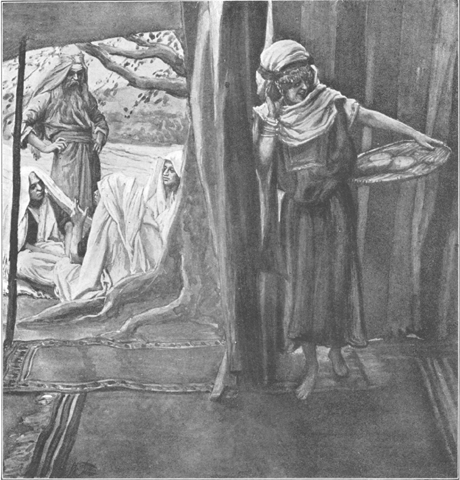
Our Torah reading offers a very different model for choosing a spouse: the arranged marriage.  Avraham is in need of a wife for his son Yitzchak, and dispatched his servant Eliezer to Aram Naharayim, his birthplace, to find an appropriate match. Eliezer returned with Rivka; and without a prior meeting, Yitzchak and Rivka marry. Remarkably, this marriage of two strangers flourished, and Yitzchak and Rivka grew to love each other.

Rabbi Samson Raphael Hirsch saw this arranged marriage as a superior model of true love. In his commentary to the Parsha, he contrasted this marriage with romantic love, and wrote that “... Jewish marriages are contracted not on the basis of passion, but on the strength of reason and judgment. Parents and relatives consider whether the two young people are suited to each other; therefore, their love increases as they come to know each other better. Most other marriages are made on the basis of what they call love. But... we immediately see the vast gulf between the love of the partners before marriage and what happens afterward ... how different (marriage is) from what the two partners had imagined beforehand. This sort of love is blind; each step into the future brings new disillusionment. Not so of Jewish marriage; here the wedding is not the culmination, but only the beginning of true love." To Hirsch, what mattered most in a marriage was compatibility and commitment; love is not necessary at the outset. Romance can even be a hindrance; the unrealistic dreams of star struck lovers may actually undermine their future marital happiness. And Hirsch's positive view of arranged marriage has some basis in experience; recent studies on couples in arranged marriages have shown that they have similar or greater levels of marital satisfaction as couples in romantic marriages.

The method by which one chooses a spouse is less significant than we might imagine; there are models of both romantic and arranged marriages in the Torah. But there is another issue that the Parsha highlights, which is far more significant: What are we choosing when we choose a spouse?

Many people believe that we are fated to marry a particular person. There is a folk belief in a bashert, a person that God intended to be your spouse. This idea is based on a passage in the Talmud, which says that 40 days before a baby is born, a divine voice announces who the child will marry. A similar concept, called soulmates, has evolved in general society. It is based on a passage in Plato that says that man and woman were divided at the beginning of their creation, and that the two halves continue to search for each other until they are finally reunited. From this perspective, you are not actually choosing; you are experiencing a miracle when your bashert/soulmate is revealed to you.

Eliezer's actions in our Parsha can be interpreted as the search for Yitzchak's bashert.  Upon arriving in Aram Naharayim, Eliezer turned to God, and established a sign; he would ask for water at the well, and the young woman who offered the right response would be the one meant to be Yitzchak’s wife. Eliezer is asking God to choose Yitzchak's bashert.

Maimonides criticized both Eliezer and the concept of bashert. He wrote that Eliezer's actions constitute divination and would later be prohibited by the Torah. In the opinion of Maimonides, there's no difference between turning around when a black cat crosses your path and what Eliezer did; both are forbidden forms of superstition.

More significant is Maimonides' rejection of the concept of bashert; he explained that man always has free will to choose what is right or wrong, and marriage is no different than any other activity. A person can choose if they want to marry, and who they want to marry; none of it is preordained.

Maimonides is intuitively correct. It is never simple to get married; it is, as the Talmud remarks, as difficult as splitting the Red Sea. There are many wonderful people who search for their bashert for years on end, without success; and there are many others who are trapped in painful marriages. They know that bashert simply isn’t true; and telling them that marriage is divinely predestined only adds insult to injury.

The ideas of bashert and soulmates have another great weakness:  the myth of happily ever after. Finding the “right one” feels like a dream come true and a divine miracle; and once the presumed soulmate arrives, the future seems bright. The couple then expects that the rest of their lives will continue along the same path. When I meet with couples before their weddings, I introduce them to several excellent research-based marriage education programs, and talk to them about the importance of building skills that will strengthen their relationship for the long term. But oftentimes, their eyes glaze over; they are so happy, so in love, they can’t imagine that anything will ever change. It is easy to believe that one has a match made in heaven, with no additional assembly required.

Rashi and Rabbi Yoseph Bechor Shor differ with Maimonides, and offer a very different interpretation of Eliezer’s plan. Their interpretation offers a powerful insight into how to choose a spouse. Eliezer was not searching for a bashert, a divinely ordained wife; he was simply looking for a young woman who was kind, who would give water to a stranger and his camels. While it might seem strange to choose a wife because of one act of kindness, it may be as good a way of choosing a spouse as any. Without kindness there is no love; but with kindness, even two strangers in an arranged marriage can learn to love each other. What you should choose when choosing a spouse is someone who can help you build a relationship, one act of kindness at a time.

Rav Chaskel of Kuzmir offers a further insight into Eliezer’s decision. The Midrash adds a fascinating detail about what happened at the well. He said that as Eliezer observed  Rivka, miraculously, the water of the well jumped into Rivka’s jar. Yet even though this occurred, Eliezer continued to wait, to see if Rivka will treat him with kindness. Rav Chaskel asked: Shouldn’t a miracle be evidence enough that she is the right one? Why wasn’t Rivka selected once the water jumped into her jar?

Rav Chaskel gives a sharp and illuminating response: “because one act of kindness is worth a thousand miracles.”

The same is true of love. Perhaps there is a bashert who is miraculously chosen for you. But Rav Chaskel’s lesson is about choosing a spouse; and he reminds us that one act of kindness is far more important than who is your bashert.

Wednesday, October 20, 2021

The Greatest Jewish Joke Ever


In 1893, Rabbi Hermann Adler, the Chief Rabbi of England, wrote an essay about Jewish humor for The Eclectic Magazine of Foreign Literature, Science and Art. He was responding to comments made by two prominent intellectuals, Ernest Renan and Thomas Carlyle, suggesting that Jews completely lack a sense of humor. (They probably were projecting a medieval caricature of the rigid Pharisees onto their Jewish contemporaries.) Rabbi Adler wrote a lengthy essay in response, in which he collected examples of Jewish humor from the Tanakh down to Moses Montefiore. Rabbi Adler himself had a sharp wit, and in his essay, he makes it clear that he took great pride in the Jewish sense of humor.

One might find it difficult to believe that anyone could accuse the Jews of being unfunny. Steve Allen, in his 1981 history of American humor “Funny People,” labeled comedy as a “Jewish cottage industry,” and observed that 80% of the comedians in the U.S. at that time were Jewish. The association of Jews with humor is so strong, that in the 2013 Pew study, 42% of American Jews responded that having a sense of humor was an essential part of what being Jewish means to them. (Of course, one wishes that contemporary Jews were as devoted to Shabbat as they are to sitcoms.) There are many, many books of Jewish humor, numerous studies analyzing Jewish humor, and multiple types of Jewish jokes. There are jokes about antisemites, foolish Jews and rabbis, off-color jokes and witty jokes, jokes about business, family and Judaism itself.

Jewish humor is not a religious tradition. In fact, rabbinic literature is ambivalent about comedy, and there are frequent condemnations of “leitzanut,” mockery, in ethical guidebooks. Many rabbis condemned the folk tradition of a “Purim Rav,” a comedian who would parody the local rabbi on Purim, mimicking the rabbi’s mannerisms and ridiculing his idiosyncrasies. Some rabbis found the lampooning they received on Purim difficult to take; there is a legend that Rabbi Shimon Sofer, the Chief Rabbi of Krakow, died right after Purim due to the grief caused by a particularly irreverent “Purim Rav.” At the same time, jokes are recognized as being a valuable psychological tool; the Talmud tells of one rabbi who would always tell jokes before he taught, to get the students to relax and focus. In another passage, Elijah comes from heaven to tell a local rabbi that two jesters in his neighborhood have an honored place in the world to come, because their jokes cheered up the depressed. Humor can certainly be a spiritual tool, but there is no commandment to be funny.

So why are Jews so funny? Sigmund Freud, in his 1905 essay “Jokes And Their Relation To The Unconscious,” devotes an unusual amount of space to Jewish jokes; it is clear that he believes Jewish humor is remarkable. In a time when Jews were extremely discreet in what they wrote about their compatriots, Freud features some unflattering jokes Jews would tell about themselves. He repeats a joke about Galitzianer Jews that pokes fun at their reputation for rarely taking baths:

“Two Jews met in the neighbourhood of the bathhouse. ‘Have you taken a bath?’ asked one of them. ‘What?’ asked the other in return, ‘is there one missing?'” (This is one of four different jokes about Jews and bathing that Freud repeats.)

Ruth Wisse, in her bookNo Joke: Making Jewish Humor,” points out that Freud’s contemporary Arthur Schnitzler criticized Freud for publishing these jokes, which Schnitzler said made Freud sound more antisemitic than antisemites. However, Freud was unconcerned, and saw these jokes as depicting a positive side to Jewish culture. He explains that these Jewish jokes aremeant to portray the democratic mode of thinking of Jews, which recognizes no distinction between lords and serfs, but also, alas, upsets discipline and co-operation.” 

Jews certainly know how to laugh at themselves, and to make fun of their failings. There is a joke about three Jews who are about to be executed by firing squad. The sergeant in charge asks each one whether he wants a blindfold. “Yes,” says the first Jew, in a resigned tone. “OK,” says the second Jew, in a quiet voice. “And what about you?” he enquires of the third Jew. “No,” says the third Jew, “I don't want your lousy blindfold,” followed by a few choice curses. The second Jew immediately leans over to him and whispers: "Listen, Moshe, don't make trouble. Take the blindfold. "

This joke is mercilessly self-critical and funny at the same time; but laughter helped Jews contend with a hostile environment, and cope during the most difficult of times. There was an entire genre of jokes created by Jews from the Soviet Union; and several books have been written about Jewish humor during the Holocaust. One would think that there are times and places where humor is impossible; but actually, that is where humor is most needed. Comedy is a refuge, a shelter for the heartbroken. One excellent example of this, from an obituary in Canadian newspaper, tells of a Holocaust survivor returning to visit the concentration camps: 

“When, in the 1980s, Celine returned to Theresienstadt with her husband Maximilien, they were stopped at the ticket counter. ‘Last time I was here,’ Celine told the ticket vendor, ‘I got in for free.’”

I had heard a similar anecdote about another survivor who returned to Auschwitz. At the ticket counter, he rolled up his sleeve, showed the number tattooed on his arm, and asked, “do I get an alumni discount?” Laughter offers ready relief for the persecuted.

Some Jewish jokes wield ridicule as a weapon. The Midrash tells the story of a young Avraham breaking his father’s idols, and then claiming that the largest idol was angry, and broke the others; this is pure satire, a joke about the silliness of paganism. (And the Talmud makes clear that one is entitled to mock paganism, even in an extreme fashion.) In response to antisemitism, Jews mocked their boorish and barbaric enemies. One example of this is the joke that Joseph Telushkin retells in his book “Jewish Humor”:

“During the Second World War, a southern matron calls up the local army base. ‘We would be honored,’ she tells the sergeant who takes her call, ‘to accommodate five soldiers at our Thanksgiving dinner.’ ‘That's very gracious of you, ma'am,’ the sergeant answers. ‘Just please make sure they're not Jews,’ the matron adds. ‘I understand, ma'am.’ Thanksgiving afternoon, the woman answers the front doorbell and is horrified to find five black soldiers standing in the doorway. ‘We're here for Thanksgiving dinner, ma'am,’ one of the soldiers says. ‘Bu ... bu ... but your sergeant has made a terrible mistake,’ the woman says. ‘Oh no, ma'am,’ the soldier answers. ‘Sergeant Greenberg never makes mistakes.’”

Mockery was a weapon, a way for Jews to belittle and diminish those who  mistreat them.

But there is no purer form of Jewish humor than the absurd. A classic example is a joke told by Leo Rosten in “The Joys of Yiddish.”

A man posed a riddle to his son: “What’s purple, hangs on the wall and whistles?”


When the son gave up, he answered: a herring.
“A herring?” his son said. “A herring isn’t purple.”
“Nu,” replied the father, “they painted the herring purple.”
“But hanging on a wall? How does a herring hang on a wall?”

“Aha! You nail the herring to the wall.”

“But a herring doesn’t whistle,” his son shouted.

“Nu, so it doesn’t whistle.”

This joke is actually a joke about jokes, a riddle that fails to add up; it absurdly ends up with a “nu” for a conclusion. And it is here where the Jewish love for humor begins. Let me explain why.

The name of the second Jewish patriarch is Yitzchak; the root word of his name is tzachak, which means laughter. In our Parsha, the root tzachak is employed several times; almost all are in relation to the birth, naming and raising of Yitzchak. They indicate the joy and shock Avraham and Sarah have when learning they will have a child in old age. The root word is also used when Lot tells his sons-in-law that their home city of Sodom is about to be destroyed. They do not believe him, for his words are “like a joke [kimitzacheik] in their eyes.”

The double reference to laughter highlights that both events are improbable to the point of being funny. And indeed they are. To an observer at the time, the possibility that a major city like Sodom will disappear, or that a childless, wandering, elderly couple will be the progenitors of a great civilization seems ludicrous. The funny thing is, this strange outcome is precisely what occurs; and it is here that the Jewish love for humor begins.

It is difficult to write a short article on Jewish humor; there are only so many jokes that you can tell, and so many others that have to be left out. But the greatest Jewish joke is ever-present: that am yisrael chai, that a small nation beat ridiculous odds time and time again. Just like the elderly couple Avraham and Sarah, Jews were expected to disappear; instead, they continue to thrive, year after year. Isn’t that laughably absurd?  Yes, it is; and that’s why the first Jewish child was named Yitzchak.


Thursday, October 07, 2021

Ordinary Greatness


Thomas Carlyle argued for the “great man” theory of history, that "the history of the world is but the biography of great men." The unique traits of great leaders allows them to transform everyone and everything around them, and change the course of history. And while the great man theory has lost favor in recent years, undoubtedly it is partially true. There are many historical figures that did change the world; for example, America would not be the same without Washington and Lincoln, and Israel would not exist without Herzl.

At first glance, the narrative of the Tanakh is also the biography of great men; most of the focus is given to larger than life individuals. Characters such as Avraham, Yoseph, Moshe, David and Shlomo take the center stage, and then direct the course of action. The abilities of these heroes is amplified in the Midrashim and other Rabbinic commentaries, leaving them with truly larger than life attributes. These great men are our heroes.

This focus on greatness has had a profound impact on Jewish culture, and has made greatness a life goal to be embraced. Many have taken the view that the entire educational system should be focused on developing the elite students, even if it means abandoning the needs of the other students. Rav Eliyahu Dessler, when contrasting the Lithuanian Yeshiva system with the educational system of early-20th-century German orthodoxy, wrote that the goal of the Lithuanian system is to create great scholars, even if it means under-serving the other students. He based his view on a Midrash that says “one thousand students enter to study Bible and only one comes out as a great Talmud scholar.”

This aspiration for greatness affects the perspective of parents as well. Maimonides makes a telling remark when he writes that a person “should set his heart to have a son who perhaps will be a wise and great man in Israel.”

This is the “great man” theory of child rearing, in which our expectations for our children are geared to greatness. David Bader highlights this in a comic Haiku entitled the “Jewish Mother’s Lament”:


Is one Nobel Prize
so much to ask from a child
after all I've done?”

For better or for worse, the Jewish community has put the “great man” theory into practice.

But there are other models of a proper life. Noach, the title character of our Parsha, is a perfect example of ordinary greatness. The Torah itself is unclear on how to describe Noach. He is considered worthy of being saved because he is a “righteous man,” which is high praise; but we are also told that “he found favor with the Lord,” which implies that he was somewhat undeserving, and saved because of his charisma. And then in a third verse there is a qualifier, “righteous before Me in this generation,“ which leads one to wonder whether Noach’s righteousness was merely relative to the rest of his generation, who were deeply immoral. For this reason, the Rabbis of the Talmud debate whether Noach would have been greater had he lived at a different time, and they speculate whether or not he could have been as great as Avraham.

But perhaps we need to stop comparing Noach to Avraham, because Noach does not conform to the usual models of greatness. Instead, he is a good person who steps up to the plate when needed, the right man who arrives at the right time. The Torah’s ambiguity about Noach is intentional, because Noach is both good and great at the same time.

Noach’s character defies the rigid fundamentalism of greatness; he reminds us that one can be a humble man of the earth and still save the world. And he is far from the only one in the Tanakh who exhibits ordinary greatness; Ruth, Esther and all the leaders in the Book of Judges are ordinary people who make an extraordinary impact. Their goodness is their greatness.

Ordinary greatness is the foundation of the Chassidic tradition of the “lamed vuv tzadikim,” the 36 hidden righteous men who uphold the world. They appear like ordinary men and live ordinary lives, yet in undertaking an important act of piety or charity, these ordinary Joes save the world. The lamedvuvnik offers us an alternative paradigm of greatness: a good man quietly doing good things, on the periphery and away from the limelight. The beauty of the lamedvuvnik tradition is that it forces us to consider that anyone might be great, even the common man; and who knows, maybe the gruff, grizzled and wrinkled water carrier in the back of the tiny synagogue is carrying the fate of the entire world on his shoulders.

Gershon Scholem has noted that this idea of hidden righteous men, lamedvvuniks, has some basis in the Talmud; and in a larger sense, there are many talmudic stories about jesters, pimps and thugs who find a distinguished place in the world to come because of the good deeds that they do. It is interesting that the Chassidic movement, which is oriented around the tzaddik (a great man who functions as a divine intermediary), gave so much attention to the simple looking lamedvuvnik.  But perhaps that is the point: even when recognizing great heroes, the quiet contributions of everyday heroes must never be forgotten.

This lamedvuvnik is an excellent role model for those who feel conflicted about their goals, uncertain about whether they must always pursue the next great possibility. Parents in particular are often torn between their career and their children. And, for anyone, every new opportunity requires new sacrifices. There are times when people don’t choose the path of greatness because they have other priorities, and the lesson of the lamed vuv tzadikim is you don’t need to do it all; you just need to do good.

The lamedvuvnik life is a model of understated greatness, to change the world one person at a time. George Elliot expresses this idea beautifully when she writes at the end of “Middlemarch”: "The growing good of the world is ... half owing to the number who lived faithfully a hidden life, and rest in unvisited tombs."

In the course of my career I have met many people from all walks of life, but it’s the lamedvuvniks that inspire me the most. One of them was Harold, who was the “candyman”  of my previous congregation; he was the person who gave out sweets to all the children in the synagogue, and the greeter who helped people find their seats. When he passed away his funeral was filled to capacity; the staff at the funeral home were curious, wondering why Harold was famous. Harold’s resume said he was a retired insurance salesman, but as I explained in my eulogy, Harold was a lot more:

“What was it about Harold that was special? Harold was not a wealthy man, (although he was more contented than virtually anyone). He was not a Nobel prize winning scientist, (although he had more common sense than anyone); he was not an Olympic athlete, not a cabinet minister, and you didn’t see his name in the newspaper. Fame and fortune were not Harold’s calling card.

What was special about Harold was a simple trait; Harold never passed people by. Every person he met, big or small (oh, how he loved children!) famous or unknown, important or unimportant, were treated to Harold’s brand of friendship, good humor and charm. What was special about Harold was that he made everyone he met feel special.”

Harold knew the lamedvuvnik credo: change the world one person at a time. In the course of our lives, every one of us has met our own, personal, lamedvuvnik: a parent, teacher, friend, or even a stranger who has made an enormous difference in our lives.

Sometimes, you can be great just by being good.