Friday, January 26, 2024

THE PEOPLE'S FLAG


Herzl's sketch of his proposal for the flag of the Zionist movement.


A country must have a flag. In 1896, Theodore Herzl wrote, “We have no flag, and we need one.” Herzl offered a somewhat pedestrian suggestion of “a white flag, with seven golden stars. The white field symbolizes our pure new life; the stars are the seven golden hours of our working day.” (However, Herzl carefully arranged the stars so that together, the seventh star is a Magen David.)

Flags have always played a role in statecraft. In the book of Numbers, flags organize the Jews as they travel through the desert; in later Jewish history, impromptu flags, often used on Simchat Torah, were symbols of Jewish solidarity. In the ancient world, flags, ensigns, and banners played a critical role in warfare, where they took on extraordinary importance; capturing the enemy’s flag was an act of heroic valor, and a humiliation for the opponent. The Romans treated their ensigns as an object of worship; Josephus writes that the Romans considered it “a terrible thing… and a great shame, if they were stolen away.” In modern times, flags are primarily a national symbol.


To Herzl, having a national flag was critical. He wrote, “If we desire to lead many men, we must raise a symbol above their heads.” To him, the flag was another way of transforming the humble Jewish masses into a nation. He would later write in his diary (June 1, 1901) that he hoped to be remembered by history as “an impecunious Jewish journalist, (who) amid the deepest degradation of the Jewish people and at a time of the most disgusting anti-Semitism, made a flag out of a rag and a people out of a decadent rabble, and was able to rally this people around such a flag.” The leader, and their flag, are what makes the people a people.


Herzl, along with his flag, lead the huddled masses to their promised land. However, what would ultimately become the flag of Israel represents a very different vision.


Four biblical commentators from medieval France mention flags in their commentaries on Parshat Beshalach, during a battle scene towards the end of the Parsha. The newly freed slaves are ruthlessly attacked in the desert by Amalek, who “surprised (the Jews) on the march, when you were famished and weary, and cut down all the stragglers in your rear.” (Deuteronomy 25:18.) The Jews have to fight back.


What ensues during this is quite unusual. Joshua is sent to lead the Jews in battle; at the same time, the Torah tells us:


And Moses said to Joshua…Tomorrow I will stand on the top of the hill with the rod of God in my hand.… Moses, Aaron, and Hur went to the top of the hill. As long as Moses held up his hands, the Israelites were winning, but whenever he lowered his hands, the Amalekites were winning. When Moses’ hands grew tired, they took a stone and put it under him and he sat on it. Aaron and Hur held his hands up—one on one side, one on the other—so that his hands remained steady till sunset. (Exodus 17:9-12)


With Moses’ hands held high, Joshua wins the war.


Every commentary grapples with the same question: What is Moses doing with his hands? The most obvious answer, offered by Rabbi Abraham Ben HaRambam and Shadal, is that Moses raises his hands in prayer and miraculously protects the Jewish soldiers.


Others find this explanation unsatisfying; if this was meant to be a time of miracles, why did Moses send the soldiers to begin with?


Four commentaries from Northern France, Bechor Shor, Rashbam, Hizzkuni, and Joseph Kara, offer a very different interpretation. Moses held his staff high (in his hands,) which functioned as a military flag. (It is fascinating that the commentaries offer three different vernacular words for flags: banniere, confanon, and pendon.) Holding the flag high strengthens the morale of the troops; Moses’ staff and his hands function like a flag.


These two explanations are polar opposites. One sees Moses’ hand-raising as the prerequisite for a miraculous intervention; the other sees Moses’ staff as playing a mundane role, a rudimentary flag that rallies the troops on the ground.


The Mishnah (Rosh Hashanah 3:8) offers a middle ground; the hands of Moses functioned as a spiritual flag. It says that when Moses held his hands aloft, “the Jewish people turned their eyes upward and subjected their hearts to their Father in Heaven; then they prevailed. But if not, they fell in battle.”


For the Mishnah, the result of the war is miraculous, but the miracle doesn’t belong to Moses; it belongs to the people. Moses' hands held aloft, metaphorically the first flag of the Jewish people, is not about the leader; it is about the people. It reminds the soldiers to focus on their divine connection and reflect on their mission.


The Mishnah offers a very different vision of what a flag is: it represents the shared values of the community. Its worth comes from what people project onto it and how people connect to it. Unlike Herzl, the Mishnah sees the value of the flag as depending on what people invest in it.


Herzl’s vision for a flag was rejected. Instead, a proposal by David Wolffsohn, a close associate of Herzl and his successor as President of the Zionist Organization, is accepted. Wolffsohn writes that at the first Zionist conference, the following inspiration came to him:


At the behest of our leader Herzl, I came to Basel to make preparations for the Zionist Congress. Among many other problems that occupied me then was one which contained something of the essence of the Jewish problem. What flag would we hang in the Congress Hall? Then an idea struck me. We have a flag — and it is blue and white. The talith (prayer shawl) with which we wrap ourselves when we pray: that is our symbol. Let us take this Talith from its bag and unroll it before the eyes of Israel and the eyes of all nations. So I ordered a blue and white flag with the Shield of David painted upon it. That is how the national flag, that flew over Congress Hall, came into being.


Wolffsohn creates a flag that reflects every man; and it also reflects the everyman, the Tallit worn on the backs of tailors and wagon drivers, the ordinary folk who understood Zionism well before the rest of the world did. It is not a top-down flag, one brought by the leader to transform a hopeless rabble; instead, it is a people’s flag, one that draws its meaning from the hopes and dreams of its followers.


Rabbi Joseph B. Soloveitchik argues that the people’s attachment to the Israeli flag transforms it into a sacred object. In a Yiddish lecture given at a Mizrachi convention in the 1960s, Rabbi Soloveitchik remarked that he generally doesn’t understand the magical attraction of flags or other objects like it. However, the Israeli flag is different. The Shulchan Aruch says that a Jew who is murdered must be buried in the clothes he was wearing when he was killed. Soloveitchik says this law teaches us that clothing “acquires a certain sanctity when spattered with the blood of a martyr. How much more is this so of the blue and white flag, which has been immersed in the blood of thousands of young Jews who fell in battle defending the country and its population. The Israeli flag has a spark of sanctity that flows from devotion and self-sacrifice.”


The people’s flag carries more than the hearts and souls of a nation; it represents the sacrifices that so many young people have made to build the State of Israel.


Today, our young men and women have to go into battle; far too many will not come home again. It is grueling to continue to fight against a fanatical, bloodthirsty foe. The ongoing losses are too large to bear. As the war continues, we too, like Moses, find that our hands grow weary.


What continues to hold the flag high are the people, who are filled with dedication. In the end, Moses can no longer hold up the flag; his hands need to be held aloft by Aaron and Hur. This moment offers a critical lesson: flags don’t belong to leaders, not even Moses. They belong to the entire people.


Today in Israel, it is the ordinary Israeli, and only the ordinary Israeli, who has held the country together. Previously unknown heroes have rushed to the front lines, organized volunteers, and taken care of a country in crisis. These ordinary people have consecrated the flag with the sacrifices they have made, sacrifices too great to count.


Israel’s flag is their flag. And they are holding it up high, despite everything.

Friday, January 19, 2024

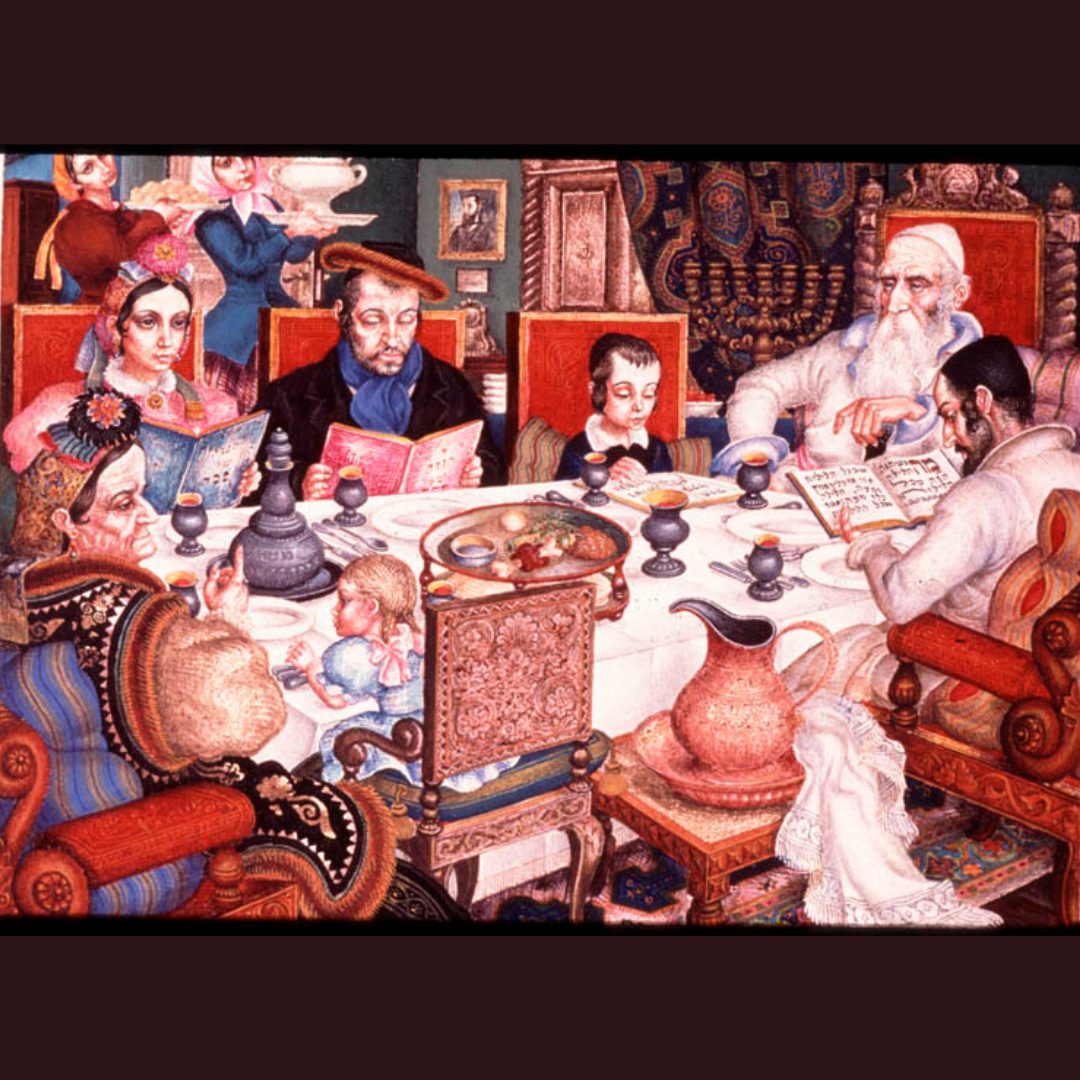
WHEN LIFE GIVES YOU BITTER HERBS


Passover, Arthur Szyk, 1948

WHEN LIFE GIVES YOU BITTER HERBS


By Rabbi Chaim Steinmetz

Bitter herbs are a culinary misfit. One can fulfill the obligation to eat the bitter herbs (maror) at the Seder with many different sour and spicy vegetables, including horseradish, romaine lettuce, and chicory. But what is very strange about maror is that we eat these vegetables on their own at the Seder; as the Mah Nishtanah  exclaims, on any other night, no one would eat a bitter spoonful of horseradish straight up.

Maror was misunderstood from the very beginning. There is no clear indication in the Biblical text as to why it is included in the Seder. The Torah in Parashat Bo says the Passover sacrifice should be eaten “roasted in fire, with unleavened bread, and with bitter herbs….” While the Passover sacrifice has a direct connection to the night of the Exodus, and Matzah is connected to the haste in which the Jews left Egypt, the reader is left to imagine what purpose maror might have.


Several commentaries see maror as a way to enhance the meat of the Passover sacrifice. The Ohr HaChaim says that “it is the way of those who eat roasted meat to do so with something sharp, for this makes it tastier, and entices people to eat more.” Ibn Ezra and Ibn Kaspi offer similar interpretations. This perspective is found in the Talmud (Chullin 132b), as well. It asserts that certain offerings of meat must be eaten in “the manner of royalty”; and it explains that the manner of royalty is to eat meat “roasted and served with mustard.” 


This interpretation is closest to the simple reading of the text. The Torah wants the Passover sacrifice to represent the joy of freedom, and be eaten in a royal fashion; to do so requires that it be served with an appropriate condiment.


But the Mishnah and Passover Haggadah offer a very different perspective on maror; Rabban Gamliel says: “The reason for bitter herbs is because the Egyptians embittered our forefathers’ lives in Egypt…” Maror is interpreted as a symbol of slavery, not royalty.


David Henshke argues that Rabban Gamliel’s explanation reflects a shift that took place after the destruction of the Temple. There was no longer a Passover sacrifice; one needed a new rationale to include the bitter herbs at the Seder. Rabban Gamliel found a different symbolism in the maror, one that related to the actual suffering during slavery.


But this new understanding of maror seems strange. An evening of redemption should be filled with joy and sweetness. The point of Passover is to escape the horrors of slavery; to place bitterness at the center of the Seder plate seems to undermine Passover’s message.


Most often, answers given to this question embrace the positive side of bitterness; or to put it a bit more cynically, that “suffering is good for us.” Maror is a reminder that slavery has shaped the Jewish soul just as much as freedom.


Undoubtedly, suffering can improve us as people. Professors Richard Tedeschi and Lawrence Calhoun coined the term “post-traumatic growth” after observing that many of their trauma patients had reinvented themselves in the aftermath of a major tragedy. They had grown in terms of their strength of character, relationships with others, perspective on life, appreciation for life, and spirituality. Their suffering had changed them for the better.


Even before post-traumatic growth was discovered by psychologists, it was evident to philosophers and theologians. Nietzsche wrote that “to those human beings who are of any concern to me I wish suffering, desolation, sickness, ill-treatment, indignities…,” because Nietzsche recognized that character is forged in the crucible of adversity. Rabbi Samson Raphael Hirsch notes that the Hebrew word for a “test of suffering,” nisayon, is the same as the Hebrew word for “raising up,” nissa, because a test raises one up; the bitterness of suffering is itself the silver lining that carries other blessings.


The Sefat Emet makes a direct connection between this idea and maror. He says that “the bitterness of slavery was a preparation for redemption, and this (bitterness) remains with us during the times of redemption.” Maror reminds us that bitterness begets character, and is itself a gateway to redemption.


As I get older, I get more uncomfortable with these types of explanations. I don’t contest their truth. Yes, suffering can spur spiritual growth. And one who suffers will find the pursuit of meaning to be the best way to live with suffering; as Rabbi Joseph B. Soloveitchik wrote, “Judaism teaches us that the sufferer commits a grave sin if he allows his troubles to go to waste and remain without meaning or purpose.” Spiritual quests are how the soul copes with tragedy.


But what I find deeply disturbing are articles and sermons that use this difficult truth to romanticize suffering. They depict the personal growth achieved in the face of suffering as some sort of Hollywood ending that makes it all worthwhile. But it doesn’t.


The Talmud discusses an idea called “afflictions of love,” which claims that the righteous suffer unnecessarily in order to receive a greater reward in the future. After a discussion of the great reward involved, it tells real-life stories about suffering. In one, Rabbi Yochanan suffers from an illness. His colleague Rabbi Chanina visits, and asks: “Is your suffering dear to you?”; perhaps Rabbi Yochanan appreciated the spiritual glory of suffering, and wanted to continue with his afflictions. Rabbi Yochanan offered a terse response: “Neither the sufferings nor their reward.”


After a lengthy discussion of theory, the Talmud shares the real-life verdict on suffering: all the growth in the world is not worth the suffering.  Marror is always bitter, and may it stay far, far away from us, always.


So how else can one see Maror? The past few months have given me a new reflection on the passage of Rabban Gamliel. I now believe that maror reminds us that even when we can proudly sing “this year in Jerusalem,” there will still be maror on the Seder plate. Despite returning to our homeland and building a remarkable state, we cannot banish the bitter herbs. Life will always have a side portion of maror.


But the maror at the Seder is not there to sober us up and offer us cynical realism. Instead, it reminds us that maror is never the final chapter. Bitter herbs may be ever-present, but so is redemption. We simply have to get through this portion of maror and start over again. We have overcome, we can overcome, and we will overcome.


In the worst of times, Jews never gave up on redemption; and now that we have experienced a taste of redemption, we certainly cannot give up on redemption, no matter how bitter things are. 


This message was powerfully articulated in a heroic eulogy that a bereaved mother, Sarit Zussman, gave for her son, Ben, a fallen soldier. After speaking about her remarkable son and the profound love he shared with his family, she ended by speaking to the people of Israel:


"And now to you, to all of you, to all of us, to the Jewish people in the Land of Israel. As a storyteller, I tell you: that our story has a happy ending. We are going to win. We have no other choice. We are a people who want to live, unlike our enemies, lowly and miserable, cowards, Nazis and their accomplices, who sanctify death. We will live, and thrive, and build...Do you hear, people of Israel? World, do you hear? Do you hear, lowly enemies who desire death and evil? Am Yisrael Chai – the Jewish people live, forever and ever and for all eternity, standing tall and with our heads held high…”


These moving words remind us that the true lesson of maror is that we must hold on to hope, even when it seems impossible. The Seder ends with joy, despite the maror. No matter how difficult it gets, we must hold our heads high and proudly declare: Am Yisrael Chai!

Friday, January 12, 2024

We Must Never Forget Them


The Israelites' Cruel Bondage in Egypt, Illustration from the 1728 Figures de la Bible; illustrated by Gerard Hoet (1648–1733) and others, and published by P. de Hondt in The Hague; image courtesy Bizzell Bible Collection


One could call this the Gettysburg Address of the Exodus. At the beginning of Parshat Vaera, God speaks to Moses and assures him that slavery is about to come to an end:


Therefore say to the children of Israel: ‘I am the Lord; I will bring you out from under the burdens of the Egyptians, I will rescue you from their bondage, and I will redeem you with an outstretched arm and with great judgments. I will take you as My people, and I will be your God. Then you shall know that I am the Lord your God who brings you out from under the burdens of the Egyptians. And I will bring you into the land which I swore to give to Abraham, Isaac, and Jacob; and I will give it to you as a heritage... (Exodus 6:6-8.)


In just a few sentences, the Torah gives us an overview of the full process of redemption; not just an escape from slavery, but the creation of a new nation with a homeland of their own. The Talmud refers to the first four verbs in this section (bring out, rescue, redeem, and take) as the “four languages of redemption”; And to this day, the four cups of wine at Passover Seder are in celebration of these words.


The parsha begins with this speech, most probably in order to begin on a high point. But it also begins mid-conversation, which strips it of context. God’s words are actually a response to an angry challenge by Moses; after his initial petition to Pharaoh backfires, and causes even greater pain to the slaves, Moses turns to God and says: “Lord, why have you done such evil to this nation? Why is it that You have sent me?”


Moses’ words border on the sacrilegious. Indeed, several commentaries criticize Moses for this. Rashi says that God, in his response, subtly rebukes Moses for his complaint; one Midrash says Moses was later punished for challenging God, and not allowed to enter Israel.  


Yet the simple reading of God’s response is that He takes Moses' challenge seriously; that is why God offers such a thorough and detailed reply. Moses is speaking on behalf of those who are oppressed and downtrodden, and even if he speaks with chutzpah, he does so out of love for his Jewish brothers and sisters.


Another Midrash (Shemot Rabbah 5:22) amplifies Moses' complaint. Moses knows the Jews will eventually be rescued, but he cannot tolerate the delay. A future redemption, Moses says, will not “help the Jews who are now being thrown under the building.” This curious phrase refers to a shocking image found in rabbinic literature (Midrash Zuta Kohelet 7:7, Rashi Sanhedrin 111a) that in the Egyptian construction projects of Pithom and Raamses, Jews were used as bricks, and squeezed into the gaps of walls. A similar Midrash (2:24) asserts Pharaoh sought to heal himself of leprosy by bathing in the blood of 150 murdered Jewish children each morning and evening.


These midrashic images amplify the biblical text, which talks at length about Pharaoh's attempts to kill Jewish children. But they are not here just to vilify Pharaoh; they come to expose the inner workings of his regime.


Some acts of hatred are utilitarian; one feels threatened, and therefore needs to fight an enemy. But other times, hatred stands at the very foundation of a society. The historian Saul Friedlander coined the term “redemptive antisemitism,” to describe the Nazi hatred of Jews. The Nazis saw Jews as a virus that weakens and undermines humanity; the destruction of the Jews would bring goodness to the rest of the world.


These midrashim are articulating something similar. In one, the murder of Jewish children is seen as therapeutic, a way for Pharaoh to recover his health. In the other, dead Jews are the foundation of Egyptian development. For Pharaoh, killing is no longer the means of maintaining power, but the very purpose of power itself. Violence against Jews is the scaffolding that holds his regime together.


Unfortunately, these Midrashim are prescient, offering a clear description of Hamas. There are no limits to Hamas’ “100-year war.” It engaged in a premeditated mass murder in the most horrible, depraved fashion, all proudly recorded by terrorists on their body cameras. Even more shocking is Hamas’ overt contempt for the very people they claim to represent. Palestinians were Hamas’ first victims, as this autocratic regime has regularly murdered its opponents. Today, Palestinians are enduring great suffering because Hamas cynically uses civilians as human shields, and calculates the strategic value of their deaths. Hamas will have the Palestinians fight to the death in Gaza while many of its leaders sit comfortably in Doha.


Supporters of Israel are sometimes reluctant to speak about the tragedy of Palestinian civilians because it has been weaponized by Hamas and its enablers; as I write these words, the International Court of Justice is presiding over a South African claim that Israel has engaged in “genocide.” But even so, we must mourn for the deaths of those caught in the crossfire. Every human being is created in the image of God.


Hamas has built its regime with the blood of both Palestinians and Israelis. Its great construction project, the Gaza tunnels, is built for death, and by death. Hamas’ wanton violence may shock us; but the Midrash predicted this type of hatred hundreds of years ago.


Like Moses, we are anguished over the innocent babies who were massacred, and mourn for those who were brutally murdered. Israel has had to send its best and brightest out to take up the fight; and too many of them have fallen in battle. For all of these tragedies, we cry.


Every death is a profound loss; but the death of a young person is all the more painful because it is so unexpected. In the ordinary way of the world, children bury their parents, not the other way around. My father died in a car accident, predeceasing my grandfather by nearly 40 years. My grandfather was a jovial man, who always had a smile on his face; that is, except when he spoke about my father. Then the smile left his face; even decades later, the grief would quickly return. No suffering is greater than that of losing a child.


A Hebrew expression, which is first found in Isaiah (38:10), best describes a young death: nektaph b’mei chayav, “cut off in the middle of their days.” It emphasizes that a young death is actually a double tragedy; one loses not just the person, but also what the person could have been.


Each of these deaths are painful for our entire community. News reports out of Israel recount the entire biography of those who have died; the entire Jewish world repeats their names and their stories. And inevitably, we find that we are one or two degrees of separation from these tragedies.


Hamas sees our response as a weakness. Yahya Sinwar sees the Israeli concern for each hostage and each soldier to be a weakness; he considers his ability to write off the lives of thousands of Palestinians to be a strength. He ridicules Israel’s willingness to call a ceasefire in order to release a handful of hostages. Like Pharaoh, Sinwar is ready to build pyramids with the bodies of babies.


Sinwar is correct that brutality holds strategic value; ignoring the suffering of one’s own people means that one can fight on without any limitations. But it is morally untenable. Moses cried for the babies Pharaoh was murdering, and we must follow his example. Even if it seems foolish, we must advocate for each hostage, and cry for every soldier.


We must never forget them. And we must challenge God to remember them, and put an end to the suffering now.

Friday, December 15, 2023

The Optimism of Seven Lean Years


Pharaoh's Dreams, c. 1896-1902, by James Jacques Joseph Tissot (French, 1836-1902),

gouache on board, Diameter: 5 1/8 in. (13 cm) each, at the Jewish Museum, New York


Optimism is profoundly human. The neuroscientist Tali Sharot, in her book The Optimism Bias, shows that optimism is pervasive, cutting across all cultures. She draws the conclusion that humans are hotwired to imagine an unrealistic picture of the future. It is instinctive to dream of “happily ever after,” even if that often is not the case.


The belief in progress is equally instinctive, because it is nurtured by optimism; and it is just as irrational. In 1992, Francis Fukuyama, a political scientist, wrote The End of History. He saw the fall of the Soviet Union as representing the ultimate triumph of the western democratic order, and the culmination of all history. There would be no further conflicts, now that the world had seen the light.


Unfortunately, that was not true. New dictators arose, and arguably, democracy has been on the decline since he wrote the book.


But the failures of optimism doesn't mean it should be completely rejected. Redemption is one of the foundational beliefs of Judaism. Jeremiah held out hope that a newly exiled nation would return home; Isaiah imagined a world filled with peace and harmony. Jews are called by Zechariah “prisoners of hope”; our soul’s first language is optimism.


But since October 7th, Jews have felt betrayed by optimism. History has gone backwards. It feels like it's 1948 again, with Israel fighting for its very existence. Every dream seems counterfeit. Optimism feels like a cognitive trap, which gives one false hope when hope is pointless.


It is here where optimism needs an unlikely ally to succeed: pessimism. That is a central lesson of Joseph's dreams.


Joseph's life story revolves around three sets of dreams. The first two he has as a child, when he is the spoiled younger half-brother who is deeply resented by his siblings. He dreams that they are in the field, and his bundle of grain rises up, and the bundles of his brothers are bowing to him. Then Joseph has another dream, where the sun and the moon and the stars are all bowing to him.


These dreams seemingly need no interpretation. Joseph is declaring himself the ruler of his brothers.


Immediately, the opposite happens. The dreams stir the brothers’ jealousy, and they sell him into slavery in Egypt.


The second set of dreams occur when Joseph is in an Egyptian prison, and two fellow prisoners, the butler and the baker, ask him to interpret their dreams; Joseph does so accurately, predicting that the butler will be freed and the baker will be executed. Two years later, the butler will recommend Joseph as a dream interpreter.


The third set are Pharaoh's dreams. He has two dreams. In one, seven fat cows are swallowed up by seven skinny cows; in the second, seven healthy stalks of grain are devoured by seven sickly stalks of grain.


Joseph is called from prison to interpret Pharaoh's dreams; he explains that there will be seven years of plenty, followed by seven years of famine. Luckily, Joseph explains, the dreams offer a timely warning, which will allow Egypt to get ready for the famine and overcome it. Joseph is so impressive, that he is immediately named the viceroy of Egypt.


What jumps out at the reader is how Pharaoh’s dreams stand in sharp contrast with Joseph's dreams.


Pharaoh's dreams project a tragic ending; but because Pharaoh shared them, they will have a positive ending. Joseph's dreams project a very happy ending for him; but because Joseph shared them, he ends up a slave.


Pharaoh's dreams are difficult to interpret; he turns to all of his priests for answers, but none have one. It is clear to everyone that God is communicating with Pharaoh. In contrast, Joseph's dreams are obvious, and need no interpretation. And his brothers assume that these dreams are just the product of Joseph's imagination and nothing more.


Finally the most fascinating contrast has to do with what occurs after a double dream. Pharaoh's double dream indicates that it will come true immediately; Joseph's double dream seems to wait for a long time to come true.


There are many lessons that these contrasts teach. First of all, it reminds us to beware of happy endings. Joseph's dreams feed his own vanity and make him oblivious to his own brother's hatred; in fact, his dreams make their hatred worse. This is a good dream that causes damage, where a sunny picture of the future is actually a liability.


Second, one must recognize that pessimism often allows optimism to succeed. Pharaoh’s nightmares allow for proper preparation, to be ready for the upcoming famine. The unhappy ending in the dream actually helps Pharaoh achieve a happy ending in real life. This is a bad dream that does a great deal of good, preparing Egypt for the future.


Third, good dreams often have a very long runway. Joseph explains to Pharaoh that the double dream means “that the matter has been determined by God, and that God will soon carry it out.” This is a strange assertion, considering that Joseph's own double dream had seemingly not come true.


However, I would argue that that isn't the case; Joseph's dreams actually came true immediately. What his brothers thought to be a mere figment of Joseph's ambition was actually a divine prophecy. However, both the brothers and Joseph misunderstood this dream; they assumed it meant that Joseph would be the recipient of great privilege, an entitled ruler who receives unearned gifts. But actually, the purpose of the dream was to call Joseph to be a true leader, to be a servant of both his family and all of Egypt.


In order to do that, Joseph would have to learn humility. In order to become an authentic leader, Joseph would need to be a slave first. And so he becomes a slave immediately, which prepares for the fulfillment of his dream.


Joseph could only achieve this dream through great difficulty. But the pain and suffering he endured as a slave got him ready for his ultimate role. And in the happiest of endings for the entire family, Joseph was in the exact right place to save them from the famine.


Right now it is difficult to dream, and optimism is scarce. But the lessons of our Torah reading is that there are no grand dreams of the future without difficulty and sacrifice. But if we learn to prepare for the famine, we will be able to endure.


And we have known this all along. In 1956, Moshe Dayan gave a eulogy for Roi Rotberg, a 21 year old soldier who was ambushed in the fields of Nahal Oz, near Gaza. This eulogy is prescient; it speaks directly to us today in the aftermath of October 7th. Dayan explained that Israel must never be lulled into complacency, imagining that everything will be okay. A country like Israel will have enemies, and she must be ready.


He said:


That is our generation's fate and our life's choice -- to be willing and armed, strong and unyielding, lest the sword be knocked from our fist and our lives cut down.


It was difficult to contemplate this reality in 1956, when burying Roi Rotberg, a young soldier who was brutally killed on a Kibbutz. Is even more difficult to contemplate this reality in 2023, after so many were brutally murdered on Kibbutzim, and much like Roi, young soldiers are giving their lives on a daily basis for Israel. Dayan’s eulogy is painfully pessimistic.


But like Pharaoh's nightmarish dream, this bitter pessimism is the only way forward to a better future. Ordinary optimism might cause us to overestimate what can be, and imagine that we simply can be carefree. But optimism is not a blank check.


Mature optimism is something different; it walks hand in hand with pessimism, to enable one to be ready for each day's crisis. Tomorrow will be another day, another opportunity for hope. But not today. We must not lose sight of reality.


What gives me optimism now is how Israelis are heroically carrying the burden of an awful time; they stand ready to meet the challenges of the seven lean years. Shai Bernstein (whose father, Dr. David Bernstein, taught at Ramaz for many years,) wrote a powerful note about his service in Gaza:


I’ve seen with my own eyes.


I’ve seen injured friends in the hospital who, despite the pain and long recovery process that await them, seem way stronger than me.


I’ve seen Colonel Asaf Chamami’s mom at his Shiva; I almost fell apart right in front of her eyes. She was the strong one, not me.


I’ve seen teachers, doctors, factory workers, and people working in tech, leaving their jobs and families, leaving everything they have and fighting like lions.


I’ve seen Matan (voted for Meretz), Jonathan (Lapid), Guy (Bibi), and Itamar (Gantz) having a fierce political argument.


It looked like a competition of who loved the State of Israel more.


I’ve seen the same four chevra leap with all of their gear into the breach, together as one.


I’ve seen them run to aid the injured after the missile hit us, even though the bullets were still flying over their heads. Each one carrying the stretcher, lending a shoulder, together.


I’ve seen communities across the US buckling down, raising money and working hard to send supplies, to support to the soldiers and citizens of Israel. (Some of the letters we got from kids were so simple, yet special and moving - you could cry).


I’ve seen a polarized and divided nation that became united in an instant.


We realize that we’re fighting not only for our lives, but for our very right to exist.


This letter chronicles the pain of young men and women leaving their families, of injured soldiers in the hospital, of parents burying their children. And yet the letter is not at all pessimistic. It is inspiring that so many people like Shai are willing to carry the burden of the seven lean years, and ensure a better future.


And even during a nightmare, that is worthy of optimism.

Wednesday, December 06, 2023

Wrestling Lessons: A Sermon About the KJ Mission to Israel

KJ/Ramaz Israel Thanksgiving Mission - Produced by Elyssa Brezel from Esther Feierman on Vimeo.


When will the war be over? Last week in Israel, this question came up multiple times in conversation. Our group had the privilege of eating lunch last Shabbat with Benny Gantz, and we asked him the same question. At the time, there was a ceasefire; some soldiers were coming home for the weekend, and everyone seemed to catch their breath once again. But this was only a temporary lull; Hamas is still in power, and hostages are still in captivity. Unfortunately, as Gantz and many others explained, there is no quick solution; the war may take several more months to achieve its objectives.


This was a difficult answer for us to hear. Everyone wants things to go back to normal as soon as possible.


We want our hostages home, we want our soldiers home, we want the evacuees back in their homes.


But sometimes there aren't any quick answers. Sometimes you must wrestle instead.

Our Torah reading includes the passage about Jacob's wrestling match with the angel. They wrestle for hours until morning; it only ends then because the angel begs Jacob to let him leave.


The Hebrew word for wrestling, vayeavek, emphasizes how tedious and uncomfortable wrestling is. The Ramban offers two theories regarding the origin of the word. One is that it’s related to the Hebrew word for hugging, chibuk; wrestlers hold each other close as they grapple in excruciating intimacy with their enemy. The other is that vayeavek is related to the Hebrew word for dust, avak. Wrestling is a very slow form of combat; the feet of wrestlers are constantly shifting, in search of a more advantageous position. When wrestlers wrestle, they kick up a lot of dust.


In short, wrestling is both painful and painfully slow. But Israel is born in a wrestling match. At daybreak, the angel changes Jacob's name to Israel, in recognition of Jacob's courage; the angel declares to Jacob, “You have struggled with God and with humans and have overcome,” and these words in Hebrew contain the root of the word “Israel.”


Here we need to pause for a moment. Names are powerful reflections of plans and perspectives. Is the Torah suggesting that the people of Israel are fated to wrestle?


And the answer is: absolutely yes.


Wrestling is part of every life; there are no easy solutions for the endless challenges of life. This is all the more so true of a people who have held tight to their destiny for 3,300 years; to survive, an aptitude for wrestling must be part of Jewish DNA.


We are once again facing a time of wrestling for Jews; and the lessons of Jacob’s wrestling match are now more important than ever. I’d like to share three insights from this section of the Torah today.


The first is: you know it won't be easy.


Side by side with this horrific massacre in Israel is a dramatic uptick in antisemitism around the world. Many Jews have been stunned by this. In truth, I am among them. Had you asked me a few years ago, I would have told you that antisemitism was disappearing.


But now antisemitism is back with enormous intensity. This is profoundly disconcerting for us. But it's disconcerting only because we had the wrong expectations. We had forgotten that being a Jew won't always be easy, that wrestling is a part of Jewish destiny.


At the same time, this attack by Hamas shocked Israel, which was completely unprepared. As Ronen Bergman reported yesterday in the New York Times, although Israeli intelligence had reliable reports of a planned Hamas attack, it was dismissed it as being improbable.


This type of mistake is sadly a common one. People evaluate the future based on what they see in the present; and they have a predisposition to optimism and tend to accept the most positive view of their own situation. The desire “to dwell in tranquility” caused Israel to forget the most important rule: it won't come easy. And frankly, you can't expect a high-tech fence to fight a war. Just ask the French; it didn’t work in World War II either.


The first, and most difficult, wrestling lesson is that it doesn't come easy. Not life, not being a Jew. But this name change reminds us that we can handle it. We are Israel, we are wrestlers.


And we are fortunate to have so many heroes ready to wrestle. Dan Polisar of Shalem College spoke to our group about his son, who is a commander currently on duty in Gaza. A piece of rubble had fallen on his helmet, and he was taken to the hospital to be checked out. Thankfully everything was good, but the doctor wanted him to stay home for a few days of monitoring. But that outcome was not acceptable; the commander knew his troops needed him. So, Dan and his son argued with the doctor; she still refused to let him go. They insisted she speak to her supervisor. That didn’t work, so they insisted that she speak to the head of the hospital; finally, the medical staff reluctantly allowed the commander to return.


But Dan related one other point, which was the most powerful part of this story. During the back and forth with the doctor, Dan and his son were discussing their problem in the waiting room. There, a soldier, who Dan described as having “a bruise the size of Texas on his arm,” sees them talking and asks them what had happened. When the soldier hears their predicament, he laughs and says: “Who cares if the doctor doesn’t give you permission? Just grab a transport and go back to Gaza!”


Jacob gets injured during his wrestling match, but he forges ahead; so do these heroes, bruises and all. Yes, wrestling isn’t easy. Israel’s soldiers know that, but they are ready to take on the challenge anyway.


The second lesson is you don't let anyone wrestle alone.


At the end of the wrestling match, the angel injures Jacob on his thigh. Because of that, the Torah tells us that Jews are forbidden from eating the sciatic nerve.


But the reason is somewhat unclear. Why would we commemorate this injury, and why with a prohibition?


The 13th-century French rabbi Hizkunni offers a fascinating explanation. He says that the prohibition against eating the sciatic nerve is a penalty; Jacob's family is being punished because Jacob was left alone and vulnerable. Jacob's sons should not have neglected their father and left him unaccompanied. And so, for generations, Jews have accepted this penalty and not eaten the sciatic nerve.


The lesson is you don't allow someone to wrestle alone.


We can be proud of how united the Jewish people are. In Israel, everybody is getting involved, whether it be soldiers in the reserves or volunteers in the streets.


We met an injured soldier who was fighting alongside Yossi Hershkovitz, the principal of the Pelech High School for Boys in Jerusalem; prior to that, he had taught at SAR. Hershkovitz died when a booby-trapped tunnel claimed his life.


The injured soldier told us that all of the younger members of the unit asked Hershkovitz why he reported. Hershkovitz was 44, had five children, and was exempt from service. Hershkovitz told them that he was there because the younger soldiers needed his experience and his help. He wasn't going to let them remain alone.


This is the story of Israel today; remarkable sacrifices, all in the cause of helping each other.


The Jews of America are doing their part as well. A few weeks ago, there was an unprecedented rally, where 290,000 people stood in solidarity with Israel. To my mind, the most powerful speech came from Natan Sharansky, who explained to the crowd why unity matters. He spoke about how he and his friends resisted against the former Soviet Union, and said:


Many people thought that our cause was hopeless. How could a few men and women beat an empire all on their own?


But we knew very well that we weren’t truly alone. Israel and the Jewish People stood with us. From the small demonstration that four students organized at Columbia University in 1964, to the massive rally when 250,000 Jews gathered right here in this very place in 1987, three generations of World Jewry dedicated themselves to our struggle. Many of your grandparents fought for us. Many of your parents fought for us. Many of you fought for us. And this fact, this togetherness, gave me strength in my years in the Soviet Gulag.


My jailors tried to tell me that I am alone, that I am doomed, that our struggle will fail. But all I had to do was to remember the many Jewish visitors who came to see us in Moscow over the years to know that they were lying. I knew you. I knew how devoted and loving you were. I knew that we were one fighting family. And so I knew that there was only one possible outcome for our joint struggle….victory.


Coming together matters. That’s why our mission went to Israel. And at every stop we were thanked for coming, by cab drivers, soldiers, and even by Benny Gantz.


And that is why I tell everyone I see they must go visit Israel now. We cannot allow Jacob to wrestle alone.


The third lesson is we are wrestling for something bigger.


The night after the conclusion of the mission I went to the wedding of our friends' son Yoni Troy, to Tali Miller. It was a beautiful wedding, the children of two families that had made Aliyah, building their own home together in Israel.


Underneath the Chuppah, there were several prayers recited. An uncle of the bride recited the prayer for the Israeli soldiers. Cousins of the groom, whose homes are on the Gaza border, recited a prayer for those who have been evacuated. And Naor, Yoni’s commanding officer, who rushed in from his base and was still in uniform, recited a prayer for the hostages. Naor is from Sderot, and ten people he knew, including family members, were killed, and five others were taken hostage. There was not a dry eye when Naor recited the prayer.


Afterwards, something troubled me. Here we were, at the picture-perfect Jewish wedding of two wonderful people from two wonderful families in Israel. For centuries, Jews have prayed under the Chuppah “od yishamah b’arei yehuda,” that soon we would return to Israel, and the rejoicing of brides and grooms would once again be heard in the cities of Judea. And now we were at a wedding in the hills of Judea, where everything we prayed for has come true; and even so, we have to offer these heartbreaking prayers.


The question is: What point was there in praying for weddings in Israel for all these centuries, when now, weddings in Israel need new prayers?


But the answer is simple: the centuries of wrestling were for something bigger than comfort or happiness.


Yes, Israel comes with crises, challenges, and hardships.


But at least we're back in our homeland.


Herman Wouk, the playwright and novelist visited Israel in 1955. He was invited by David Ben-Gurion, who was out of politics at the time, to visit him in Sde Boker in the Negev. At that point, terrorists were regularly coming across the border from Gaza, and they needed to provide Wouk with an army escort, and Wouk had to return to Tel Aviv before sunset.


At the end of the visit, Ben-Gurion turned to Wouk and said, “When are you moving to Israel? You know that this is the only place for Jews like you. You know only here you will be free.”


Wouk responded with a bit of shock. He said: “Free? Free? The enemy has armies surrounding you, their leaders publicly threatening to wipe out the Zionist entity, your roads are impassable after sundown, and you say that you're free?


Ben-Gurion responded, “I did not say safe. I said free.”


And that was the ultimate lesson of our trip. We've seen Israel at a difficult time; but this is also Israel's finest hour. We are wrestling once again, and that’s never easy; but we are wrestling for something bigger. And thank God we have our own sovereignty, our own state, our own army.


Thank God we're free.


And that's worth wrestling for.