Friday, September 08, 2023

Rabbis Roundtable: The Meaning of the High Holy Days

I joined Rabbi Angela Buchdahl of Central Synagogue and Rabbi Elliot Cosgrove of Park Avenue Synagogue in a wide-ranging discussion about what the holidays mean, the challenges of preparing sermons, the moments that are most meaningful, and more. Below is the link to the entire broadcast.

Tuesday, September 05, 2023

Why Would You Want to Visit Poland?


Eliyahu haNavi Synagogue, Nabi Daniel Street, Alexandria, Egypt


For the past few months, I have been promoting our synagogue mission to Poland, which took place in July. Every time I announced the mission from the pulpit, people would approach me and pose variations of the same question: Why would you want to visit Poland?


Those who oppose visiting Poland offer a straightforward argument. First, they wonder what is to be gained in visiting concentration camps and reliving the agony and pain of six million martyrs. They also carry a sense of resentment against Poland; many focus on the Poles who betrayed their Jewish neighbors, and at times, participated in the murders of Jews themselves. The blood-stained soil upon which millions of Jews were murdered should be abhorred.


This perspective is not new; its roots go back to the Bible. The Torah issues a command to the King that he "must not acquire great numbers of horses for himself or make the people return to Egypt to get more of them, for the Lord has told you, “You are not to go back that way again.” (Deuteronomy 17:16.) The simple reading of this verse implies that God had issued a command (which was previously unrecorded), that the Jews must never return to Egypt.


Multiple commentaries grapple with why there is such a prohibition. Rabbi David Tzvi Hoffmann actually rereads this passage as a curse; that if the King buys too many horses from Egypt, it will lead to the Jews returning there and being enslaved. He bases his interpretation on a verse later on in the book of Deuteronomy (28:68), where the Jews are told that if they violate the Torah they will be cursed: “And the Lord will take you back to Egypt in ships, by the way of which I said to you, ‘You shall never see it again.’ ’’   Returning to Egypt is not a prohibition, it’s a punishment.


Rabbeinu Bachya offers a different rereading. In his view, this prohibition was only in force for the generation that left Egypt. The former slaves and their children were not to return to a land that, at the time, had a corrupt and perverse civilization.


The purpose of this prohibition was to avoid a culture that was the very opposite of the Torah.


But the consensus view is that there is a prohibition against returning to Egypt. (The Talmud Yerushlami (Sukkah 5:1) says that there are actually three prohibitions recorded in the Bible against returning to Egypt.) The Talmud (Sukkah 41b) writes about the Jewish community in Alexandria, which thrived during the first two centuries of the Common Era. In the years 115-117, nearly 200,000 members of the Jewish community

were killed by Roman Emperor Trajan after riots in the Jewish quarter. This catastrophe is seen by the Talmud as a punishment for the sin of settling in Egypt,


A permanent prohibition against living in Egypt requires a broader explanation. Rabbi Samson Raphael Hirsch sees the rationale as having to do with the geopolitics of the ancient world, where Egypt, as a local power, had a significant influence throughout the region. This is clear from the Bible and the Talmud, where various people, from Abraham to Jeremiah, sought refuge in Egypt during times of crisis. Israel could easily become dependent on Egypt for supplies, which would lead to a loss of autonomy. Jews should strive to build their own country, not to return to Egypt.


Yet even Rabbi Hirsch’s explanation depends on which historical era you live in; for example, his explanation would not hold true today.


But the simplest understanding of this prohibition is that one should never return to a place of ugliness and horror where Jews were enslaved, tormented, and murdered for 400 years. Unlike Lot’s wife, we should never look back at what needed to be destroyed. That is why there is a permanent prohibition against returning to Egypt.


Bans on places of persecution do not end with Egypt. Although there is no clear source for it, there is a persistent tradition that after the expulsion in 1492, the Jews of Spain instituted a prohibition against returning there. Similar traditions relate to the cities of Trent and York, where ugly blood libels took place. These later bans were almost certainly inspired by the prohibition against returning to Egypt.


One could conclude that Poland and Germany are today's Egypt; one is a country that perpetrated the Holocaust, and the other is where it took place. For Jews, these countries are places of torment and horror, and should never be returned to.


Before returning to this argument, it should be noted that the prohibition against returning to Egypt was a rule more honored in the breach than in the observance. (The same is true of the tradition against resettling Spain.) Generations of Jews lived in Egypt for over two millennia. Maimonides, who unequivocally asserted in his Mishneh Torah that “it is permissible to live anywhere in the world, except for Egypt,” was living in Alexandria when he wrote those words. Later authors sit and puzzle at this striking contradiction; there's even an invented tradition that Maimonides signed his letters with the confession that he “violates three prohibitions every day” because he lived in Egypt. Despite this prohibition, Jews never gave a second thought about living in Egypt; instead, rabbinic authors came up with multiple interpretations of Halakhah that could explain Jewish practice.


One opinion that is particularly relevant to our discussion is offered by the 13th century rabbi, Yom Tov ben Abraham of Seville. He writes that the only prohibition against living in Egypt is when there is a Jewish state in Israel; in such a case, it is essentially a choice to move from a place of redemption and return to the very symbol of the bitterness of exile. But after the destruction of the Temple, when the entire Jewish experience was one of exile, there was no longer a prohibition against living in Egypt.


By the logic of this argument, once the State of Israel was established, the prohibition against living in Egypt would restart.


This offers a second argument against visiting Poland: Why emphasize a country of exile when we can visit Israel?


Many have said precisely this. Shmuel Rosner wrote in The New York Times (February 14, 2018) that Israel should stop bringing students on Holocaust education trips because they will “contribute to a misperception by many Jews that remembering the Holocaust is the main feature of Judaism...a healthy society cannot be defined by the memory of a tragedy...”. Others have berated the community to stop obsessing over the Holocaust. In 1992, Rabbi Ephraim Buchwald warned that “obsessing over the Holocaust is exacting a great price. It is killing America’s Jews." This critique sees Holocaust education as replacing Judaism and Zionism with guilt and death. Rosner concludes that student visits to the concentration camps in Poland should end. And so do the others who ask: Why would you want to visit Poland?


I disagree. On our mission there were quite a few 'reluctant’ participants, people who came because their spouses or friends pressured them to join. Yet on the final night, everyone had changed their mind. There is something profoundly spiritual about visiting Poland.


One of the more fascinating explanations of the prohibition against returning to Egypt comes from the great (Egyptian-educated) kabbalist, Rabbi Isaac Luria. He writes (Shaar Hamitzvot, Reah,) that everything spiritual that could be accomplished by living in Egypt had already been completed; in the language of Kabbalah, all of the sparks of holiness in Egypt had already been absorbed by the Jewish people. There is no spiritual work left to be done there, and that is why it is prohibited to return there.


But this is not true of Poland. There are sparks of holiness to be found everywhere.


There are lost Jews there. Avi Baumol, the Rabbi of Krakow, told us a remarkable story. A young woman saw him in a store and noticed his kippah. She introduced herself and mentioned that her maternal grandmother was Jewish. Rabbi Baumol explained to her that meant that she too is Jewish, and handed her his card; she was shocked, having never thought that way before. A week later she appeared at Rabbi Baumol’s office and said: “OK, I’m Jewish. Tell me what I need to do now,” and quickly enough, she became a regular member of the community.


There are six million souls there. Jews believe in an “ethics of memory”; this is why we visit graves, recite Kaddish, and tell stories about our grandparents. We have an obligation to make certain that the six million are not forgotten and that their burial places are visited. One of our stops on our trip was Zbylitowska Góra, a mass grave where thousands of people are buried, including the 800 children from the local orphanage. This spot is visited by student groups, and some of them leave behind notes. I found one written to those 800 children, which said: “I will remember you and I will love you.” That is our responsibility as well.


There are Jews from around the world there. In Poland, Jewish groups visit not just death camps, but historic synagogues, schools, and neighborhoods. On Shabbat morning we went for prayers at the Rama Synagogue, which was built 500 years ago; every seat was taken with yeshiva and seminary students. And even in the death camps, these students carry the flag of Israel on their backs, a powerful testament to Jewish survival. Their very presence defiantly declares that “We are here.”


Why would a Jew want to visit Poland? Because the story of redemption is still ongoing, and there are so many sparks of holiness for us to connect to.

Friday, September 01, 2023

The Secret of Jewish Resilience


Thank offering unto the Lord, offering of first fruits, as in Deuteronomy 26:1-11, illustration from a Bible card published by the Providence Lithograph Company between 1896 and 1913


Totalitarians don’t like the truth. In the Soviet Union, reality was consistently denied, and bad news was ruthlessly censored. Josef Stalin’s declaration in 1935 that “Life is getting better, comrades! Life is getting merrier!” was turned into a full propaganda campaign, including a hit song. This joyous slogan was coined just a year after a four-year famine that claimed the lives of 8,000,000 people. A year later Stalin would launch the Great Purge, which would claim the lives of over 700,000 people. Life certainly wasn’t getting merrier.


Throughout history, authoritarian regimes from the Pharaohs down to Putin have hidden their failures. Ancient Egyptian records carry no mention of defeats; much the same is true in contemporary China and Russia, where disinformation has been turned into an art form. Bad news is a challenge to the authority of dictators.


The Tanakh is very different. Joshua Berman writes that “the Bible displays a penchant for judging its heroes harshly, and for recording Israel’s failings even more than its successes. No other ancient Near Eastern culture produced a literature so revealing of fault….”


The Tanakh’s willingness to grapple with bad news launches a culture of authenticity and responsibility. Even more astounding is the obligation, found in Deuteronomy (26:5-9), to revisit the worst moments in our history at the most joyous of times. “Parshat HaBikkurim,” or the “The Declaration of the First Fruits,” was a short proclamation read by farmers when bringing their offering of first fruits to the Temple. In it, a short precis of Jewish history is offered:


My father was a wandering Aramean, and he went down to Egypt and dwelt there, few in number; and there he became a nation, great, mighty, and populous. But the Egyptians mistreated us, afflicted us, and laid hard bondage on us. Then we cried out to the Lord God of our fathers, and the Lord heard our voice and looked on our affliction and our labor and our oppression. So the Lord brought us out of Egypt with a mighty hand and with an outstretched arm, with great terror and with signs and wonders. And He has brought us to this place and has given us this land, a land flowing with milk and honey....


While thanking God for the new harvest, a farmer recites a proclamation that tells the Jewish story, starting from the patriarchs. It is a narrative of wandering and slavery, with equal space allotted to the misery of exile and the blessings of redemption.


Parshat HaBikkurim also becomes the central text of the Passover Haggadah, where it is punctuated with additional commentary. The Mishnah states that the Haggadah follows a format that “begins with disgrace and concludes with their glory.” There are two theories in the Talmud about what this phrase means; but Rabbi David Tzvi Hoffman offers convincing arguments that the Mishnah is actually referring to the reading of Parshat HaBikkurim at the Seder, which emphasizes the humiliation of slavery before turning to the story of redemption.


The Seder starts with an extended retelling of the years of slavery. This is particularly notable because being a slave was considered a stigma in the ancient world. Yet for Jews, this section was of such importance that the Talmud says that one should recite the story of disgrace and slavery “in a loud voice.” (Sotah 32b)


But why? What exactly is the point of revisiting slavery?


“Beginning with disgrace and concluding with glory” is certainly an effective narrative tool; one truly appreciates freedom after enduring slavery. The Zohar remarks that “one doesn’t understand a sweet taste until they have tasted bitterness.” Starting the narrative in the midst of the agony of slavery is a far more meaningful and dramatic way to tell the story of redemption.


Remembering the disgrace of slavery also keeps one grounded. Maimonides explains that the shared lesson of the holidays of Pesach and Sukkot is that “man ought to remember his worst days in his days of prosperity. He will then offer a great deal of appreciation for God’s gifts, and learn the importance of a modest and humble life.” Success can corrode the soul, and allow people to imagine that they are invulnerable. The memories of slavery are meant to be humbling, a way to present the comfortable and prosperous with a more authentic picture of life.


A third possibility is that recalling the years of slavery can, paradoxically, make us more resilient. Nicolas Taleb in his book Antifragile: Things That Gain from Disorder, notes that the opposite of being fragile is not being strong; it is being able to adapt to threats and overcome them. He uses the example of Hormesis, which is the ability of organisms to become stronger when exposed to low-dose stress. In humans, exposure to small doses of poison increases the body’s ability to cope with larger doses of that poison in the future; similarly, vaccines expose people to a weakened or dead form of a virus that triggers the immune system and readies it to fight off future threats.


On a psychological level, the same thing occurs when retelling family stories. Marshall Duke, a psychologist at Emory University, and his colleague Robyn Fivush, director of Emory’s Family Narratives Lab, have found that the most resilient children are those who are deeply familiar with their family's history and are taught an “oscillating narrative”: that the family has had challenges in the past, but then were able to overcome them. Knowing their family history of adversity made the children psychologically stronger.


Resilience is psychological hormesis, where one learns how to transcend their personal challenges by remembering past challenges endured by their parents and grandparents.


Resilience is why we begin the Exodus story with an extended discussion of slavery. The traumas of exile over us an important lesson: We have transcended slavery in the past, and we can do so in the future. As Michael Walzer puts it: “Wherever people know the Bible and experience oppression, the Exodus has sustained their spirits and inspired their resistance.” We retell the story of slavery because it strengthens us, and helps us transcend future challenges.


Parshat HaBikkurim’s narrative about the Exodus from Egypt stands in marked contrast to the ways of ancient Egypt, which exaggerated its victories and hid its defeats. But that is precisely the secret of Jewish resilience to this day; and these former slaves are still going strong, while their masters have long disappeared from the world stage.


Jews continue to draw incredible strength from the Passover Seder. Natan Sharansky, who was imprisoned by the Soviet Union for nine years after he applied for a visa to emigrate to Israel, has spoken often about the meaning the Seder held for him in his years of imprisonment. During endless KGB interrogations, Sharansky would tell himself: “Your history did not begin with your birth or with the birth of the Soviet regime. You are continuing an exodus that began in Egypt. History is with you.”


Sharansky would explain that he first learned about the Seder when he joined the Zionist movement at 24: “As part of my Zionist activities, I began to learn Hebrew in secret, in an underground ulpan. I celebrated the first Passover Seder of my life with my fiancé at the time, Avital (then Natalia), in Moscow. … As we didn’t know Hebrew well enough to read from the Haggadah, our teachers gave each of us a short part to memorize.”


A few years later when Sharansky was in solitary confinement, he continued to celebrate the Seder. As he put it, “Recalling the lines I had learned for my first Seder, I felt that our struggle continued…. I repeated the words of the Haggadah: ‘This year we are slaves, next year free men; this year we are here, and next year in Jerusalem.’... And I found out that this is the great place to …enjoy thinking that….next year we could be free people in Jerusalem.”

Here is the secret of Jewish resilience on full display. Sharansky draws strength from the Seder, which tells a story that “begins with disgrace and concludes with glory.”


The same holds true for all of us. No matter how awful the situation, we must remember that Jews have overcome worse in the past. And at the most difficult of times, we must never forget that tomorrow we could be free again.

Thursday, July 27, 2023

Concluding Words for Tisha B’Av Evening 2023

Traditionally, this moment is used to offer words of consolation.

But there is no comfort this year. The sins of the past are being repeated in the present.


The Second Temple was destroyed because of unnecessary hatred. That is not just a Talmudic homily, It is a historical fact. 


No less than three factions of “baryonim”, zealots, took control of Jerusalem at that time: Eleazar ben-Simon’s group held the Temple itself. John of Gischala (Gush Chalav) and his faction occupied the outer courts of the Temple as well as a portion of the lower city. Simon ben-Giora retained control over the entire upper city. 


And even with the Romans standing at the gates of Jerusalem, these men fought a vicious, bloody civil war, killing each other whenever they could. The hatred they had for their fellow Jews destroyed the Temple.


This year the nightmares of history have returned to the headlines. Israel is filled with anger, hostility, and strife. There is no spirit of brotherhood, no interest in consensus. Israel's enemies laugh at her, and these internal conflicts threaten to undermine the Jewish State. 


It is difficult to find comfort when old wounds have been ripped open again. What consolation is even possible?


Yet I still have hope; perhaps the very essence of this day, Tisha B'Av, will lead us back onto the path of unity. It is true that one of the lessons of Jewish history is division is a direct cause of destruction. But there is a second lesson of Tisha B’Av as well: shared loss can inspire unity.


Rabbi Joseph B. Soloveitchik, in his essay Kol Dodi Dofek, explains that a common fate has brought Jews together during their years of exile. We have always been one nation and one family; unfortunately, this has been ignored all too often. But even though discord often arose among Jews, the indiscriminate persecution they shared was a constant reminder that Jews are one family with one fate.


This lesson was brought home to me on our recent KJ mission to Poland. During the trip there were some very difficult moments when we felt profound grief; the heartbreak experienced beside a mass grave where 800 children were murdered is indescribable. But what gave us hope and inspiration was that our group was not alone. Multiple Jewish groups of all different ideologies and backgrounds were there as well, with black kippahs, knitted kippahs, and no kippahs at all. And everywhere we went there were large cohorts of Israeli students, proudly wearing Israeli flags on their backs.


Walking through the valley of the shadow of death we realized how important it is for us to love our brothers and sisters unconditionally.


This year on TishaB’Av, I pray that the Jewish people will remember this lesson: After a churban, after destruction, love is the only way forward. 


On the final day of the trip, I told a story from Yaffa Eliach’s Hasidic Tales of the Holocaust, one that has been retold many times before.


In it, the Bluzhever Rebbe, Rabbi Israel Spira, recounts what happened one day when he was in the Janowska labor camp.


The Rebbe had befriended an irreligious freethinker, who quickly became his daily companion.


One day the Nazis made a cruel selection. They dug a vast pit and said that in order to survive, the starving Jews, whose bodies had been beaten and broken, must jump across the pit to reach the other side. Those who fell into the pit were to be shot immediately.


The Bluzhever’s friend turned to him and said: “Spira, all of our efforts to jump over the pits are in vain. We only entertain the Germans. Let’s sit down in the pits and wait for the bullets to end our wretched existence.” 


The Rebbe refused to accept this suggestion and insisted to his friend that they both must jump. And so they did.


Moments later, they were both on the other side. The Bluzhever’s friend said to him:  “Tell me, Rebbe, how did you do it?”


The Bluzhever responded: “I was holding onto the coattails of my father, and my grandfather and my great-grandfather, of blessed memory.” 


But then the Bluzhever turned to his companion and asked:


“Tell me, my friend, how did you reach the other side of the pit?”


“I was holding on to you,” replied the rabbi’s friend.


This is what we must learn today: no matter how different we are from each other, no matter how many differences we have with each other, we can only survive if we hold on to each other. We will only find strength in unity, and only find comfort when embracing our brothers and sisters.


May God inspire us to do so.


Friday, June 23, 2023

You Can't Say You Can't Play


The Punishment of the Rebels, Detail of a fresco, Sandro Boticelli, 1481 - 1482


We all carry the nicks and scratches of childhood.


I vividly remember an incident in the third grade. After a spat, two classmates ignored me all through recess. As we were walking back into school, one of them pointed to me and said, “We aren’t talking to Chaim; he’s not normal, you know. He doesn’t have a father, and anyone who doesn’t have a father must be crazy.” The remark really hurt; being an orphan was something I was terribly self-conscious about. The cruel schoolyard teasing poured salt into an open wound, and this insulting rejection made me feel profoundly lonely.


No one likes being excluded. To have others judge you as undesirable is extremely painful. And while exclusion is challenging for individuals, social divisions are toxic for communities.


Korach is the paradigm of the community divider. The Talmud says, “Anyone who perpetuates a quarrel violates a prohibition, as it is stated: “And he should not be like Korach and his assembly”; the importance of unity is derived from the negative example of Korach.


To fully understand this imperative, one must first consider how Korach’s quarrel started. The narrative begins with the vague words "and Korach took"; but what exactly Korach took is unclear. Perhaps, as the Midrash and the Netziv suggest, he took the hearts of his followers through persuasion. The Ramban sees it as referring to Korach taking a particular opinion; it is a reference to the inner workings of Korach's mind, when he took the decision to mount a battle against Moses. Rashi offers a very different view. He explains that the phrase means that Korach "took himself to one side" to separate from the rest of the community. Korach is creating social distance even before he comes with his complaint. Rabbi Yoseph Bechor Shor adds that the Hebrew letters for Korach are the same letters as the word for distant; the root of Korach’s rebellion is when one man decides to stand a distance from the community.


While this debate between Rashi and the Ramban is about the interpretation of one word, it offers as well an insight into the genesis of disputes, an issue that is frequently discussed by contemporary political scientists. Are the social divisions of polarization simply a product of intense disagreement, or does polarization itself begin with social distance, which then fosters disagreement? The Ramban focuses on the intellectual aspects of a community quarrel: two sides have conflicting views (and interests,) and for that reason are in conflict. Rashi offers a different account. Before Korach mounts his insurrection, he first and foremost separates himself, and stands alienated from the rest of the community. He's no longer part of what they're doing. Only then does the quarrel begin.


Rashi reminds us that polarization is often a product of social divisions and not the other way around. Local communities frequently forge strong individual bonds, and thereby avoid polarization despite political disagreements. Polarization arises when the conversation becomes global, and strangers, inflamed by TV talking heads, debate each other on Twitter; then it contaminates every community, no matter how tight-knit.


In short, distance fosters dispute and division. Similarly, small schools are less likely to form cliques than large ones; the intimacy of constantly being together with other students prevents exclusion.


The importance of community is critical in Jewish thought. The Talmud (Keritot 6b) says that any public fast day, (such as Yom Kippur,) that does not include the sinners of Israel is not a true fast day. The entirety of the community needs to come together as one, even if some have acted improperly and imperfectly. No person should be left behind.


This is easier said than done. Large synagogues can sometimes feel like train stations; everybody boards at the same time and take their seat, but outside of friends, have no interest in anyone around them. Gary Rosenblatt relates how a friend told him that when he was sitting shiva, he couldn’t identify someone who visited the shiva house several times. "He looked familiar but I couldn't place him….I finally asked him who he was and he said, 'I'm the guy who's been sitting in your row in shul on Shabbat for the last six years."


That’s what it’s like praying in a train station. You don’t know the other commuters. You can sit far apart, even while sitting in the very same row. And in that distance, exclusion emerges.


The most worrisome impact of these social distances is how they impact our kids. Even if the school mandates it, students will refuse to show up at the Bar Mitzvah of someone who isn’t part of their clique; they’ll simply mail in the reply card, and then claim to be sick that day. The empty seats at the Bar Mitzvah lunch speak of an ugly social divide. Birthday parties will exclude some of the children in a class; parents will thoughtlessly push aside the kids they think “don’t belong.”


I have thought for a long time about how to address this issue. A quick review of Pirkei Avot makes it clear that exclusion is against fundamental Jewish values. Pirkei Avot teaches the importance of loving all people (6:6), greeting others warmly (1:15), bringing people together (1:12), carrying the burden of others (6:6), and not separating from the community (2:4). It should be easy to preach against exclusion.


But I had to pause for a moment. If we are honest, we need to accept that it may be instinctual to exclude. The teacher and researcher Vivian Gussin Paley, in her book You Can’t Say You Can’t Play, describes an experiment in her Kindergarten classroom. She explains that she began to lose patience with the voices of exclusion in her classroom. So she put up a sign that said: You can't say you can't play. As she describes it: “I announced the new social order and, from the start, it is greeted with disbelief. Only four out of 25 in my kindergarten class find the idea appealing, and they are the children most often rejected.” There is enormous resistance in Paley’s classroom.


One child said it straight: “It will be fairer, but how are we going to have any fun?” This is not just how a kindergartener thinks; adults consider what is exclusive as being far more desirable. But exclusivity often begins by excluding others; one needs a bouncer to make any gathering truly unique. The allure of exclusivity is that it separates the elite from the ordinary; and there is no greater balm for a fragile ego than to imagine that one is something other than ordinary. (Yes, excluders are often quite insecure.) Exclusion is part of a quest to feel special; and doesn’t everyone want to feel special? If we are honest, we will recognize that exclusion is instinctive.


But there is more to humanity than instinct; and even these young children in Paley’s classroom were able to listen to the better angels of their nature. She explains that after a short while, inclusion became the norm in her classroom; the new culture had a powerful effect on every child. They recognized it was the right way to do things and eventually embraced You can't say you can't play.


But for many children, it took an effort to be inclusive. In a later interview, Paley talked about Lisa, the kindergartener who at the time offered the most strenuous opposition to the You can't say you can't play rule. Lisa eventually understood how important it was. But as Paley explained: “All the years later, whenever Lisa…met me in the hallway, she would always stop and ask me how is the rule doing, and give me an example of something she had done that showed she was still trying to follow the rule. The last time I met her was in the grocery store with her mother, and she said, "Mrs. Paley, it's still pretty hard for me, but I know I can do it, and I always try." And her mother nodded, and said, "She really does, you know."


Yes, inclusion is possible if we really try. And try we must, because it changes who we are. Life is diminished when lived in a tiny corner. To be clustered into a tiny clique of the like-minded impoverishes the soul; it is like living in black and white, unable to appreciate the true color of the world around us. More significantly, separating into little social factions weakens our sense of community; and that hurts our synagogues and schools.


Above all it is wrong. To take yourself to one side and create a distance between yourself and others is hurtful. The pain of the child who gets left out is very real, and I can personally attest to that. The echoes of exclusion linger, even decades later.


Perhaps exclusion is an inborn tendency. But even so, there is no question that all of us can do better. Kindergartners can learn the rule You can't say you can't play; so why can’t their parents?

Thursday, June 22, 2023

The Power of Jewish Chutzpah


Hagana Ship "Exodus 1947" Off the Coast of Israel, Lazar Dunner, 1947


There is a tale told about the small Jewish community in Poland that lived in the village of a local nobleman, or Poritz. One day, the Poritz adopted a puppy, and grew extremely attached to his new dog. The Poritz’ priest and confessor, who was virulently anti-semitic, saw this as an opportunity. He convinced the simple-minded Poritz of a bizarre slander: the Jews know how to teach dogs how to talk, but were refusing to teach the Poritz's puppy because they hated him.


The leaders of the local Jewish community were summoned to the Poritz's palace and given an ultimatum: either they teach the puppy how to talk, or they must leave town. They pleaded repeatedly with the Poritz, but the Poritz refused to change his mind; he gave them a final week to decide what they wanted to do.


At the end of the week, the Jewish community gathered together one final time. In desperation, the leader of the community called out to the crowd: "Can anyone here help?" In the back of the room a humble tailor raised his hand and said: "Let me go speak to the Poritz." With no other alternatives, they sent in the tailor.


About an hour later, the tailor walked out of the palace along with the Poritz's dog. He announced proudly to the community that they have nothing more to worry about and can stay right where they are.


The leaders of the community were stunned; they ran over to the tailor to find out what he did, and why he was walking the dog.


The tailor explained that he told the Poritz that indeed, the Jews can teach dogs how to speak. However, the process is very complicated and time intensive; after all, even a human child takes a few years to learn how to speak. The tailor told the Poritz that if he allows him to take the puppy and train it non-stop for 6 years, it will learn how to speak.


The leaders were horrified. How could the tailor tell the Poritz this absurd lie? What will happen in 6 years' time?


The tailor smiled and said: "What will happen? In the next 6 years, I could die, the Poritz could die, and the dog could die. Why are you worried about that now?"


This is a classic story of Jewish chutzpah; it flouts the rules, mocks convention, and ignores risk, all while driven by desperation. After centuries of dispersion and displacement, this trait of chutzpah has developed into an art form.


Chutzpah plays a central role in the narrative of Parshat Shelach. The spies, who are sent to check on the promised land, offer a negative report. The people, hearing this, turn against Moses and God and organize a return to Egypt. God then appears, and condemns the entire generation to wander for 40 years in the desert and die there.


Immediately, regret sets in. “Then Moses told these words to all the children of Israel, and the people mourned greatly. And they rose early in the morning and went up to the top of the mountain, saying, “Here we are, and we will go up to the place which the Lord has promised, for we have sinned!” (Numbers 14:39-40.) Moses warns this group of would-be pioneers not to defy God, for it will not succeed. Even so, they stubbornly ignore Moses and press forward, and are killed by the Canaanites and Amalekites in battle.


An unusual Hebrew word is employed to describe their decision to ascend the mountain: “va’yaapilu.” (It actually defines this episode, and the people who ascended the mountain are referred to in the Talmud as the “ma’apilim.”) This word is translated by Rashi as “insolence,” which means the verse is saying: “They defiantly ascended.” The ma’apilim are the role models of chutzpah, ignoring Moses and God while taking destiny into their own hands.


But the question remains as to why God rejected the ma’apilim in the first place. By expressing a willingness to go into battle, aren’t the ma’apilim repenting for the sin of the spies' cowardice? Why doesn’t God support their plan to enter the land?


Two perspectives arise in the commentaries. Some, like Rabbi Ovadiah Seforno, see the ma’apilim as spiritual failures, and that they are being punished for defying God’s command. They should not have invaded the land on their own initiative; the very failure of the ma’apilim is their chutzpah


But others take a very different view. Rabbi Naftali Tzvi Berlin explains that the ma’apilim were misguided idealists who wanted to repent for the sin of the spies and were desperate to enter the land. They even accepted the inevitability of losing in battle. What they hoped for was to be taken by the Canaanites as captives, and brought to live in Israel. (And even if they would be killed in battle, they would at least have their bodies buried in Israel.) The ma’apilim were good people who were determined to make their way to the Promised Land, even if it cost them their freedom or their lives. They only failed because they misapprehended what God wanted of them.


In the last century, the narrative of the ma’apilim has taken on new meaning. For anti-Zionists like the Munkaczer Rebbe, Rabbi Chaim Elazar Shapira, the lesson is simple: It is wrong to ascend to Israel without divine assent. He sees this text as a prophetic prediction, and connects this passage to the 1929 Arab riots, which he blames on a march by young Zionists to the Western Wall.


Within the Zionist movement, the ma’apilim were role models. In 1919, Levin Kipnes wrote the “ma’apilim song,” which, in contrast to the biblical text, urges the Jews of his time to “go up, go up; to the top of the mountain, go up.”


Perhaps due to the popularity of this song, the term ma'apilim was used to describe the over 100,000 Jews who immigrated to British-controlled Palestine. The Peel Commission of 1937 limited Jewish immigration into Palestine to 12,000 people a year. This restriction occurred precisely at the time that Jews most desperately needed a safe haven. As Chaim Weizmann put it, for the millions of Jews then left in Europe at the time, "The world is divided into places where they cannot live and places where they cannot enter."


Without any real choice, Zionist organizations ramped up illegal immigration in defiance of the authorities. These were modern-day ma’apilim, who with courage and chutzpah ascended to their homeland.


They took on immense risks. On February 24, 1942, the Struma, a ship sailing from Romania with 800 Jewish refugees, was torpedoed in the Black Sea by a Soviet submarine. There was only one survivor.


Even those who managed to get to mandatory Palestine often ended up in jail. Some were imprisoned in Atlit, south of Haifa, or sent to Cyprus; 1600 refugees were brought to Mauritius where they spent nearly 5 years. But against all odds, nearly 100,000 ma’apilim made their way from Europe to the future State of Israel.


One particularly daring episode inspired the Leon Uris novel (and later movie) Exodus. On July 11th, 1947, the steamship President Warfield set sail to Mandatory Palestine from France. On this ship built for 800 people were nearly 4,500 Holocaust survivors. As it neared the coast it was met by 6 British warships. With its true identity no longer a secret, the crew unfurled a flag saying: “Haganah Ship - Exodus 1947.” The British Navy boarded the ship, and in the battle that ensued, two members of the crew and one of the passengers were killed.


In order to deter future illegal immigration, Ernest Bevin, the British Foreign Minister, was determined to send these refugees back to Europe. The very next day the passengers were reboarded on three smaller ships and sent to France.


When they reached France, the refugees were promised citizenship and financial support if they would leave the boats. But they refused, and the boats sat in port. After languishing for three weeks in the summer heat, Bevin sent the boats to Hamburg in the British military zone of Germany. Upon arriving there, British soldiers beat and bullied the survivors until they left the ship.


Bevin’s response backfired dramatically. The world was shocked by the spectacle of Holocaust survivors being brutally forced to return to Germany, and moved by the enduring courage of the survivors. This was a turning point that won many over to the Zionist cause just a short few months before the United Nations vote on establishing a Jewish State.


These modern-day ma’apilim were successful.


However, the contemporary usage of the word ma’apilim is unsettling; how can the biblical ma’apilim be considered role models? Rabbi Asher Weiss, in his commentary on this parsha, tells how he had a teacher in Yeshiva that forbade his students from singing Kipnes’ ma’apilim song.


But later, Rabbi Weiss took another view. He quotes Rav Zadok of Lublin, (Tzidkat Hatzaddik 46) who offers a fascinating exegesis of this biblical passage. When Moses urges the ma’apilim not to go into battle, he says: “Why are you disobeying the Lord’s command? For this will not succeed.” Rav Zadok writes that the implication of the verse is: “This (time it will not succeed)...but another time it will.”


This is virtually a prophetic statement; Rav Tzadok, who died in 1900, was predicting acts of heroism that would happen decades after his death.


But Rav Zadok explains why he offers this interpretation. What the ma’apilim did was a supreme act of chutzpah, grabbing hold of leadership on their own and not waiting for Moses or God. Perhaps this chutzpah was improper in the desert, while the Jews stood under God’s divine presence. But the Talmud says chutzpah will be necessary in the times of the Messiah. During a godless time of conflict and confusion, no one would be sending out invitations to redemption. It would take chutzpah to get things done; and then the world would need the spirit of the ma’apilim to return.


And that is exactly what happened.


After the British forced the passengers of the Exodus 1947 off their boats in Hamburg, they were taken to two Displaced Person camps. Upon registration, when asked their country of origin, all the survivors responded "Palestine". Soon enough, they made new plans. Within a year, nearly every passenger on the Exodus 1947 found their way to the newly created State of Israel.


This is exactly what Jewish chutzpah is all about: a willingness to pursue one’s destiny, no matter what everyone else says; and the ma’apilim had plenty of chutzpah. They were going to go home, no matter what.


I imagine if they had to, they would have found a way to teach a dog to talk.

Friday, June 09, 2023

At the Heart of Complicated Legacy


rcsblogarticle27 image

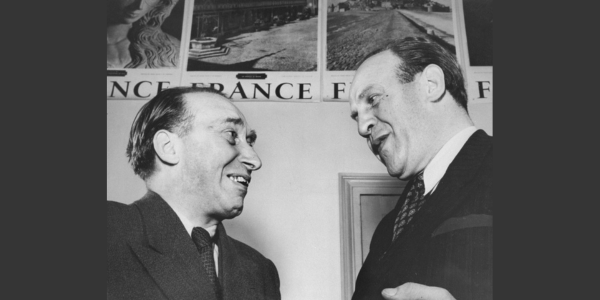
Itzhak Stern (left) had not seen Oskar Schindler for four years when he met him again in Herbert Steinhouse's Paris office. Both men were still trying to get out of Europe, 1949


Oskar Schindler is an inconvenient hero. Without question, what he did during the Holocaust was exceptional; he risked his own life, time and time again, to save over 1,300 Jews. But Schindler was no saint. He spied for Abwehr, the counterintelligence arm of the German military in Czechoslovakia, and played a critical role in helping the Nazis take over that country. He was a hard-drinking man who died of liver disease, a womanizer who neglected his wife, and after the war, he would constantly make financial demands of those he saved. Schindler remains an enigma, an exceptional hero at one period of his life who lived very differently for the rest of it.


Complicated legacies are difficult to disentangle. A figure like Paul Gauguin, who abandoned his family to pursue his artistic aspirations, still challenges those who evaluate his biography: Do his cultural contributions mitigate his moral failures? While art historians and even philosophers might be willing to overlook his flaws, his family would undoubtedly have a very different perspective.


The Talmud grapples with this question when discussing the life of Elisha ben Avuyah, who, embittered by Roman persecution, abandoned Judaism. He is called Acher, the “other one,” because the Rabbis don’t want to pronounce his name; he is seen as a traitor who abandoned the Jews in their time of need. The Talmud declares that Acher can never repent and is banished from the world to come.


Yet Elisha ben Avuyah’s devoted disciple, Rabbi Meir, prays for him to be brought to heaven; Rabbi Meir cannot bear to see a beloved teacher languish in hell. Acher is at once a despised heretic and a beloved teacher, and his legacy remains a matter of controversy.


And this goes to the crux of the matter: how complicated legacies are disentangled depends on who is looking at them. Children have a unique relationship with their parents, and both villains and heroes are seen in a very different light by their own families. (Jay Nordlinger wrote a book about the children of brutal dictators, Children of Monsters, where he explores the very different ways they see their own fathers’ legacies.)


On the other hand, how we see historical figures is in many ways a look in the mirror. Evaluations of them often vary, depending on one’s political viewpoint, and frequently change with the times. There are ample examples of revisionism, where historical assessments are modified to better fit with contemporary attitudes.


The case of the “generation of the desert” offers a lesson on how difficult it is to judge a complicated legacy. The Mishnah in Pirkei Avot says that the Jews “tested” God ten times during the 40 years in the desert; it is a time of complaints, cowardice, and betrayal. They build an idol when Moses is slow to return from Mount Sinai, they rebel against Moses' leadership during the episode of the spies and do so again at the direction of Korach.


Throughout the Book of Numbers, the Jews complain and complain again. Some of the complaints are readily understandable, such as incidents when they don't have water or food, or when they face a large army. Some of the complaints, like one in this week's Torah reading, are unreasonable; instead of being appreciative of their freedom, they begin to hound Moshe for meat.


The Hebrew word used to describe their complaining, “kimitonanim” (Numbers 11:1) elicits multiple negative interpretations among the commentaries. To Ramban, this word reflects bitterness, the broken soul of worried ex-slaves. However, Seforno sees the complainers as insincere. It is “as if” they were complaining, but not out of worry or fear; they just wanted to grumble. Ibn Ezra sees their complaint as reflecting an evil motivation; and Rashi concurs, saying the complainers were looking for a way to distance themselves from God.


In short, their incessant whining is indicative that they are lacking both character and faith. The quick and easy verdict on the generation of the desert is that they were moral failures.


However, it’s not that simple. The full story of the generation of the desert is hidden from the text. The Torah is silent about most of their lives; there are no events recorded for 38 of the 40 years in the desert. This lack of information conspires against the generation of the desert and encourages us to condemn them. We only hear about their failures, not their day-to-day lives. Certainly, they must have done some good during those 38 years. But how good were they?


This issue is debated in the Talmud (Sanhedrin 110b). It explains:


“The generation of the desert have no share in the World-to-Come … this is the view of Rabbi Akiva... Rabbi Eliezer says that (they were so pious that) about them the Book of Psalms (50:5) declares: “Gather My pious together to Me, those that have entered into My covenant.”


Rabbi Eliezer offers a revisionist view of the generation of the desert. He puts aside their complaints against Moshe and their lack of faith in God, and instead, focuses on the rest of the years they were in the desert. The Talmud explains Rabbi Eliezer was inspired by the verse in Jeremiah (2:2) which says: “Thus says the Lord: “I remember you, the kindness of your youth, the love of your betrothal, when you followed Me into the desert, in a land that is barren.” Following God into the barren desert is a profound act of faith.


What about the complaining, the times that they tested God? Clearly, Rabbi Eliezer recognizes the generation of the desert was quite imperfect. But for all their failings, this generation did continue forward; and one must recognize that survival alone is heroic for a group of runaway slaves. One needs to see the positive in a complicated legacy.


Rabbi Eliezer does offer a rather generous reading of this generation’s legacy. It is fascinating that Rabbi Akiva, the eternal optimist, the one who always sees the best in human nature, takes a hard line on the generation of the desert; as the Talmud puts it “Rabbi Akiva left behind his kindness in this case.”


Why does Rabbi Akiva do this? I would speculate that it had a lot to do with his historical perspective. Rabbi Akiva dreamt of the Jews overtaking the Romans and was the foremost rabbinic supporter of the Bar Kochva rebellion. This would require stoic courage, a willingness to battle and accept losses; survival alone would not suffice.


That is why Rabbi Akiva needed to condemn the generation of the desert. Their spinelessness and dissension are the opposite of what is needed in a rebellion. Rabbi Akiva needed his own generation to despise cowardice.


In this case, current events suggest a particular interpretation of a complicated legacy.


As I mentioned before, family members wrestle with this subject as well. In my role as a Rabbi, I’ve watched families contend with complicated legacies at funerals as they prepare for their eulogies. There are many such scenarios; some include great leaders who were abusive parents, and predatory felons who were loving husbands.


More difficult to unwind are the legacies of people whose relationships change; parents who are estranged from their children, only to reenter their lives years later, or those who go in the opposite direction, and disengage from their children later in life. Such eulogies will often latch on to the few good years at the end. (A similar perspective is offered by Teshuvah, repentance, which sees the person’s character at the end of their life to be determinative.) But not every complicated relationship follows a timeline; some have good and bad interspersed.


Rabbi Eliezer offers a different way to interpret complicated legacies. He is willing to listen to the silences in the record and hear echoes of goodness. He appreciates how difficult the position of the generation in the desert was, and yet even so, they did end up being the parents of a generation of pioneers, whom they carried to the doorstep of the promised land. There is another story hidden between the lines of the text. And in their own struggle with complicated legacies, many family members use Rabbi Eliezer’s approach.


Years ago, I performed a very small unveiling, which was attended by the late woman’s child and another friend. The woman had suffered from serious mental illness all her adult years, and she had pushed her son away from a very young age; he never had an opportunity to form a loving relationship with his mother. I asked him at the unveiling if he had any memories of her that he thought he should share. The son thought for a moment, and said he remembered one time when he was sick, his mother, concerned about his welfare, made him a cup of tea and brought it to his bed. He explained that it was the one moment that he could see through the veil of mental illness and experience his mother’s love.


In his heart, the son could hear a voice of love breaking through all the confusion of a complicated legacy.