Tuesday, July 29, 2008


Junk Food For the Soul

Nike. Hermes. Pepsi. Versace. Starbucks. Mercedes. Armani.

You know these names, and so do millions of people worldwide. They are examples of “brands”, trademarks used by manufacturers and designers to distinguish their goods. Today, brand names are a multi-billion dollar economic juggernaut that drives the global economy.

Brands may be great for business, but they’re bad for the soul. Brands used to be about quality and style, and a good brand meant a reliable high quality product. (And a brand that lost its reputation was mocked – I remember when a certain car company was ridiculed by the phrase Fix Or Repair Daily). But contemporary brands are more about image than about quality; the logo on the front of a polo shirt is a substitute for personal identity.

It’s usually wise to avoid judging a book by its cover (or as the Mishnah puts it, judge a wine by the bottle). But with brands, we are encouraged to believe that changing our cover will change our personality. Ad taglines imply that the brand’s image will become our own. If we drink Pepsi, we will “think young”, and if we buy an Apple computer we will “think different”. Nike sneakers announce that you are a proactive person who will “just do it”, and true love requires a diamond, because “a diamond is forever”. As Susan Fournier, a professor at Harvard Business School put it: "People look at brands as carriers of symbolic language and forget that a brand's first purpose is to close the sale."

Brands are junk food for the soul. The search for identity is a powerful spiritual force that encourages people to live meaningful lives. Even when man has all of his other needs met, he still needs to create a spiritual identity. As the prophet Amos says: “Behold, the days come, says the Lord, that I will send a famine in the land. Not a famine of bread, nor a thirst for water, but a hunger to hear the words of God.”. A store bought brand identity substitutes ersatz meaning in place of spiritual depth.

The glamour and glitz of brands make them far more attractive than old fashioned spirituality. People contort themselves in order to own the Porsche or buy the Rolex. Among young upper middle class couples, there is what I call a “baby vs. BMW dilemma”. Should they have another child and live more modestly, or should they curtail their family in order to lease “the ultimate driving machine”?. In a materialistic, brand intoxicated culture, too many people choose BMW’s instead of babies. (Maybe babies just need to improve their brand image!)

Like junk food, brands are a tasty little pleasure when enjoyed in moderation. But like junk food, brands can replace a healthy spiritual identity with fashionable but hollow designer vanity.

And too many people have sold their souls for a logo.


Thursday, July 10, 2008


What Do You Have When You Have Nothing?

Natural disasters have dominated the news. In June there were the disastrous floods in the Midwest, and in July, wildfires ravaged Northern California. Thousands have watched their homes and possessions destroyed.

It is particularly painful to consider the fate of those who lived outside of flood or fire “range”, and were not insured. In a matter of hours, they watched the bulk of their assets disappear, along with their homes and communities. In natural disasters like these, lives are ravaged along with the countryside.

The question that nature forces upon the survivors of these catastrophes is simple: what do you have when you have nothing? It's a question that seems absurd at first; if you have lost everything, then you truly have nothing.

Actually, those of us who live comfortably are afraid of contemplating this question. We are driven more by a fear of loss than by any possibility of gain. (This has been demonstrated by the economist Daniel Kahneman, who won a Nobel Prize in Economics for his work in this area). If fear of loss is frightening, the thought of losing everything is terrifying and unthinkable.

In loss, the unfortunate victims have nothing, and feel like they are less than nothing. Indeed, the Midrash, refers to this sentiment in saying that “poverty is like death”. Faced with extreme losses, it feels like life is not worth living; indeed, Job, after suffering the loss of his family and his wealth, is urged by his wife to curse God and commit suicide.

But this is the wrong answer. Even when stripped of everything else, people still have their character. In times of extreme stress, a person still has the courage to cope with their circumstances, and the dignity to transcend their limitations. Although impoverished and homeless, man still holds the keys to his own character.

Character is our most precious possession. Little David, a shepherd boy armed only with a slingshot, can take on Goliath because he has something Goliath lacks: character. David’s weapons are courage and cunning; weapons like these are held in one’s heart, not in one’s hands.

Dreams are another priceless possession that can never be destroyed. No matter what a person’s situation, he can still pursue his dreams. And when the dispossessed pursue their dreams, they can change the world. The Prophet Zachariah describes the messiah as poor, and riding on a simple donkey. Zachariah’s words remind us that if you want to redeem the world, you need to hold on tight to your dreams, even in poverty and hardship.

Throughout history, many have faced the question of “what do you have when you have nothing?”. Some, like Job’s wife, have given the wrong answer, and given up. But those who continue to hold courageously onto their dreams have changed the world.

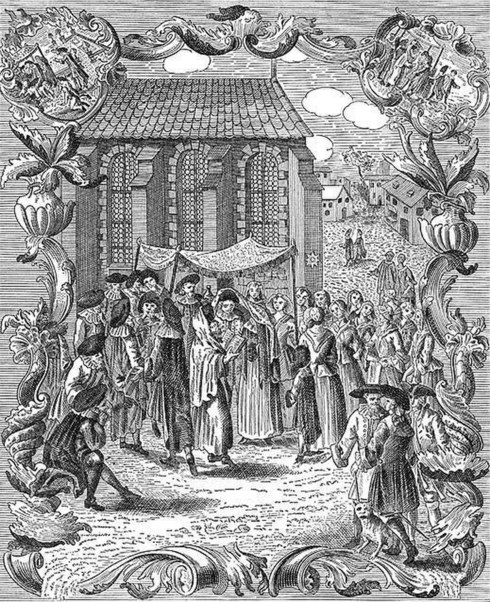
A few months ago, I visited the Museum of the Jewish Heritage in New York. On display was a special chuppah commissioned in the year 1946 by the Joint Distribution Committee. (a chuppah is a marriage canopy used in Jewish weddings). What made this chuppah unique was that it was for the use of Holocaust survivors who were marrying each other after surviving the war.

When I saw this chuppah, I was overwhelmed with emotion. How is it that people who had seen so much destruction, who had lost everything, could still get married? Isn’t it absurd to try again at life when you have nothing left? But I realized that these couples where not truly destitute and bereft; after all they had their dignity and their dreams, the most important possessions in the world. And it is these couples, with nothing else but each other, who went about rebuilding the Jewish world and succeeding beyond their wildest dreams.

These poor survivors, who had nothing in their hands, actually had everything they needed, tucked away in their hearts.

Thursday, July 03, 2008


What is “Naches”?

It is the great parental quest: to receive joy from one’s children. In Yiddish, the word “naches” (which means parental joy) is laden with emotional connotations, the result of generations of immigrants dreaming of their children’s success.

To many Jews of a certain era, naches was defined by four simple words: “my son the doctor”. This particular parental obsession was often lampooned for going overboard. One joke is about an apocryphal birth announcement that declared “Mr. and Mrs. Irving Goldberg are pleased to announce the birth of their son, Dr. Jeffrey Goldberg.” Jokes aside, the mindset of “my son the doctor” gives a distorted picture of what the parent-child relationship is about.

Pushing a child in order to provide the parent with pride can have destructive consequences. Elisha, a second century Rabbi, is chosen by his father Abuya to become a Rabbi so that Abuya could impress others with his son’s ability. Elisha does become a great Rabbi, but in an era of Roman persecutions, eventually crumbles and becomes a heretic. Unfortunately, Elisha’s studies left his soul empty because they were intended to impress his father. In the end, neither father nor son had any naches.

This uglier side of “getting naches” is what psychologists call “achievement by proxy syndrome”. A parent with simple achievements sees his child, the prodigy, as a ticket to greatness. The parent-child relationship is then reduced to a puppet show, with the child acting as the parent’s puppet, dancing to the tune of the parent’s dreams. In the end, both parent and child lose their souls and insanity ensues.

Achievement by proxy syndrome leads to a multitude of dysfunctions. There are violent altercations between fathers and coaches over the proper treatment for athletic prodigies; there are parents who quit their own careers in order to manage their children’s “talent”. And the child ends up paying dearly for a childhood in a pressure cooker; indeed, Macaulay Culkin and Jennifer Capriati are poster children for the excesses of “achievement by proxy syndrome”.

True naches is not about getting, it’s about giving. The real joy in parenting comes from being a true parent. A parent’s role is to give guidance and impart wisdom to one’s children. When the Bible tells the child “Hear, my son, your father's instruction and do not forsake your mother's teaching”, it is reminding us of the parent’s greatest role, as a teacher.

Randy Pausch is a college professor and father of three young children, who was diagnosed with pancreatic cancer in the summer of 2006. After going on permanent leave, he returned to university to deliver one final presentation based on the wisdom he had learned from life experience. This lecture that became a youtube sensation (and later a bestselling book) called “The Last Lecture”. Pausch explains in the forward to the book that the lecture was his way of “bottling” the life lessons he wanted to impart to his children as they grew up.

Pausch’s book is an exercise in true naches; it’s a dying father’s way of giving his children a legacy of authentic wisdom.

Most importantly, naches is about love. Parents transform the lives of their children when they show dedication and devotion to them. And the parents that do this the most are the parents of the developmentally disabled. Unfortunately, they often stand alone in their efforts.

Until recently, a child with cognitive impairments didn’t have a Bar-Bat Mitzvah. Synagogues were too rigid and formal to accommodate the needs of the developmentally disabled. But that is changing. In Boston, a program called “Gateways” has enabled dozens of developmentally disabled children to have their own innovative Bar-Bat Mitzvahs. I myself have been involved in several Bar-Bat Mitzvahs like this, and there is no question that there are powerful emotions in the air. You can sense the love, you can sense the family’s dedication, and as the young man finishes his carefully rehearsed presentation, you can sense something else as well:

Authentic naches.

Wednesday, May 28, 2008


Article = Combination of Two Posts

This column is the combination of this post and this post. (Due to space limitations, I have to cut each post, leaving out some important stuff, though.)

The Humble Hero

Why be humble? It seems so passé. The word “humility” immediately conjures up the medieval image of a cringing, cloistered clergyman, subsisting on breadcrumbs and brackish water. This sort of self-abnegation seems out of place in the 21st century, where self-promotion and self-indulgence are the norm. Humility can only get in the way of “exercising leadership” or “promoting your personal brand”.

We reject humility out of ignorance. Being humble has nothing to do with being meek, or lacking in self confidence. In fact, humility is the hallmark of any true hero. The humble hero doesn’t aspire to glory, or even humility; he simply wants to do his job. Or, as the Mishnah puts it:

“Rabban Yochanan ben Zakkai would say: If you have learned a great deal of Torah, don’t take credit for yourself---it’s for this reason that you were created.”

This Mishnah teaches us that authentic responsibility is not pursued in order to attain glory. The truly humble live to achieve lofty goals, but make little of it; they see themselves simply as doing what is expected of them. Their attitude is that they are “just doing their job”.“I’m just doing my job” is the motto of humble heroes. Their humility is based on a work ethic which drives them to succeed in silence, content to have accomplished what life expected of them.

On May 12th Irena Sendler passed away. During World War II, Irena, a young mother and social worker, was a member of a Polish underground devoted to saving Jews. With great courage and cunning, Irena used her position to smuggle 2,500 children out of the Warsaw ghetto and hide them in orphanages.

Reading the obituaries about Irena, it’s hard not to notice the differences between this humble woman and today’s erstwhile heroes. Our contemporary heroes are celebrities, people who look good on baseball diamonds, on movie screens and on the red carpet. The “entertainment media” breathlessly follows their every move. These celluloid heroes have our undivided attention, and are famous for being famous.

In actuality, a real hero doesn’t look good; they do good. And after they’ve done good, they don’t revel in self congratulation, but rather think about what more they could have done. After receiving a long overdue award from Poland in 2007, Irena declared:

"I could have done more…..this regret will follow me to my death.".

Irena is a genuine hero. Like all humble heroes, she was “just doing her job”. Or, to put it in Irena’s words:

"Every child saved with my help and the help of all the wonderful secret messengers, who today are no longer living, is the justification of my existence on this Earth, and not a title to glory."

I wish the justification for my existence on earth was as good as Irena’s.

Thursday, May 22, 2008

The Survivors vs. Hitler

In a recent article in Newsweek’s My Turn, Shirley Paryzer Levy writes about her late father:

"When my father felt the end was near, he started to obsess about his past. He decided that if he didn't start talking about the Holocaust, who would remember? He made a series of audiotapes beginning with his life in Europe, leading up to the Holocaust and ending with his wedding to my mother in Germany in 1946……
I don't know if he felt the Nazis would rise again, but I know for sure Hitler never left him. A friend of mine who recently lost her mother told me that two weeks before her death, her mother started acting in a way that made my friend think she was hallucinating about being back in a concentration camp. She was once again being tormented by the Nazis. We agreed Hitler got her in the end. Just as he got my father. Hitler didn't end at 6 million. He is still killing the Jews. It is 6 million and counting."

While I can feel her pain, I cannot accept Paryzer Levy’s conclusion. Hitler killed 6 million, and scarred millions more. Yes, some survivors were so emotionally crippled they were unable to reenter society. However, most did their utmost to triumph over Hitler. Indeed, this week I officiated at a funeral of someone who lost his entire family in the war, yet immediately after the war started all over again, intent on rebuilding his life and his family.

So why do so many survivors fixate on the Holocaust? Wouldn't it be emotionally healthier just to "get over it"? I think that for many survivors memory is a personal responsibility. Having faced the ultimate evil, they feel uniquely responsible to live. For them, the biblical responsibility to “remember what Amalek did to thee” spurs them to live, to ensure that evil is defeated. These memories are not the reminiscences of bitter people consumed by inner demons, but rather a motivation for the wounded and scarred survivors to summon the courage to triumph over evil. Success was far from uniform; indeed, the great chronicler of the Holocaust Primo Levy, committed suicide in 1987, 42 years after the end of World War II. But by building families, retelling stories, and recreating Jewish community, the survivors emerged victorious in their encounter with Amalek.

The Holocaust ravaged the Jewish community; Hitler very nearly succeeded in his goal to destroy world Jewry. However, looking back at the last 63 years, the survivors have shown that they had the commitment and toughness to outlast the unimaginable and rebuild a community. Or as Benjamin Mead, a survivor, said to a gathering of fellow survivors in 1995:

“He tried to kill us, and he lies in the ground. And we are here”.

Monday, May 19, 2008

“Just Doing My Job”: Humble Heroism

Why be humble? It seems so passé. The word “humility” immediately conjures up the medieval image of a cringing, cloistered clergyman, subsisting on breadcrumbs and brackish water. The self-abnegation of classical humility seems centuries out of place in the 21st century, where self-promotion and self-indulgence are the norm. Humility can only get in the way of “exercising leadership” or “promoting your personal brand”.

It’s a shame we reject humility out of ignorance. A truly humble man is not meek, and does not lack in self confidence. Indeed, the humble man doesn’t aspire to glory, or humility; he simply wants to do his job. As the Mishnah in Pirkei Avot puts it:

“Rabban Yochanan ben Zakkai would say: If you have learned a great deal of Torah, don’t take credit for yourself---it’s for this reason that you were created.”

This Mishnah teaches us that studying Torah, like any responsibility, should not be about fame and glory. The Mishnah also reminds us that the truly humble are interested in doing, not in being. They live to labor and achieve, but make little of it; they see themselves simply as doing what is expected of them. Their attitude is that they are “just doing their job”.

On a recent trip to Israel, I couldn’t help noticing how authentic heroes, from the soldier who just returned from hazardous duty as a sniper, to the guide who spent 25 years in a special ops unit, to a retired general whose heroism was critical to saving Israel from disaster in the Yom Kippur War, were all reluctant to speak about their exploits, and deflected praise by saying they just were doing what they were supposed to. They were self confident and successful, without a hint of self-promotion. They were humble, but not meek.

“I’m just doing my job” is the motto of humble heroes. Their humility is based on a profound work ethic which drives them to succeed in silence, content to have accomplished what life expected of them.

Monday, March 31, 2008


The Death of Shiva

Death used to make us act like grownups. Funerals required black suits, solemn expressions and somber eulogies. Even pointless traditions regarding death were carefully preserved; to this day, many English communities still use a horse drawn carriage as a hearse, in an attempt to recreate the ambience of a Dickensian era burial.

The 21st century has no patience for lugubrious traditions. It’s time to lighten up!! Now funerals need panache, theatre, and a dollop of laughter. Mourning is no longer a deep felt emotion; now, it’s a performance art!! And of course, let us not forget, the funeral is not supposed to be sad – it should be a “celebration of life”.

Forgive me my sarcasm. I appreciate why the old style funeral, more funereal than real, failed to be meaningful. Remote, wooden clergymen delivered incompetent eulogies while family members squirmed silently in their seats. Tears were banned, in order to maintain “the dignity of the service”. However, in reaction we have gone too far. Indeed, in many ways, we have perverted Judaism’s spiritual mourning practices into a fast paced pop psychology “happy meal”.

Falling by the wayside is the significant practice of observing Shiva. “Shiva” means seven, referring to the seven days that mourners refrain from any outside activities and sit on the floor and mourn. As reported in this article in the Globe and Mail (March 27th), shivas are becoming less and less common. Sadly, we are now observing the death of shiva.

Shivas are disappearing due to impatience and superficiality. Everything today must be high speed: internet, e-mails, even emotions. No one has an entire week to “disconnect” from work.

Even worse is the plague of superficiality. The mourning practices of shiva have been dangerously mixed up with psychological explanations. People think that somehow the purpose of the shiva is to bring the mourners consolation; indeed, I often hear testimonials to “how good” the shiva makes the mourners feel.

This understanding of shiva is at best half true. It is correct that there is a rabbinic commandment for friends to visit the mourners during the shiva; and yes, it is the friends’ responsibility to help console the mourners. This is why visitors come to the shiva house, but it is not the purpose of the shiva itself.

The actual purpose of shiva is for mourners to mourn, for a bereaved family to express their pain. And mourning in Judaism has a simple goal: to honor the deceased. (Indeed, when a person is buried on the intermediate days of Passover or Sukkot, the period for visitations begins immediately, while the actual mourning begins after the holiday – Shulchan Aruch Orach chaim 568:6)

At shivas, the families put their lives on hold for a week to grieve over a relative’s death and contemplate their legacy. The week of mourning publicly expresses that the family truly misses the person who has passed away. This is why the shiva is an act of honor: to be mourned, to be remembered, to be missed, is to be loved and respected.

By viewing shiva purely as a palliative for the mourners’ pain, we have transformed a sacred obligation into a vintage form of psychotherapy. Shivas are essentially grandma’s recipe for consolation, best stuffed away in a closet when the almighty Blackberry beckons. Indeed for many, all this mourning is a drag.

Tragically lost is a sense of obligation to the deceased. Often, the phrase “celebrating life” is usually just an excuse for the family to avoid mourning. Instead of honoring the deceased, we choose to honor our appointments.

The death of shiva affects us all, Jewish or not. What has really disappeared is the ethics of memory, the responsibility to remember others. In a world of high speed narcissism, the dead are tossed by the wayside while we go on “celebrating life”.