Friday, January 06, 2023

The Purpose of Pessimism, The Practice of Optimism


Jacob Blesses His Sons; illustration from the 1728 Figures de la Bible; illustrated by

Gerard Hoet (1648-1733) and others


Complacency has a habit of making intelligent people look like fools. In 1909, Norman Angell published The Great Illusion, which, (to quote John Keegan) "had demonstrated, to the satisfaction of almost all informed opinion, that the disruption of international credit inevitably to be caused by war would either deter its outbreak or bring it speedily to an end." Five years later, the bloodiest war in world history (until that point) would take place. Yet even the World War was not enough to bring Angell's thesis into question; in 1933, he would be awarded the Nobel Peace Prize for this book, the only one ever presented to an author. Hope often triumphs over experience.


Angell was a firm believer in progress. But others are far more skeptical of utopian narratives because life is too unpredictable and human nature too erratic to expect unending progress.


Right now, sunny optimism seems out of touch. The last decade has ushered in extreme political polarization, a new Cold War, a ground war in Europe, and a pandemic; pessimism is beginning to make a lot more sense. In September 2021, Niall Ferguson challenged Steven Pinker to a wager. Pinker, a cognitive psychologist, had written The Better Angels of our Nature, which argued that humanity has become progressively less violent. Ferguson, a historian, rejected this thesis, and bet Pinker that "by the end of this decade, Dec. 31, 2029, a conventional or nuclear war will claim at least a million lives." Tragically, Ferguson’s wager doesn't seem all that ridiculous anymore.


Jews sit uncomfortably at the crossroads of progress and pessimism. Judaism emphasizes hope and the possibility of a better future. It requires one to seek repentance and self-improvement, and believes in the coming of the Messiah and the ultimate redemption of humanity. The continued existence of the Jewish people itself is the product of optimism; as the Talmud points out, having a Jewish baby during periods of persecution was a supreme act of hope.


While optimism is wonderful in theory, Jewish history has repeatedly taught the lesson of pessimism. In the years before the Holocaust, too many Jews took comfort in the status quo and thought they could simply wait Hitler out. A major Jewish charity event took place at Berlin's Cafe Leon on January 30, 1933, the day when Hitler was appointed Chancellor of Germany. Among all the representatives of Jewish organizations that spoke at the event, only the Zionist Rabbi Hans Tramer spoke about Hitler. Saul Friedlander, in Nazi Germany and the Jews, quotes a newspaper report that Tramer’s "speech made no impression. The entire audience considered it panic-mongering."


The Jewish leaders at Cafe Leon were blinded by their own optimism, and couldn’t see the danger right in front of them. In her book on Jewish humor, Ruth Wisse relates the following quote: "We used to say that there were two kinds of German Jews: the pessimists who went to Palestine, and the optimists who went to Auschwitz." There are times when pessimism is important.


Balancing pessimism with hope is the theme of Parshat Vayechi. On the surface, the end of Genesis is upbeat; Jacob’s family is growing by leaps and bounds, becoming wealthier and entrenched, and Joseph is the Viceroy of Egypt. If one could stop right here, the story of the Jews in Egypt would conclude as one of comfort and contentment.


When Jacob passes away, he is mourned for 70 days by all of Egypt, and given a hero's funeral. The Torah describes at length the scene at Jacob’s burial in order to emphasize the elevated status of the emerging Jewish community. A large leadership delegation, including a military guard, accompanies Jacob's casket from Egypt into Canaan (which was presumably an Egyptian vassal state at the time). Then, "they came to the threshing floor of Atad, which is beyond the Jordan, and they mourned there with a great and very solemn lamentation….and when the inhabitants of the land, the Canaanites, saw the mourning at the threshing floor of Atad, they said, 'This is a deep mourning of the Egyptians.' Therefore its name was called Abel Mizraim…" (Genesis 50:10-13) The Egyptian funeral for the patriarch of the Jewish people is so large and dramatic, a city is named for it. Isn't this the very definition of success?


Yet behind the scenes, there are quiet whispers of skepticism. When Jacob requests to be buried in the family plot in Israel, he adds an additional phrase: “Please do not bury me in Egypt” (47:29.) Jacob rejects Egypt, even as a place of temporary burial. As the Ralbag points out, Jacob is profoundly disturbed by Egyptian society and wants to disassociate himself from it. At the very end of the Torah reading, Joseph hints more directly at the impending doom, and says, “God will surely come to your aid and take you up out of this land...” (50:24) Divine intervention will be needed to return the Jews back home.


A thought-provoking Midrash is cited by Rashi at the beginning of the Torah reading. It notes that Vayechi is the only Parshah that begins in the middle of a paragraph. Rashi explains: “Why is this Parsha totally closed? Because, as soon as our father Jacob passed away, the hearts and eyes of Israel were closed by the misery of the bondage which the Egyptians began to impose upon them. Another reason is because Jacob wished to reveal to his sons the date of the End of Days (i.e., redemption), but this vision was closed from him.” The middle of a paragraph is all closed up, with no window through which to see anything positive; and that is the ambiance of Parshat Vayechi, in which the gloom of exile slowly descends upon Jacob’s family.  


A closer look at the Biblical text uncovers the literary brilliance of this Midrash. The final words of the previous Parsha, Vayigash, are: "And Israel settled in the country of Egypt, in the region of Goshen; they acquired landholdings in it, and were fertile and increased greatly." (47:27) In a sense, this report of prosperity is “edited out” of the Parshat Vayechi, which begins instead with the following verse that introduces Jacob’s impending death. The starting point of Vayechi declares: Here begins the tragedy. With Jacob’s death, the golden age in Egypt will come to an end.


Jacob’s family in Egypt live a split-screen reality, of outward success and inner fragility. It is the sort of situation where a pessimist will find plenty to worry about. Jacob's family has a relationship with Egyptian society that hinges on one man, Joseph; and they are also expanding rapidly, which will test the hospitality of their hosts. Eventually, in a bitter reversal of fortune, these aristocrats will become slaves, and endure exile in their adopted homeland.


So how does one prepare for exile? Jacob chooses an unusual method: He blesses his family. What makes this particularly odd is a fascinating biblical parallel. There are only two times when the tribes of Israel are blessed; once by Jacob before they enter exile, and then again by Moses before they enter the land of Israel.


Moses' blessing seems to be well-timed; blessings belong to new beginnings, to a people about to return to their homeland. Yet in Vayechi, as his family stands on the threshold of a 400-year exile, Jacob blesses them as well. And that is strange.


But Jacob's blessings are intended to extend hope. Yes, he recognizes that exile is about to arrive; but it is precisely during times of despair that one must practice optimism.


Jacob wants to offer a preview of the blessings that the twelve tribes will receive before they enter the land of Israel; he wants to ensure that they never forget where their home is, and never forget that they are blessed.


Parshat Vayechi carries a paradoxical lesson: in times of prosperity, consider pessimism, and in times of despair practice optimism. Pessimism is a necessary corrective to the irrational exuberance of heady times; optimism is a spiritual practice, which sustains the soul when one's blessings have otherwise evaporated.


In Hasidic Tales of the Holocaust, there is a story entitled "Fine Generations." It relates an anecdote about Bronia Koschitzki, who together with her two sons, aged six and three, were trapped in the Bochnia Ghetto. There was a Hasidic Rebbe in the ghetto to whom people came at all hours to ask for blessings. Bronia came with her two sons for a blessing as well. Initially, the Rebbe gave them a generic blessing “that God will help.” Bronia pressed for something better, and requested that the Rebbe offer her the blessing of “fine generations in the future.” The other people in the room murmured, thinking Bronia was insane; at a time when children were being rounded up and murdered, she was asking for a future of fine generations!


But the Rebbe obliged, and gave her a blessing for a fine future; and Bronia and her children did survive. As she was interviewed for the book, surrounded by her children and grandchildren, she noted that “in a time of war, one has to organize everything, even a blessing.”


Jacob does this as well. As exile closes in, he organizes a blessing for his family, a beacon of hope that will carry them through a bitter exile. Pessimism has its purpose; but during the darkest of days, one must insistently practice optimism, and never let go of hope.

The Problem of Other Jews


Judah supplicates Joseph about the cup

(The Phillip Medhurst collection of Bible illustrations)


A rabbinic colleague of mine was introduced to Jimmy Carter at a cocktail party in the early 1980s. Carter spoke with pride about all that he had done while President, on behalf of Soviet Jewry. My friend, who has a bit of chutzpah, turned to Carter and asked him: "And what did you do for the Pentecostalists in the Soviet Union?" Carter was stunned by the question and simply changed the subject.


Carter is an evangelical Christian, and the Soviet Union had imprisoned thousands of evangelical Christians. One would imagine Carter would have taken a particular interest in his fellow evangelicals; instead, because American Jews had mounted a massive campaign on their behalf, Carter put Soviet Jewry at the top of his foreign policy agenda instead.


But the real question isn’t about Carter, and what he did or didn’t do for Soviet Pentecostalists; it’s about the Jews. What is it that motivates one Jew to do so much for their fellow Jews, even though they are total strangers? Why were there massive campaigns in the United States for Jews who lived thousands of miles away?


This attitude is not new; through the centuries of exile, Jews extended caring and benevolence to fellow Jews around the world. In the medieval era, Jewish communities came to the aid of the brethren around the world and undertook significant fundraising campaigns to ransom captives and support refugees. Maimonides explains that this unique bond is based on Jewish self-image. The Jewish community sees itself as a family writ large, as a group of brothers and sisters; therefore, one is obligated to give generously to charity because “if a brother does not show compassion for another brother, then who will have compassion for him?" (Matanot Aniyim 10:2.)


With the emancipation of the Jews in the 19th century, solidarity became a nuisance. Jews were granted rights, but still craved acceptance; and in order to do so, they had to prove their patriotism. Too much fervor for foreign Jews led to accusations of disloyalty. French Jewish advocacy for the Ottoman Jews who had been imprisoned in the Damascus blood libel brought a harsh response from critics, who saw this as an act of disloyalty to France. Julie Kalman of Monash University notes that to French critics, “it was a crime simply that French Jews should publicly show sympathy for the accused Jews of Damascus.” (Yes, accusations of dual loyalty against Jews predate the State of Israel.)


In this environment, many Jews were tempted to look inward and let go of their global family. The leader of the German Reform movement, Abraham Geiger, wrote in a letter to his friend Joseph Dernburg regarding the Damascus blood libel that (whether) Jews in Prussia may have the chance to become pharmacists or lawyers is much more important to me than the rescue of all the Jews in Asia and Africa … (It should be pointed out that Geiger did advocate on behalf of the Damascus Jews on humanitarian grounds.) When one believes that they must choose between being loyal to their Jewish brothers or to the German fatherland, the worldwide Jewish community can seem like too large a burden to bear.


In many people, this challenge eroded a true sense of Jewish kinship. The early 20th-century German-Jewish novelist Jakob Wassermann wrote about his discomfort with Ostjuden, the Jews from Poland, Hungary, and Russia, whom he saw as peculiar in their dress, language, and names. Wasserman viewed the Ostjuden as foreigners, explaining that if I spoke with a Polish or Galician Jew and tried to understand his way of life and thinking, I could stir myself to feel compassion or sadness, but never a sense of brotherhood. He was entirely strange and, when individual human sympathy was lacking, even repulsive. Wassermann explained that the Ostjuden and German Jews were so different that one could say: Are those not two distinct species, almost two distinct races, or at least two distinct modes of life and thought? Anxiously grasping on to their newfound freedom, some Western European Jews abandoned their brothers and sisters in other countries.


A different problem with Jewish solidarity arose in the Orthodox community. Almost overnight, Orthodox Jews became a minority of the Jewish population in Western Europe. This shocking change left them worried about the future of Judaism. Rav Saadia Gaon, the 10th-century Jewish philosopher had declared our nation is only a nation by virtue of its Torah; one could argue that those Jews who had left the Torah were leaving behind the Jewish people as well. Some proposed a complete divorce between the Orthodox and Reform communities. The Chatam Sofer, Rabbi Moshe Sofer, argued that just as the Pharisees had separated themselves completely from the Sadducees, so too should Orthodox Jews completely separate themselves from those in the Reform community; marriage between the two communities should be forbidden. The Chatam Sofer's student, Rabbi Moshe Schick, offered a more disturbing metaphor, saying that in multiple areas, the Reform community should be treated as non-Jews in the eyes of halakhah.


In short, after the enlightenment, religious differences and national loyalties divided Jew from Jew; and for the first time, Jewish solidarity was no longer a given. But what is remarkable is this: despite everything, the vast majority of Jews maintained a profound sense of connection to each other.


The reason why this happened is because Jewish identity comprises both religious and national identities at once. Rabbi Joseph B. Soloveitchik, in his essay Kol Dodi Dofek, explains that two foundational covenants created the Jewish people: the covenant of fate and the covenant of destiny. The covenant of fate was enacted in Egypt, a place of shared suffering and shared redemption. The covenant of destiny was enacted at Mount Sinai when the Jews took upon themselves the mitzvot and joined in a shared spiritual destiny.


The covenant of destiny is the foundation of Jewish religious identity. However, after emancipation, this covenant became a source of division.


But the covenant of fate is shared by every Jew. Rabbi Soloveitchik explains that throughout history, Jews have endured the hatred of the world. Every Jew can empathize with the plight of their fellow Jews because they know that they themselves may one day be victims of antisemitism. Shared suffering has created a powerful bond of connection.


In recent years, the Talmudic phrase Kol Yisrael Areivim Zeh Lazeh, "all Jews are guarantors for each other," has become a common way of expressing this covenant of fate. On the face of it, it is an unusual choice to express national identity; Rav Soloveitchik points out that Kol Yisrael Areivim Zeh Lazeh is a narrow halakhic concept, meant to explain that each Jew is responsible to ensure the religious observance of other Jews, much like a guarantor ensures that another person’s loan is repaid. So how did this become the slogan of Jewish solidarity?


I believe it is due to a passage in this week’s Torah reading, which very well could be the founding moment of the Jewish nation.


The sons of Jacob are grappling with a terrible crisis. They are desperate for food, which, because there is a famine, is only available in Egypt. The Viceroy of Egypt, (whom they don't know is their brother Joseph,) has demanded that they bring their youngest brother Benjamin down to Egypt. Jacob refuses to let go of Benjamin, frightened that he will die, just as his brother Joseph had. After much back and forth, Judah finally convinces his father to entrust Benjamin in his hands by saying: I will be his guarantor.


When they return to Egypt, Benjamin is framed for the crime of theft. As punishment, the Viceroy wants to take Benjamin as his slave. Then Judah approaches. He explains that he given a guarantee to his father that Benjamin would return home; he then requests of the Viceroy: Please let your servant remain as a slave to my lord instead of the boy, and let the boy go back with his brothers….


This moment changes everything. Judah has come full circle to complete repentance. It was Judah who suggested selling his brother Joseph into slavery in the first place; and now he's the one who is willing to become a slave to protect Joseph's younger brother Benjamin. Joseph, who is deeply touched by this repentance, breaks down and reveals himself to his brothers. In the end, a broken family is repaired by a heroic act of solidarity.


Jacob’s family should have fallen apart, collapsed by the cumulative weight of lies, rivalries, and envy. But it doesn’t, because Judah shows us the importance of being our brother’s keepers. And at this moment, the foundation for a nation is set. Judah’s declaration that he will be his brother’s guarantor has inspired generations of Jews to do the same.


One final point must be made. One can imagine that Jewish solidarity is pragmatism, that banding together is necessary for survival; or perhaps it is just based on sentimentalism and nostalgia. But Jewish solidarity is more than that. It represents a glimpse of a profound unity that, one day, will hopefully belong to all of humanity.


Rabbi Sharon Shalom, (an Ethiopian Rabbi and author) related the following story to me. In the late 1970s, Sharon fled with thousands of other members of the Beta Israel community to Sudan. There, they lived in makeshift refugee camps, which were treacherous and dangerous.


Sharon and his fellow refugees were rescued as part of the Mossad’s “Operation Brothers.” The Mossad operated a beach resort called “Arus” as a front, and every few months would enter the refugee camps and smuggle out a group of children. They would slip onto the beach in the middle of the night, where Israeli commandos would take them to a waiting boat, which then sailed to the Sinai.


Sharon remembers how that night, he was picked up by a big Israeli commando, who hugged him tightly as he carried Sharon to the boat; and Sharon remembers how the commando had tears in his eyes.


Sharon was a young boy, and greatly respected those who were big and strong. He couldn't understand why this brave commando would be crying.


Now he understands.


But the story continues. A few years ago, Sharon got a call from a member of the Mossad, who had been the commander of the operation that took Sharon to Israel. The Mossad agent said that his daughter was getting married, and he wanted Sharon to be the rabbi at the wedding.


At the chuppah, everyone had a good cry - the Rabbi, the Mossad commander, and the bride and groom. These were the tears of a big family reunion, a reunion that brought together Jews from around the world.


These tears are Judah’s tears. They reflect a Jewish commitment to stand in solidarity with other Jews, no matter how different and distant. And maybe one day, they will be a model of how the entire world can transcend their own differences.

Friday, December 23, 2022

The True Meaning of Christmas, for Jews


Christmas and Chanukah decorations in Berlin

(Photo credit: Leonhard Lenz December 11, 2020


What is the true meaning of Christmas?


This question is the topic of numerous holiday sermons around the world. To sincere Christians, the materialism of the shopping season undermines Christmas, so the devout shift their focus to the spiritual message of the holiday. But for American Jews, Christmas has a very different meaning, complicated by history and demographics.


In medieval Europe, Christmas was a time of fear and loathing for Jews. During the rest of the year, the Jews were an embattled minority; on Christmas, they were absolute pariahs. The Chaumont Christmas play of the 1200s depicts Jews as true devils, and antisemitic attacks often occurred in and around Christmas. For example, blood libels took place on or around Christmas in Fulda, Germany in 1235, in Judenberg, Austria in 1312, and in Le Puy, France in 1321, and a steady stream of Christmas related riots and pogroms continued through the Middle Ages.


Jews responded to this outpouring of hatred with bitterness. In Yiddish, Christmas Eve is known as “Nittel Nacht,” which is derived from the medieval Latin "Natale Domini." On Nittel Nacht, many Jews would play cards instead of studying Torah. This custom is intended as a spiritual boycott of Christmas, a way of preventing one’s Torah study on that day from inadvertently being considered a spiritual merit for the founder of Christianity in the divine court above.


The United States is the polar opposite of medieval Europe and has by and large been a true refuge from antisemitism. But Jews found that being accepted into a largely Christian society created new tensions. The public celebrations of Christmas, which were commonplace in schools and town halls until the 40s and 50s, challenged Jews to find inventive new ways to fit in. Janice L. Booker recalls the customs of Jewish public-school students in 1930’s Philadelphia: “Anunwritten, unspoken agreement among the Jewish kids was that when we sang the carols, lustily and with pleasure, we kept our lips sealed when the name of Jesus Christ was mentioned. To my knowledge, no parent ever asked for this, and no one discussed it; it just was.” How can you be Jewish and sing a Christmas carol? Just cut out part of the lyrics.


This “solution,” which is neither here nor there, epitomizes the uneasiness and uncertainty many Jews have felt about Christmas. In 1958, the United Synagogue Commission on Education published a pamphlet entitled "Our December Dilemma," about the social pressure that Jewish children feel during the holidays. Written by Rabbi Abraham Karp, a leading Conservative rabbi, it included a set of scenarios that Jewish children in public schools might confront during the holiday season and advised the students how to politely avoid being drawn into school Christmas celebrations.


Karp’s answers are rooted in a discomfort with Christmas that has profound theological roots. Medieval rabbis debated whether or not Christianity is considered to be idolatry; if it were categorized as such, it would, among other things, forbid Jews from selling holiday supplies to Christians before Christmas. And while a consensus later emerged to consider Christianity as monotheistic, many held certain restrictions in place. Rabbi Moshe Feinstein ruled that schools should not close on Christmas or even for the following week, because that would acknowledge Christmas as a holiday. He even advised people to avoid making weddings and Bar Mitzvahs on Christmas Eve. (Rabbi Feinstein’s ruling has changed the school schedule of many day schools, which now have a “Yeshiva break” in the winter.)


For most American Jews, the December Dilemma is not just about theology. Jews at Christmas feel like an uninvited guest at a party, the man stuck outside in the cold pressing his face against the window. Hanukkah has become the Jewish Christmas with plentiful presents; and, many Jews embraced the Hanukkah Bush, essentially a Christmas tree repackaged with a Hebrew wrapper. (The Maccabees, warriors against Hellenism, would not have been amused). In 1895, even after publishing The Jewish State, Theodor Herzl had a Christmas tree in his home. In his diary, he records that a prominent rabbi, Moritz Gudemann, came to visit, and expressed criticism of the tree. Herzl responded, “I was just lighting the Christmas tree for my children when Gudemann arrived. He seemed upset by the "Christian” custom. Well, I will not let myself be pressured! But I don’t mind if they call it the Hanukah tree— or the winter solstice.”


The “Hanukkah Bush” became popular in the late 19th and early 20th century among assimilated Jews. But even more traditional Jews still find the siren song of Christmas too difficult to resist. Cindy Chupack proclaimed in a 2006 article in The New York Times that she decided to celebrate Christmas because she was overwhelmed by a desire for Christmas Decorations and Stocking Stuffers, mainstays of a holiday virtually every other American celebrates. Chupack reminds us that the December dilemma is actually a year-round dilemma: How will Jews maintain their identity in the face of a seductive and embracing culture? Ironically, a religious tradition that has heroically triumphed over persecution and oppression is finding it ever more difficult to overcome acceptance and tolerance.


The “December Dilemma” belongs most to Jews who take the middle road. Deeply Orthodox Jews find no need to concern themselves with someone else’s holiday; some even continue the custom of “Nittel Nacht,” treating 21st century America like medieval Europe. More liberal Jews increasingly accommodate Christmas; a 2013 survey found that 32% of American Jews have a Christmas tree. It is those, who, to use the words of Rabbi Haskel Lookstein, are “a part of the world, while at the same time standing apart from the world,” who must consider how they will respond to Christmas, and what direction they will give their children during this time. I believe that there are two lessons that Jews need to remember over Christmas. The first is darkei shalom, ways of peace. This is a Talmudic principle that Jews are required to embrace their responsibility to the larger community, and to treat everyone with kindness and friendship; one can even put aside certain halakhic prescriptions to do so. I believe that the obligation of darkei shalom is even more significant today, in 21st century America.


American Jews must be grateful that we live in an era like no other in Jewish history, where they are fully embraced as citizens, and have taken leading roles in this country. And we should share that gratitude with others. In an article in the New York Times several years ago, several Jewish professionals explained that they cover extra shifts on Christmas and New Year’s to enable their colleagues to celebrate Christmas at home. Dr. Robert van Amerongen, an Orthodox Jew who was at the time director of pediatric emergency service at New York Methodist Hospital, told the newspaper that“although he is senior enough to be able to take Christmas off…. he always works. 'That just infuses good will,' he said.”


Good will, or darkei shalom, is something precious. And for Jews who live in peace in countries that practice the ways of peace, good will is certainly part of “the true meaning of Christmas.” The second lesson, which takes the concept of darkei shalom a step further, is Kiddush Hashem, sanctifying God’s name. As Samson Raphael Hirsch points out, living in the Diaspora offers Jews daily opportunities to be a light unto the nations. Each day, Jews can sanctify God’s name with acts of kindness. And there’s no better time for this than Christmas.


Rabbi Berel Wein tells a powerful story he heard from an editor at the Detroit Free Press. During the Great Depression, the editor’s mother, a recently arrived Irish woman, got her first job as a housekeeper with a prominent Orthodox Jewish family. The family went away on vacation, leaving behind their new housekeeper; they were due to return on December 24th. The housekeeper, who had never met any Jews before, decided to make sure that her employer’s home was set up properly for Christmas, so she went out and bought a Christmas tree and decorated the home from top to bottom. Arriving home, the family was stunned by what they saw. What would their friends think? The father, however, responded differently. He took the new housekeeper aside, and in a gentle voice said to her: "In my whole life, no one has ever done such a beautiful thing for me as you did." He then took out a $100 bill, a remarkable sum at the time, and gave it to the housekeeper. Only later did he sit down and explain to her that Jews do not observe Christmas. The Jewish man’s dignity and kindness made such an impression, that the housekeeper’s son continued to tell the story forty years later.


This is what Christmas can teach us about being Jewish. During the holiday season, Jews can dedicate themselves to helping others, like the elderly Holocaust survivor I knew who each Christmas would distribute blankets to the homeless. We can do small acts of kindness and charity for those in need. And maybe, if Jews rediscover their mission of being a light unto the nations, Christmas lights will not be a challenge, but rather an opportunity.

Friday, December 09, 2022

The Courage of Ordinary People


Rembrandt, Jacob wrestling with the angel, 1659, oil on canvas


For centuries, antisemites have libeled the Jews as cowards. During World War I, rumors circulated among the German public that the Jews had refused to fight on the front lines. In October 1916, the German Military High Command announced a Judenzählung, “A Jewish Count,” to examine these charges. (When it turned out that a remarkably high percentage of Jews had volunteered for combat duty, the report was shelved.) Jews went to great lengths to disprove the image of cowardice. Peter Gay, in The Cultivation of Hatred, writes about the duels popular among German university students in the late 19th century. The goal of the duel was to get injured, and the schmisse, the wound received while fighting, was considered to be a permanent record of one's courage and honor. Gay explains that Jewish students, eager to disprove the antisemitic libel that they were cowards, were four times as likely than others to engage in these duels.


Jews have a complicated relationship with courage, and Jewish jokes often adopt the stereotype of the “cowardly Jew” as well. One joke tells of two Jews who are walking at night and come across two thugs in the street. One says to the other, "We'd better make a run for it. There are two of them, and we are alone."


Another joke is told about Sid Luckman, the famed Jewish quarterback who played for the Chicago Bears. One day, Luckman invited his father to a game; his father, an immigrant who was ignorant of the rules of football, watched the game nervously. On one play, Luckman went back to pass, and the defensive line began to give chase. Luckman's father jumped up and shouted: "Sid! It's not worth it! Just give them the ball!"


This joke is particularly interesting; while it finds humor in the immigrant father's cluelessness, it contains a cynical edge, an unwillingness to embrace popular attitudes towards courage. Does it really make sense that a person would be willing to get crushed by a pack of hulking giants rather than hand them a small piece of pigskin? Does it really make sense to have your face sliced up in a duel, just to prove how brave you are?


The unusual perspective Jews have on courage begins in this week's Torah reading. In a single night, Jacob is transformed; or so it seems. On the way to visit his brother, Esau, an angel attacks and wrestles with him; Jacob eventually defeats his supernatural foe. As the morning arrives, the angel tells him “Your name will no longer be Jacob, but Israel, because you have struggled with God and with humans and have overcome.”


This new name declares that Jacob is a new man, a courageous hero rather than a crafty coward. Jacob had always lived in the shadows, afraid of confrontation. He is born grasping at Esau's heel, a desperate also-ran; he is even named for the heel, which is a constant reminder that he came second. Now he is powerful, confronting his attacker and fighting him off. Afterward, like a cinematic hero, Jacob limps away into the sunrise, soldiering on to his next engagement. He is Jacob no more.


Several commentaries highlight this transformation. Seforno explains that the gid hanasheh, (the sciatic nerve), which is where Jacob was injured, is forbidden as a gesture of indifference. The injury meant nothing to Jacob, who just shrugged it off and moved on; we symbolically recreate this moment of resilience by ignoring the sciatic nerve and refusing to eat it. The Sefat Emet and Shem Mishmuel interpret the name Israel (Yisrael) as an anagram for 'I am the head' (li Rosh); Jacob, who until now has a name that declares he is at the very bottom, at the heel, is now Israel, at the very head of humanity.


But what remains a puzzle is this: If Jacob is now a new man, a man of courage, why does he appear so timid and weak in the confrontations that follow? The next morning, when Jacob sees Esau, he is obedient and flattering, constantly calling his brother “my master.” Later, when it comes time to confront Shechem over the rape and capture of his daughter Dinah, Jacob does nothing; when his sons destroy the city of Shechem, Jacob objects by saying: “You have… made me obnoxious among the inhabitants of the land…and since I am few in number, they will gather themselves together against me and kill me. I shall be destroyed, my household and I.” Not only does Jacob not join the battle, he also objects to his sons' attack, seeing it as too dangerous. Jacob seems no more courageous after the wrestling match than he did before; he does not sound like an "Israel," a proud warrior, at all.


In part, this question is the product of a myth, that of the classical hero. Rabbi Joseph B. Soloveitchik points out in his essay Catharsis that the classical view of heroism sees courage as an end in itself. He explains that the hero…. was a grandiose figure with whom, in order to satisfy his endless vanity, classical man identified himself with….The hero is an actor who performs in order to impress an appreciative audience. The crowd cheers, the chronicler records, countless generations afterward admire, bards and minstrels sing of the hero. Courage is a display, a public exhibition of one's power and strength. Public adulation makes the hero's actions worthwhile.


Soloveitchik explains that Judaism holds a very different perspective on courage. A true hero will at times withdraw, and step away from victory; as the Mishnah in Pirkei Avot teaches, "Who is strong? One who overpowers his inclinations." Heroism demands self-discipline and self-defeat as well; and at times, heroism is actually humbling.


That is why after overpowering the angel, Jacob doesn't glory in his newly discovered courage. Instead, he does everything to reconcile with his brother. Yes, Jacob may be groveling, but it was necessary to do so to repair his relationship with Esau. Jacob castigates his sons for their recklessness, and will later criticize them for their bloodthirstiness, in their battle with Shechem. Heroism in the pursuit of honor is worthless if it is irrational and immoral. Judaism rejects courage as an end in itself; what matters is not glory, but goodness.


Another aspect of the myth of the courageous hero is that heroism is a special endowment, the preserve of an extraordinary elite who are preternaturally fearless. Judaism rejects this and asserts even ordinary people can become heroes. Courage is born when an ordinary person, fearful and trembling, steps forward to ensure their destiny.


This is precisely what happens with Jacob. He wakes up in the middle of the night and moves all he has across a river; it is then that the angel comes and wrestles with him. But why did God send an angel to wrestle with Jacob? The Rashbam offers a fascinating explanation. He says that Jacob had decided to flee; he didn't want to confront his brother Esau, who was arriving with 400 men, and seemingly quite angry at him. As Jacob flees, God sends an angel to stop him; and the angel wrestles with Jacob simply to ensure that Jacob doesn't run away.


It is only after the wrestling match begins that Jacob gathers the inner strength to fight. Yet that belated bravery is enough to make him worthy of a new name, Israel.


The lesson is you don't need to be fearless to be a hero; what is important is to rise to the occasion when the situation demands it. Jacob teaches us about the courage of the ordinary man, of the lengths to which good people will go to ensure that goodness continues. Perhaps no one will make a movie about these small acts of courage; but it is precisely this type of courage that has allowed the Jews to survive and thrive.


My mother, who was a survivor of Auschwitz, would often point out to me that she never imagined she would find the strength to grapple with the horrors of the Nazi killing machine. She had grown up spoiled and sheltered; nothing about her or her upbringing would have predicted that she would respond courageously. Yet somehow, she found the fortitude to continue onward.


At the end of the war, my mother and her two sisters were forced onto a death march. In middle, her younger sister was starting to collapse, and it was clear that she wouldn’t survive the death march. So when the guards turned their backs, the three sisters escaped, racing away from the German soldiers and their attack dogs.


When I tell my children my mother’s story, I always emphasize this point: my mother never imagined she would be courageous. But when the time came, she rose to the occasion.


This is precisely the Jewish legacy of courage; a history of ordinary people doing what they must to pursue their destiny.

Friday, December 02, 2022

Marriage & Other Disappointments


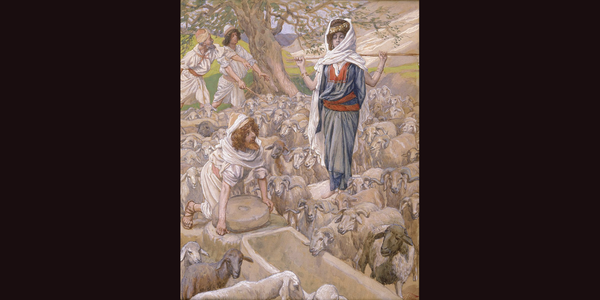
Jacob and Rachel at the Well, c. 1896-1902, by James Jacques Joseph Tissot

(French, 1836-1902), gouache on board, , at the Jewish Museum, New York


Jacob’s family has more than its share of discord and dysfunction. Due to Laban's deception, Jacob ends up marrying two sisters, Leah and Rachel; this unwanted love triangle leaves all of them heartbroken.


Comparisons and competitions pull them apart. Like any family, there are imbalances. Jacob prefers Rachel. Leah has children, while Rachel does not. These differences stoke the flames of jealousy.


Each one of them pursues what the other has. Rachel wants children like Leah. Leah wants Jacob's companionship. Jacob wants Rachel's attention. All three are disappointed.


Leah's frustration with Jacob's attitude is expressed in the names she gives her first three children. She calls her firstborn Reuben, because “the Lord has seen my misery. Surely my husband will love me now.” She continues this theme with her next two children, Simon and Levi, whose names mean “because the Lord heard that I am hated, he gave me this child too, ” and “now, at last, my husband will become attached to me, because I have borne him three sons.” (Genesis 29:31-35.)


Rachel, who is infertile, becomes jealous of her sister. In desperation, she lashes out at Jacob and says “Give me children, or I will die!” (Ge. 30:1.) She then asks Jacob to have children with their maidservant Bilhah; they will be considered Rachel's foster children. Rachel names Bilhah's first child Dan, because “God has vindicated me; he has listened to my plea and given me a son.” The reference to “vindication,” the Radak explains, is because of Rachel's competition with her sister Leah; with this child, God is leveling out the playing field. Similarly, Rachel names Bilhah's second child Naftali, because “I have had a great struggle with my sister, and I have won.” (Gen. 30:6-8)


Unquestionably, Jacob experiences the greatest disappointment. He had worked hard for seven years to marry the woman he loved, and then his father-in-law (and uncle) cheats him, and switches wives on him. Disappointment has a direct correlation to the size of one’s dreams; and for Jacob, his best-laid plans go awry, leaving him with seven more years of labor and a pair of marriages crippled by sibling rivalry.


This is just an outline of how Jacob, Leah, and Rachel found their dreams undone. But behind it all is an even greater disappointment: the failure of destiny.


Jacob arrives in Padan Aram with otherworldly expectations, because the backstory to his own journey foreshadows what will happen. His grandfather Abraham, when looking for a proper wife for his son Isaac, sent his servant Eliezer back to Padan Aram, to find a wife from his own family. Divine inspiration leads Eliezer to find Rebecca standing outside the well; after that, Jacob’s uncle Laban runs out to warmly welcome Eliezer into his home.


And so it happens with Jacob. First, his mother sends him to Laban's house and tells him to marry Laban's daughter. On the way, God appears in a dream and tells Jacob that He will watch over him. When Jacob arrives in Padan Aram, the local shepherds tell him that Laban's daughter is approaching the well; Jacob sees Rachel, and is immediately overcome by feelings of love. Then, as if on cue, Jacob’s uncle Laban runs out, welcoming him warmly. Jacob certainly knew his parents’ marriage story; and as he sees it replay in his own life, Jacob must imagine that he is about to meet his destiny. Jacob assumes that his match with Rachel was made in heaven, and truly "bashert."


Then everything falls apart. Destiny fails Jacob; and undoubtedly, Rachel and Leah, who knew the family stories, feel exactly the same way. Jacob carried this pain in his heart his entire life; when Pharaoh asks him how old he is, Jacob responds: "few and unpleasant have been the years of my life." (47:9)


Disappointment is very much a part of our daily lives. Our reach always exceeds our grasp; disappointment is a by-product of ambition. Much like this narrative, all marriages are prone to dissatisfaction, due to popular beliefs regarding "soulmates" and finding "love at first sight." The question each of us must answer is: how do we respond to disappointment?


For the Jewish people, this question is existential. How long can one people endure exile? How many times will the Messiah stumble on his way to redemption?


If Abraham is tested regarding his faith in God, Jacob and his family face a different test: the test of overcoming disappointment.


Leah and Rachel lead the way, and offer two responses to overcoming disappointment. Leah ultimately reconciles herself to the shortcomings of her situation. When she has a fourth son, she names him Judah and exclaims ‘this time I will give thanks to God' (29:25)


The Talmud remarks: "from the day the Holy One, Blessed be He, created the world, no one thanked the Holy One, Blessed be He, until Leah came and thanked Him." Centuries of commentaries have been astonished by the statement; is it possible that the spiritual giants who lived before Leah never thanked God?


I believe the answer lies in this: Leah was thanking God for His kindness, despite her own continuing dissatisfaction. Until this point, Leah hoped that having a child would bring Jacob closer to her. But now, after three prior children, Leah knew nothing would change; she would still be the neglected, inferior wife. Yet even with this disappointment in her heart, she finds a way to appreciate the blessing she does have. Leah thanks God even while being rejected, and she is the first to offer gratitude while nursing a broken heart.


Contentment is one of the great lessons of Judaism. In a Mishnah that holds a great deal of affinity to Stoic philosophy, Ben Zoma tells us that "who is wealthy? one who is happy with their lot." To reconcile with reality and accept that one's dreams may never be actualized is difficult; to take joy in what one has left is no simple task. True contentment requires acceptance.


Leah's sister and co-wife Rachel takes a very different path. She refuses to let go of her dreams, and grasps at any solutions for her infertility. She is not content to accept a flawed and broken reality.


The Midrash sees Rachel as a key to Jewish history. It explains that Rachel is buried on the road out of Israel, so she would be of assistance to her children. “When the Jews are exiled and pass by her tomb… Rachel will emerge from her grave and weep and beg mercy for them…and the Holy One, blessed be He, answers her, ‘There is reward for your work,’ says the Lord,… ‘and the children shall return to their own border." Rachel's unending hope becomes the foundation of redemption; she cries for those whose dreams are shattered, and God hears her voice. Rachel remains committed to her destiny against all odds and ultimately brings her children back home.


Rachel and Leah bring opposite responses to disappointment. One is pragmatic, accepting reality for what it is, and finding contentment within the blessings that remain. The other is romantic, and refuses to let go of the great dream of destiny. Paradoxically, the Jewish people have always done both. We have built homes in exile and put down roots, but at the same time, have always held on to our vision for the future.


I knew a woman named Rose, who was a survivor of the Holocaust. At the end of the war, she was an inmate in Auschwitz; during that time, one Friday night she managed to smuggle a makeshift candle into the barracks, to light for Shabbat.


After the war, Rose moved to Canada and built a family and a business together with her husband. A few years later, on a trip to Israel, they went out to eat at a restaurant. As the waitress approached their table, she looked up at Rose’s face, and collapsed on the floor.


When they revived the waitress, she explained that she too was a survivor, and had been in the same barracks as Rose. One day, this woman learned that everyone else in her family had been murdered by the Nazis. Despondent, she was planning to take her own life by running into the barbed wire fence.


But that night, as she returned to the barracks, she saw the women gathered around the Shabbat candle that Rose had lit. It was at that moment she decided that she would survive, no matter what.


Even in the most difficult times, one must accept the gifts life gives us, even if it is just a flimsy candle; but as we hold that gift, we must see within it the dreams of a better future. Disappointment may spring eternal; but the search for hope can start with just one candle.